

How Much Longer Farm-Fresh Eggs Last And The Best Way To Store Them

Despite a relatively similar appearance, eggs are not all the same. This is something many have come to learn as they stand in a market, a little confused about what it means when an egg carton is labeled "farm fresh". Of course, the name itself might already clue you in on the fact that it comes straight from local farms, possibly freshly-laid by free-range pasture hens. Consequently, this makes a world of difference in how long these farm-fresh eggs last, as well as their storage methods.
The first thing you need to know about farm-fresh eggs is that they usually have a protective, slightly glossy outer layer called the "egg bloom". Made up of proteins, lipids, and complex carbs, it's the eggs' first line of natural defense against external contaminants like bacteria and dirt. You won't find this coating with commercial eggs, which are required by the USDA to be sanitized, pasteurized, and refrigerated before hitting the store shelves.
The bloom also allows the farm-fresh eggs to be kept at room temperature for up to two weeks without risk of spoilage, instead of a few hours like normal raw eggs. Refrigerated, they are good for several months, a stretch longer than the three to five weeks you usually get to store eggs in the fridge. Do note that this timeline only applies when the farm-fresh eggs are unwashed, so until you are ready to eat, keep them as they are.
The art of storing farm-fresh eggs
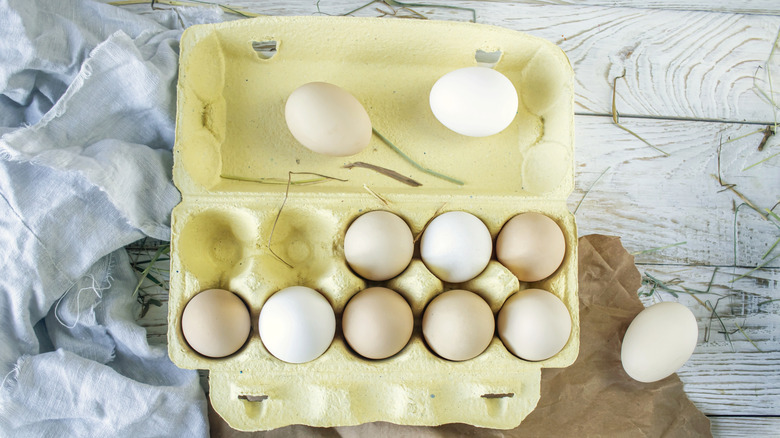
Preserving farm-fresh eggs' quality starts from the moment you source them at the farmers' market. Choosing the highest-quality eggs boils down to the same few standards, such as uncracked shells and enough density. In your kitchen, as aforementioned, it's important not to wash away the bloom coating, leaving the eggs more porous and susceptible to contamination. If you've done it by accident, make sure they are thoroughly dried and opt for refrigeration, preferably in closed containers, to minimize the risks of bacterial growth. In any case, refrigerated farm-fresh eggs should always remain at 40 degrees Fahrenheight or lower, as fluctuation in temperature and humidity can create condensation that weakens the protective outer layer.
At room temperature, the farm-fresh eggs are best kept away from direct sunlight, in a dry, cool area, such as on the kitchen counter or in a pantry. Don't throw out those containers they come in just yet. That's the best way to keep the eggs safe and secure, just make sure you mark the date to keep track. Alternatively, a wire egg basket is another fitting choice.
No less important is maintaining a hygienic practice when you're handling farm-fresh eggs. While they don't require any washing, you might still need to gently scrub off any visible sign of dirt (or maybe even feces) before putting them in storage. No matter what you do in the process, always make sure to wash your hands with warm water and soap afterward to minimize exposure to foodborne pathogens like Salmonella.