

A Butcher Says These Two Beef Cuts Are Overlooked — Here's How To Ask For Them
We may receive a commission on purchases made from links.
Beef can be broken down into eight primal cuts. From those, numerous subprimal cuts can be derived, including everything from chateaubriand to skirt steak. There's no universal standard for how many of these secondary cuts there are. Some butchery guides list a couple dozen, but others mention over 100 different cuts. With so many options, and only a handful like ribeye or filet mignon dominating restaurant menus and store shelves, it can be easy to overlook lesser-known steaks. We talked to an expert to learn about two of the many underrated cuts you should be eating.
Brad Baych, also known as the Butcher Wizard, is a professional butcher and the author of "Primal Cuts: A Butcher's Guide to Selecting, Preparing, and Perfecting Beef." He spoke with Tasting Table about overlooked steaks worth trying. "A few of my favorites come from the chuck primal cut. The chuck eye is an actual piece of the ribeye muscle, but because it is found in the chuck it is about half the price," he told us. In terms of flavor and tenderness, it really does make a great alternative to ribeye.
If you are unsure how to cook a chuck eye, tell your butcher how you plan to prepare it and ask for recommendations. "Anytime you are talking with your butcher, you want to be upfront with what you are going to do with a particular cut," Baych said. "Are you going to grill it, will it be marinated, is your recipe a braising dish? All these factors can change the recommendation from your butcher."
This steak is no mistake
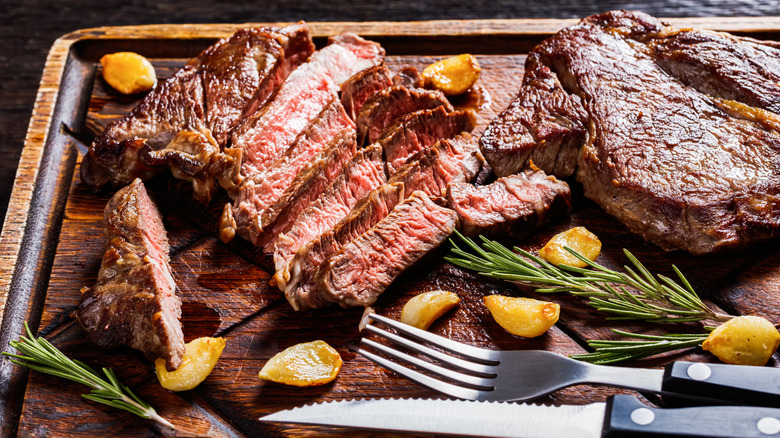
Chuck eye isn't always easy to come by, but if your butcher has chuck roast, they have chuck eye. Ask your butcher if they can cut a chuck roast down into chuck eye steaks, otherwise known as the poor man's ribeye. Once cut, the two steaks look very similar. Per Baych's advice, let your butcher know how you plan to cook it, or ask if they have suggestions for the best way to prepare it. Maybe they'll recommend the chuck eye or another of Baych's favorite cuts, the flat iron steak.
"This cut has gained popularity in the past few years. It is a very flavorful and tender steak," Baych said of the flat iron steak. It cooks quickly, but when done right it's juicy, with a melt-in-your-mouth texture that's delicious — here's everything you need to know about perfectly cooking flat iron steak. This cut comes from the blade section with the sinew removed. Most butchers will know exactly what you mean if you ask for it by name. Like chuck eye, flat iron also comes from the chuck primal.
The chuck is from the upper shoulder area of the cow, ahead of the rib. Both the chuck and rib are primal cuts. The chuck, however, tends to be tougher. Remember, this is the animal's shoulder, so the muscle has done a lot of work. The tradeoff is that there is more collagen and a stronger, beefy flavor. The rib section is more tender, but still full of flavor. It's one of the most desirable parts, and where you find the ribeye. The same muscle runs from the ribs into the shoulder, which is why Baych said the chuck eye is part of the ribeye muscle, and worth giving a try.