

The Water You Cook With Could Be Affecting How Your Food Turns Out. Here's Why
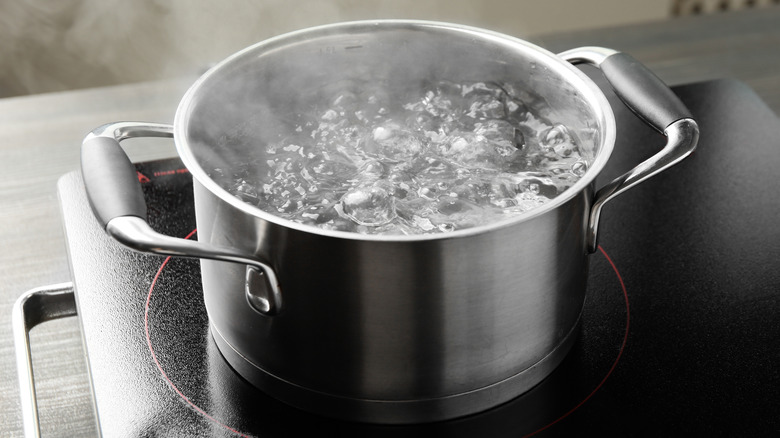
Any experienced cook will tell you that acidity is an essential thing to consider in the kitchen. Whether adding much-needed sharpness to soup or balancing flavors to fix food that turned out too salty, acidic ingredients, like vinegar or citrus juice, are a vital part of a chef's arsenal. But there's something else you should consider that's even more basic (if you'll pardon the pun), and that's the pH of the water itself.
Water is often arguably the most important cooking ingredient, but most of us don't consider it at all. The pH scale is a measure of how acidic or basic something is, and pure water is always neutral (with a pH of 7). You're almost certainly never using that in your kitchen, though. Tap water is far from pure, containing various dissolved minerals, and that can slightly change its pH. A pH lower than 7 means acid and higher than 7 means basic (or alkaline). Tap water is in the range of 6.5-8.5, and on average, it's slightly alkaline, usually with a pH of 7.5.
The running water in your home most likely started out as groundwater, from an aquifer underground, which affects the water's hardness. If you live in a place with hard water, it'll be slightly alkaline — this is the same kind of water that leaves behind chalky limescale deposits when it dries out. On the other hand, some water sources are naturally acidic, thanks to things like rock formations or tree roots. Most of us don't think about any of this when we're cooking rice or making soup stock — we just turn on the faucet and fill a pan with water — but water quality can change both the taste and texture of the food you're cooking in it.
When you need to know your water
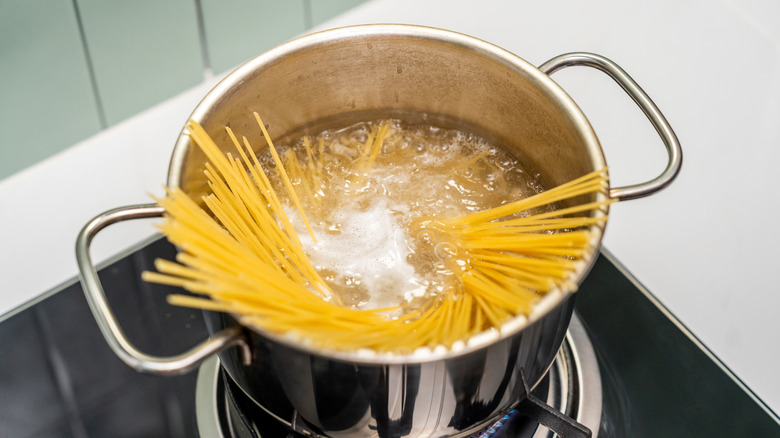
In most places, you probably won't need to worry about the pH of your tap water — anything close to 7 is essentially the same as neutral. It's also not so relevant if you're making more complex recipes, either, because nearly all foods are varying degrees of acidic. It's worth keeping in mind if you're boiling something, though.
Alkaline water will make for stickier pasta. Cooking rice in alkaline water, on the other hand, will leave it firm and chewy, while using acidic water for rice will leave it softer, and even a little mushy. With green vegetables like broccoli, though, it's acidic water that keeps them more al dente, while alkaline water will leave them much softer, perfect for mashes. Most dramatically, vegetables with red or purple colors, like red cabbage or blood oranges, will change color in water with different pH levels. It's a good idea for home bakers to think about water acidity, too. Softer, more acidic water will make for stickier dough, while water that's more alkaline will make yeast act more slowly. If your water has a pH above 7, you may want to give your dough a little longer to rise properly before baking.
To make sure your meal turns out just right, it's a good idea to know your water, and how to control its acidity. Thankfully, that's very easy to do. If you live in a place with alkaline tap water, a teaspoon or two of lemon juice is all you need to add to a pot of water to offset that high pH. If your water's acidic, then a little baking soda (which is alkaline) will easily neutralize it.