

The Cutoff Time For Rotisserie Chicken Shelf Life You Should Always Follow
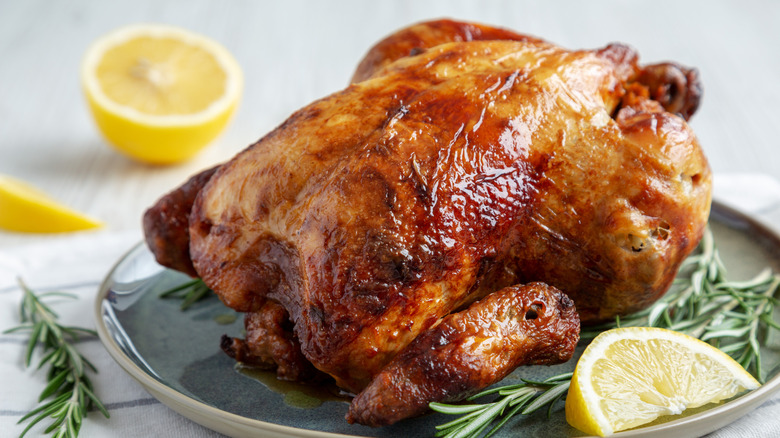
It's rare to find anyone saying they hate the taste of rotisserie chicken, and for good reason: It's tasty, warm, well-seasoned, and makes the perfect centerpiece for building homestyle meals. Since few home kitchens have rotisserie setups, and few home chefs have spare time to use one, you're likely buying that chicken from a supermarket — already cooked for swooshing right onto a waiting table. So, what's the catch with this miracle-meal component? That depends on where you're buying that rotisserie chicken and how long it sat waiting for it's journey to your home.
For our Tasting Table deep dive on rotisserie chicken red flags at grocery stores, we explored, among other things, the potential issue of cooked chicken sitting out too long before landing in your cart, car, and finally, in your kitchen. Through our discussions with experts on the topic of post-cooking display periods, they pretty much agree there should be a maximum cutoff time of three hours, or even as few as two hours, per one source. That's considering things such as freshness, heat lamps, moistness, and food safety, which all have a shelf-life when dealing with the quality of cooked chicken.
You'd ideally be choosing a rotisserie'd wonder-bird fresh from the oven, but that's much easier said than done. Not all grocery stores, supermarkets, and warehouse membership stores reveal exactly when rotisserie birds left the oven and headed to heated display bins. Our experts offer some suggestions on how to glean that valuable intel — and we can also reveal exactly how long one major player in the rotisserie game allows its cooked birds to remain in the hot-seat.
Determining when that rotisserie chicken left the oven
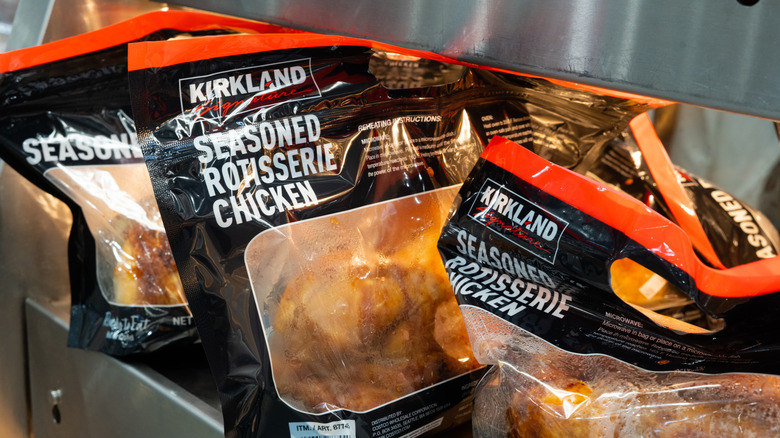
When choosing the best place to snag your dinner-time rotisserie bird, consider sticking to stores that attach cook-time stickers to the container. It's the most reliable way to discern this important information, allowing you to gauge the two- to three-hour limit. Brian Theis, recipe developer and cookbook author of "The Infinite Feast", says to "Check for a cook time if [it] is included. Anything over three hours [is] probably no good, it's been under the lamps too long and may be dried out."
Mark McShane, chef and food safety expert at Level 3 Food Hygiene Certificate, is even more cautious about cook time versus display time. "Once a product sits outside of refrigeration for longer than two hours, regardless of what temperature it has maintained at, both quality and safety begin to decline," he cautions. If packaging fails to indicate a cook time, try getting that information from an in-store employee, or phoning ahead to ask typical store routines and times for rotisserie chicken cooking and displaying.
McShane's two-hour rule brings not just overcooked texture into the conversation, but also food safety issues. The USDA "danger zone" timing of two hours refers only to foods left at room-temperature, not ones safely placed in warmers of 140-plus degrees Fahrenheit — but some retailers play it safe and stick to two hours. That includes Costco, the well-known king of affordable whole-cooked-bird dining. When Costco stores exceed the two-hour shelf life, its rotisserie chickens get repurposed into refrigerated deli items such as pot pies and chicken soups. For more innovative ideas in that vein, check out our collection of 14 delicious ways to use rotisserie chicken.