

The Unexpected Pantry Staple That Can Kill Pesky Vegetable Garden Weeds
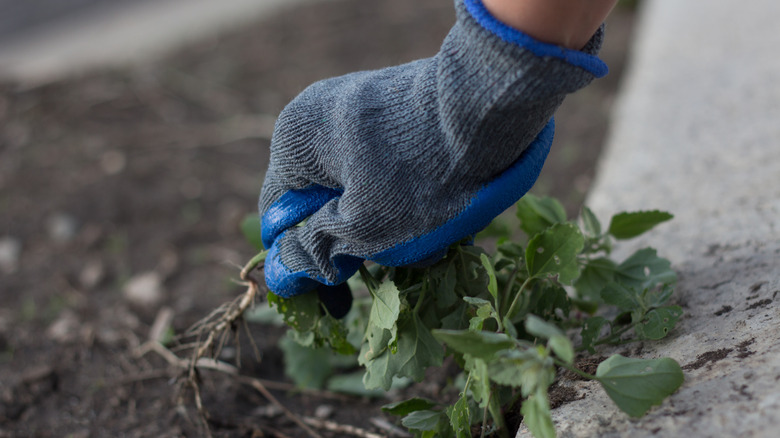
Nearly 52 million Americans grow vegetables at home, according to the National Gardening Association. Not only can gardening help reduce stress, but a vegetable garden comes with the added bonus of (mostly) free food. A 2016 study in the Journal of Hunger & Environmental Nutrition found that the average gardener saved $339 by growing their own produce. It makes sense to want to protect that investment by weeding your garden. Herbicides can be costly and dangerous, but you can weed your garden more safely by using cream of tartar.
Tasting Table asked Alexis Rochester, investigative chemist and owner of Chemistry Cachet, how cream of tartar, a natural by-product of wine-making, can kill weeds in your vegetable garden. "Cream of tartar — potassium bitartrate (KC₄H₅O₆) — works as a natural weed killer because of its acidic properties and ability to disrupt plant cells," she said. "When mixed with water, it creates a mildly acidic solution (around pH 3-4), similar to vinegar, which allows it to break down the waxy protective layer on plant leaves. As a result, the plant loses its ability to retain water, leading to dehydration and a 'burning' effect that causes wilting."
"A simple solution can be made by mixing 1–2 tablespoons with water in a spray bottle and spraying directly onto weeds," Rochester said. Just like when using vinegar as a weed killer, when you spray the weeds has an effect on results. "Doing it on a sunny warm day can enhance the effect," Rochester suggests.
Cream (of tartar) of the crop

Using cream of tartar as a weed killer is especially convenient since it's likely already in your pantry. Cream of tartar offers some benefits not found in traditional weed killers, but, as Rochester told us, it also comes with some additional risks.
"It can be a better choice over chemical weed killers because it is safe for animals and wildlife," she said. "However, like vinegar, it acts as a non-selective herbicide. This means it will harm any plant it touches. It can kill both weeds and grass, so it should be applied carefully." Instead of spraying across a large area, bring the spray bottle close to each weed and spray quick, short bursts directly onto the leaves to minimize any mist or blowback that might damage nearby plants.
Depending on how well the weed responds to the treatment, you may need to reapply the mixture. If it rains after you spray the weeds, but before it's fully effective, the solution could be washed away. For best results, keep an eye on the plants you've sprayed; if you see that they are still thriving after 24 hours, spray them again.
An added bonus of using cream of tartar is that it has some pesticidal properties, too. Slugs and snails don't like cream of tartar, so sprinkling some dry powder around the edges of your garden can keep them away. Cream of tartar has been used since Victorian times as a cleaner as well, so it's always a good idea to have some on hand.