

The Giant Company Behind McDonald's Fish (Supplying 15 Million Pounds Per Year)
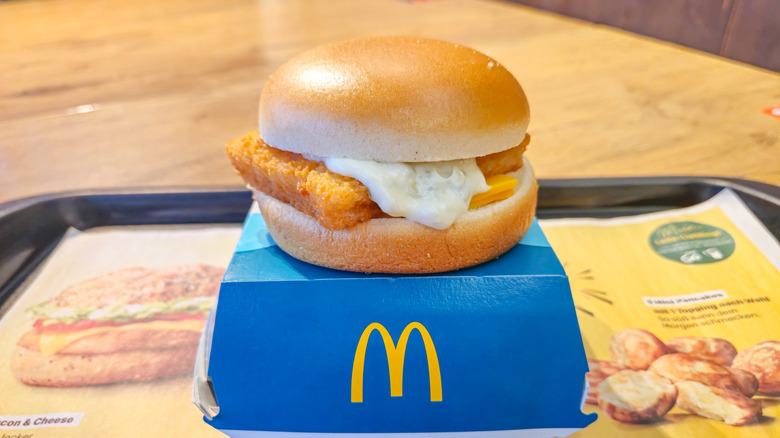
Ever since brothers Dick and Mac McDonalds introduced America to 15-cent hamburgers in 1948, the now-famous restaurant chain has been intrinsically tied to burgers — despite a much broader menu of tasty treats and sandwiches. One in particular rarely snags the spotlight, but deserves plenty of kudos when it comes to sourcing. That's the Filet-O-Fish sandwich, which requires a hefty 15 million pounds of fish annually to meet demand from Mickey D's fans.
The fish sandwich may be a small fry in the McDonald's universe, relatively speaking, but behind that modest sandwich is Keystone Foods, a giant supplier operating on a strikingly large scale. It oversees sourcing of not only the fish, but also 150 million pounds of beef and 300 million pounds of chicken for McDonald's restaurants. Keystone's roots go back to Philadelphia in the 1960s, when founder Herb Lotman developed an individual quick-freezing method for beef patties. Lotman introduced the Individual Quick Freezing (IQF) to McDonald's, and it's still part of the fast-food giant's operations today.
Keystone is also responsible for helping develop the total distribution system that pulls all of McDonald's sourcing and delivery together. When it comes to fish for all those McDonald's FIlet-O-Fish sandwiches, the connection and ongoing story centers on the Bering Sea, wild Alaskan pollock, and fishermen like Kenny Longaker. His boat, the Defender, operates from the Port of Dutch Harbor, long considered one of the top fishing spots in the U.S. based on volume, providing as much as 60 percent of America's total annual seafood harvest. The primary species emerging from those rich fishing grounds happens to be Alaskan pollock — which is exactly the type of fish resting between the buns of those McD's sandwiches.
Wild-caught pollock from the Bering Sea
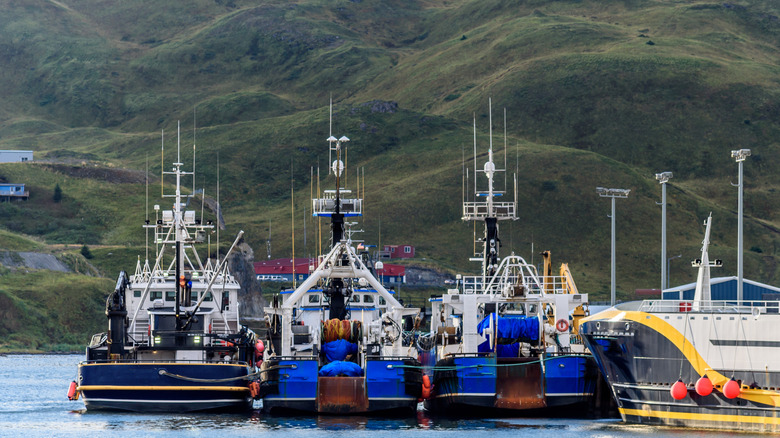
Like Keystone meat products for McDonald's restaurants, the fish meets strict standards for quality and safety, while also embracing aquatic practices for sustainability. The pollock hauled in by Longaker for Filet-O-Fish sandwiches is always wild-caught, and it adheres to protocols established by the Alaska Seafood Marketing Institute and required for certification by the Marine Stewardship Council.
After catching the wild pollock fish, Kenny Longaker and his team fillet and freeze them within a period of roughly 24 to 72 hours, ready to become those golden fried fish patties. The sandwich itself is basic enough: Crispy fish made with wild-caught Alaskan pollock, tartar sauce, and a slice of American cheese, served on a steamed bun. But the intricate system keeping that sandwich and other menu items consistent across the McDonald's chain of 13,000-plus U.S. restaurants is far from simple.
The same goes for the Keystone operation as a whole. The early contract with McDonald's paved the way for significant success, and it's now a major player in the international fast-food industry. It services operations in at least 13 countries scattered across North America, Europe, Asia, the Middle East, and New Zealand and Australia. Despite the global reach and millions of products traveling the Keystone network, those humble McDonald's fish sandwiches harbor their own stories — birthed far from the countless drive-thru's and walk-up counters beneath the infamous Yellow Arches. For more fishy tales and tidbits, explore our deep dive on all you need to know about the McDonalds famous Filet-O-Fish. You can also learn more about the key suppliers behind McDonald's burger patties.