

These Donuts Aren't Sweet — They're Meant To Be Dipped Into Your Breakfast
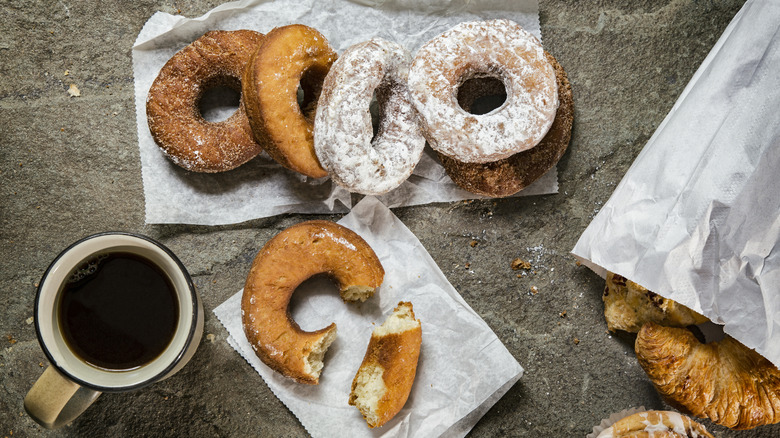
Let us start with a surprising fact: donuts are not always sweet. As familiar as we all are with that doughy circle, coated in powdered sugar or glazed in a glossy icing, that's only one of the many popular types of donuts out there. In China, youtiao — Chinese donut sticks (also called Chinese crullers) – look and taste nothing like what you would expect. Still, if there's any donut that makes a good breakfast, it's youtiao.
Youtiao is long and thick in shape, with a crevice running down the middle. The deep-fried dough is a touch savory and prominently salty, with a warm hint of doughy scent peeking through. Its texture is a unique blend of solid, crispy exterior and puffy, airy interior. This is a delight that comes in twofold, because you can enjoy it as it is, or dip it into a hot liquid, and revel in the stretchy dough.
These Chinese donuts take on different identities across China and Southeast Asia. Originally, they are called youtiao in Mandarin, and yau char kwai in Cantonese. They are often dipped in hot soy milk, stuffed into cheung fun (steamed rice noodle rolls), or used as a topping for congee, all of which are dishes you might eat for breakfast in China. In Vietnam, they are called dầu cháo quẩy and are often found in pho and porridge eateries, where they are sliced into bite-sized pieces. Pa thong ko, as Thai cuisine knows it, also doubles as a sweet treat. Thai folks frequently have them for breakfast by dipping them into sweetened condensed milk or a pandan custard.
Bring youtiao right into your daily meal
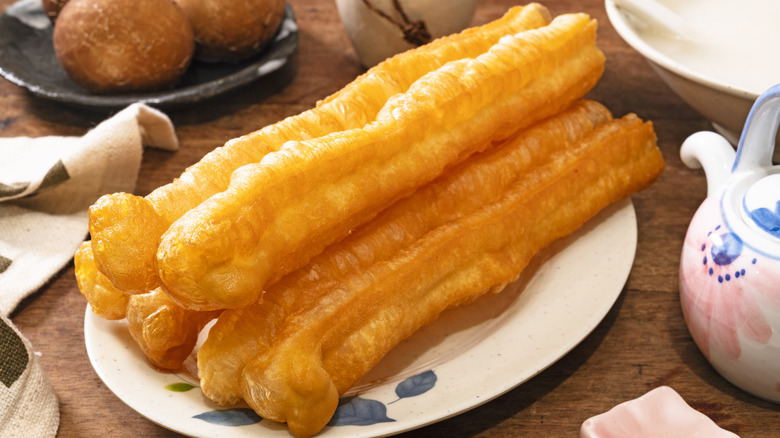
If you've got eggs, flour, salt, baking powder, and water, or alternatively, a store-bought youtiao mix, you can already make youtiao at home. The process starts with mixing the ingredients into a pliable, soft dough, then kneading and shaping it into a long flat log. Make sure to work ahead of time, because the dough needs at least 12 hours of refrigeration, plus a few more at room temperature.
The most important step is to cut the dough into thick strips. Each strip is then cut in half, the two halves layered atop each other and pressed in the middle lengthwise by a chopstick to form an indent. This creates youtiao's signature shape. Make sure to also stretch the strips from both ends to make the donuts longer. And when you're ready to deep-fry, pick an oil with a high smoking point, like vegetable or canola.
Other than making from scratch, you can also get youtiao when you're out and about. Find it in Asian-American supermarkets and specialty stores, primarily in frozen packages. Those, however, might pale in comparison to freshly-made batches from Chinese, Taiwanese, or Vietnamese restaurants and bakeries. Look for dimsum houses, noodle shops, or even pastry joints scattered throughout Chinatown.
Once you've got your hands on youtiao, a comforting breakfast is guaranteed. Try it the traditional way with hot soy milk or any Asian soup and noodle soup. Silken tofu is another marvelous choice. Dress it up with soy sauce, scallion, vinegar, and chili oil, and add a few youtiao sticks on the side. You can even use youtiao as a bread substitute for Cantonese golden-fried shrimp toast, stuff it with meat and veggies like a typical sandwich, or just eat it plain with any dip of your choosing.