

6 Haitian Dishes To Try At Least Once In Your Life
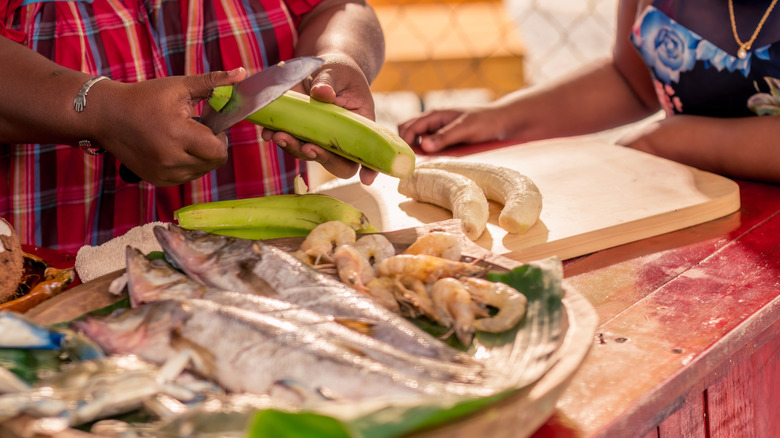
A bite of Haitian food is a bite of history. As the Caribbean's first free black republic, Haiti has a legacy unlike anywhere else. It's the product of centuries of resilient survival which continues to happen along the intersection of cultural influences from Africa, Europe, North America, and the indigenous Taíno. Over centuries, these influences have folded together to create a unique culture that spans generations and diasporas. Haiti's culinary foodscape is bold, intensely spiced, slow-cooked, and built on a resourcefulness that turns simple ingredients into extraordinary tastes. Needless to say, there are loads of Haitian dishes you need to try.
If it's your first time venturing into Haitian cuisine, there are some building blocks that are standard to know. The first is epis. It's a shifting, blended seasoning consisting of herbs, spices, peppers, and alliums that functions as the flavor foundation for most Haitian cooking. It might be a marinade for meat, or a seasoning packet for beans. The second is pikliz, a fiery pickled slaw of cabbage, carrots, and Scotch bonnet peppers steeped in vinegar. Pikliz appears (nearly) everywhere.
Luckily, those two aspects don't come close to scratching the surface of what this unique Caribbean cuisine has to offer. There is a variety of historic and modern dishes, and they're often one and the same. That's why we're turning to experts. Using her personal experience as a chef, founder of Cookin' Kiddos, and proud Haitian American, Sandra Maestas is jumping in to help us understand a few of the basics of Haitian food.
Griot
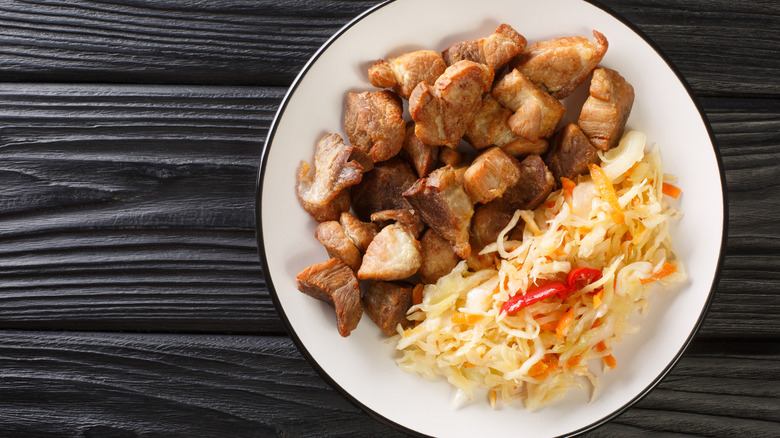
"If you've ever been to a Haitian gathering and wondered what that smell was — that's probably it," chef Sandra Maestas says of griot. Griot is considered a national dish of Haiti and all it takes is a taste to understand why. Adored by José Andrés, this dish is a wonderful mix of cooking techniques; marinated pork shoulder is slowly braised and then fried, leaving the meat caramelized, crusty, and golden. The marinade, which can eventually become an accompanying sauce called sòs ti-malis, is made of acidic ingredients like citrus juice and vinegar, stock, and heavily seasoned with alliums and epis.
"Griot almost always comes with pikliz on the side," says chef Maestas. "The two together are just ridiculous in the best way." Together, the tang and the spice, the crackle and succulence, offer a window into the legacy of Haitian cuisine. For much of its history the dish was considered food for the wealthy, due to the high cost of pork shoulder. In some West African cultures like Senegal and Burkina Faso, "griot" is used to denote a person of high social standing, be they community leaders or tribal authorities. As West Africans made up a majority of Haiti's population during the 17th and 18th centuries, they had an impact on the country's foodscape in a way that came to associate the dish with its high reputation.
As Haiti fought for independence, the dish became a broader symbol of the country's unity. Nowadays, it's much more of a street food that something served from the lap of luxury, but griot is substantial enough to make a full meal out of.
Diri ak sòs pwa
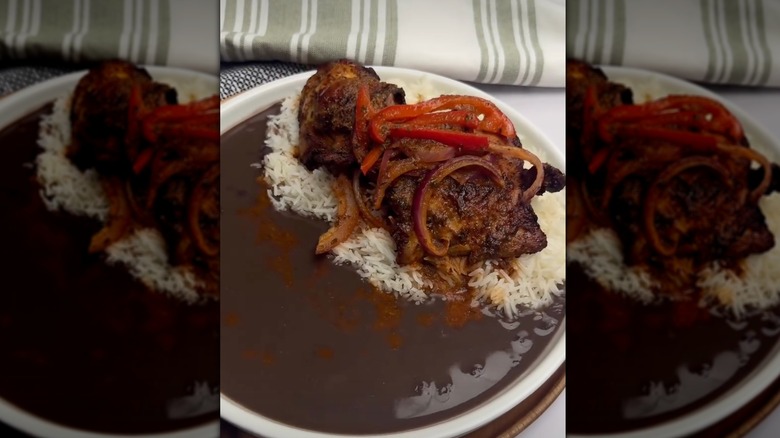
"Diri ak sòs pwa is rice with bean sauce, and I know that doesn't sound exciting, but please trust me on this one," says chef Sandra Maestas. She's right. Rice with bean sauce is definitely an undersell. The simplification belies the depth of diri ak sòs pwa both as a culinary pride, and as another insight to Haitian history. (The dish is often called national rice for a reason.)
Rice and beans were staples during some of Haiti's darkest days, as they were two ingredients common among enslaved peoples from West Africa and beyond. Following Haitian Independence, the dish was carried among the diaspora, where it possibly became a forerunner to Creole foods like red beans and rice. But diri ak sòs pwa is defined as much by its technique and ingredients as it is by history.
"The beans are cooked down, blended smooth, then simmered with seasoning until the whole thing becomes this thick, velvety sauce," says Maestas. The seasoning spices may be garlic, thyme, and definitely some epis if you've got it, and some Scotch bonnet peppers for a spicy kick. After that, the sauce is served with rice and meat — particularly, griot. The result, as chef Maestas puts it, is "just so good — it's the kind of meal that doesn't need anything else." Regional variations of diri ak sòs pwa are plenty. You may find a sauce made with Congo peas or lima beans, the use of coconut milk can be common, and sometimes tomato makes an appearance as well.
Haitian spaghetti (Espageti)
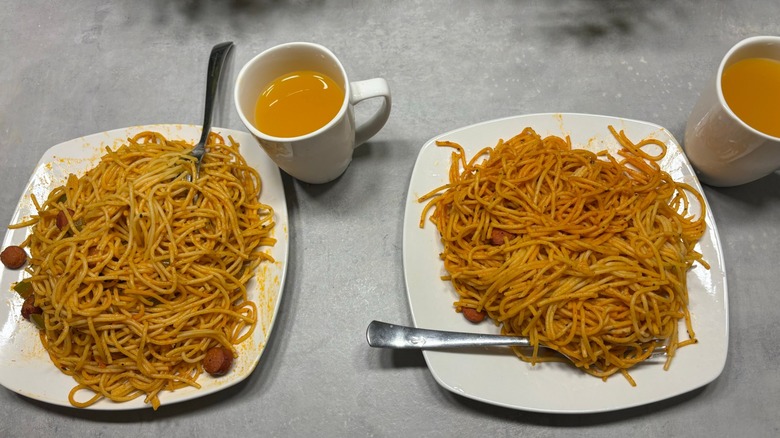
The culture and history of Haiti are greater and represent more than the legacy of oppression left behind by Western nations and imperial powers. Still, colonization and occupation have had an irrevocable impact. Much of that impact has yielded difficulties, but in some cases, it's also brought deliciousness. Consider espageti, or Haitian spaghetti. It's widely accepted that this plate emerged into the national cuisine of Haiti as a byproduct of American occupation from the 1910s to the 1930s. Now, it's a common breakfast dish.
"Spaghetti for breakfast?" asks chef Sandra Maestas. "Yes. It sounds weird until you try it, and then suddenly it makes complete sense." Here's how it's made: The base of espageti is formed with tomato paste, tomato sauce, or tomato ketchup that is paired with rich aromatics — some onion, some pepper, some garlic — and herbs. Once again, the epis cannot be forgotten here, and will vary in flavor depending on who's cooking. The spaghetti is mixed in with the sauce, and it's topped with hot dogs or sausage. Espageti is served alongside bread, boiled eggs, and maybe a slice of avocado if available.
"It's not a special occasion dish," tells chef Sandra. "It's a Tuesday [dish]. It's a parent feeding their kids before school with whatever's in the kitchen, and somehow it's still delicious."
Akasan
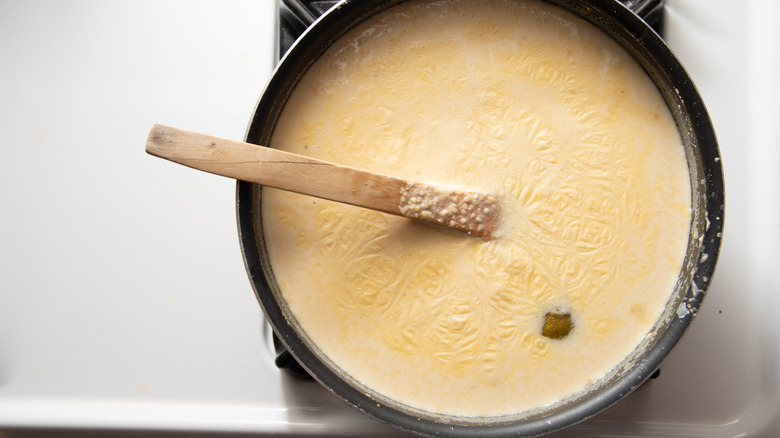
As chef Sandra Maestas tells us, akasan is a dish that holds down its own little corner of Haitian cuisine. It's comforting and full of nostalgia, all due to its simplicity. "[Akasan] kind of blurs the line between breakfast and dessert, and I think that's part of why people love it," says Maestas. "It's not fancy. It's not trying to be. It's just one of those things that tastes exactly like growing up."
Akasan is a type of porridge made from yellow cornmeal. To prepare it, fine corn flour is cooked into a paste with water, then finished with evaporated milk, sugar, vanilla, cinnamon, star anise, and salt. Some recipes include chocolate, and the most traditional versions of this smoothie-like beverage will be cooked from corn kernels. Akasan can be served warm or chilled. Hot in the morning from a street vendor's container, or cold in a plastic bottle from a bakery. What makes it a complete dish is the way in which you consume akasan. According to Maestas, "you eat it with bread — you dip the bread in, which I feel like is important to mention." It isn't just linked to breakfast anymore, as it's now consumed regularly throughout the day.
If it sounds rustic, that's because it is. Akasan is a precolonial food that's rooted in the Taíno ancestry of Hispaniola. Indigenous people have been consuming this liquid foodstuff for centuries. Numerous techniques have developed to facilitate this being an ultra-smooth beverage, such as using super fine cornflour, or mixing the cornmeal with cold water prior to boiling it, to reduce lumps.
Kokiyòl (Coquillole)
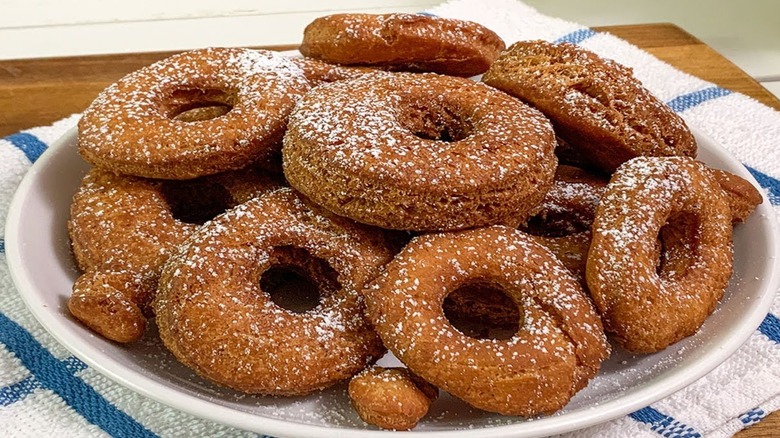
It can be tempting to look at fried dough — especially fried dough that may be shaped into a ring — and label it simply as donut. It's natural, and we understand the impulse. As Sandra Maestas reminds up, kokiyòl is more than just this common moniker.
"It's fried, yes," she says, "and it's got that same comfort of fried dough. But the flavor is different — there's evaporated milk, lime zest, banana. It has its own thing going on." That list of ingredients lends this Haitian food a bit more of a resemblance to banana fritters, and in some places throughout Haiti, it's more likely that's the shape they'll take, too.
"Depending on where in Haiti you're from, you might know it by a different name or a slightly different version. But the feeling is the same. It's a treat that tastes like it belongs somewhere specific, like it has a history." Less sweet than its Western-style donut counterparts, kokiyòl harkens back to a time before traditional ovens were common in Hispaniola.
Soup joumou
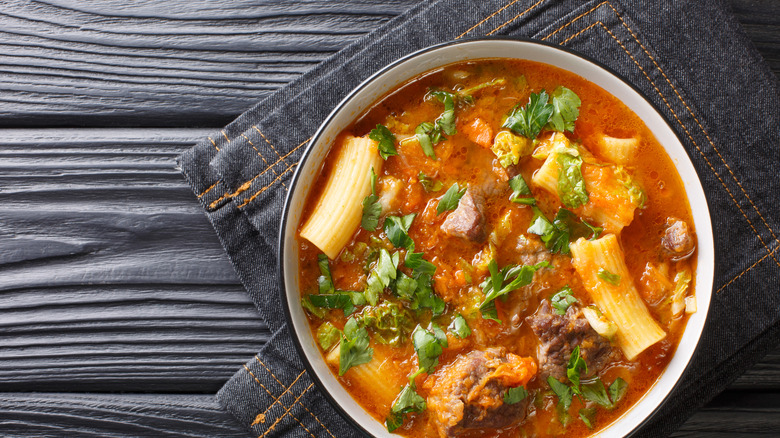
Possibly, there is no dish in Haitian cuisine that carries more weight than soup joumou. Part of its importance is that it's also precisely tied to a single date. Every January 1st, Haitians around the world eat soup joumou to mark the moment Haiti became the first free black republic in history.
During French colonial rule of Haiti, enslaved peoples were forbidden from eating the calabaza squash that's at the heart of soup joumou. Despite growing the squash and having to cook it, the soup was relegated as a dish only fit for enslavers or free people. When Haiti declared independence in 1804, the soup was served up as an act of reclamation, with Marie-Claire Heureuse Félicité Bonheur Dessalines (wife of revolutionary leader Jean-Jacques Dessalines) advocating for every Haitian to enjoy the fruits of their labor. In 2021, UNESCO declared it an Intangible Cultural Heritage of Humanity, which is the first Haitian entry to gain that designation.
The flavor is something between a stew and a broth. Pureed calabaza or turban squash are deeply savory, warmly spiced, and packed with earthy sweetness. (The squash also gives the soup its orange color and velveteen texture). Into that base goes beef marinated in epis, then carrots, cabbage, potatoes, celery, plantains, and pasta. Send a Scotch bonnet pepper floating along the top for a buoy of heat. It is served with Haitian bread for dipping, and eaten as breakfast, lunch, and dinner on New Year's Day and Ancestors' Day, January 2nd.
Recipes will no doubt vary drastically depending on the where, who, and how is cooking it. The beef isn't even a necessity: It's possible (and easy) to make soup joumou entirely vegetarian.