

Keep Your Soda Bubbly For Longer With This Effortless Ice Trick
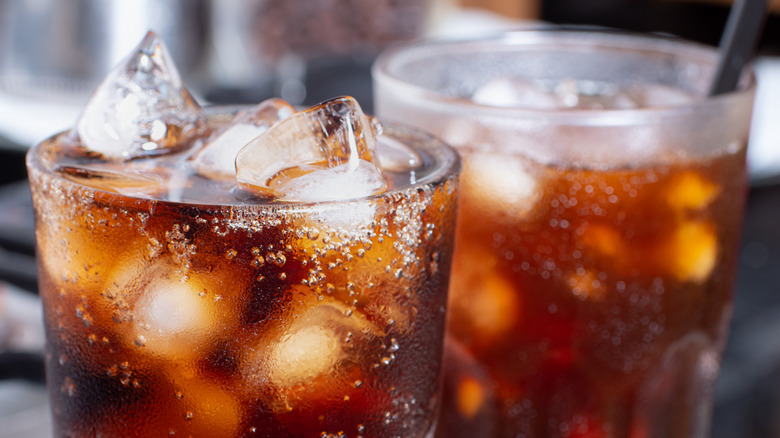
One of life's cruel jokes is when you thirstily pour a can of soda over crisp, fresh ice cubes, causing the soda to fill the glass with undrinkable foam. When the soda eventually returns to liquid form, it's flatter than a photograph of uncarbonated water. The culprit: dry ice straight from the freezer. The fix: wetting the ice before you use it.
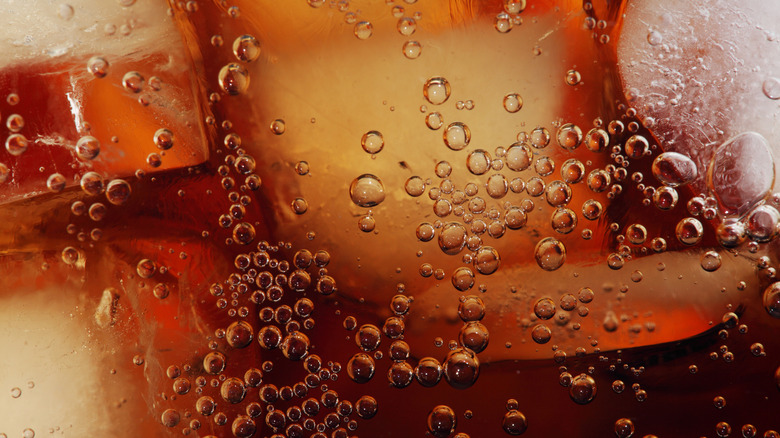
This happens for basically the same reason as soda's explosive reaction to Mentos. The surface of Mentos are rougher than they look, featuring a high density of invisible imperfections. Dry ice straight from the freezer is the same, with microscopic chips, frost particles, and a surface area far greater than what can be seen with the naked eye. CO2 (carbon dioxide) gas is evenly dissolved throughout the soda on a scale that's also microscopic. Those teeny-tiny surface imperfections give the dissolved carbon dioxide a place in which to combine, known as "nucleation sites." CO2 forms units of gas that scientists call "bubbles," rapidly separating from the liquid and foaming up.
This, unfortunately, also means that the CO2 that escaped is spent, no longer dispersed throughout the liquid to slowly form the bubbles that we enjoy in carbonated beverages, leaving flat soda only suitable for barbecue sauce. Rinsing ice works like a Zamboni running over the surface of an ice rink, smoothing out the surface and getting rid of imperfections. Water melts these features or otherwise fills in nucleation sites, so CO2 remains dissolved and soda tastes "fizzy" for longer.
How do you even rinse ice?
Some anecdotal discussions claim that rinsing ice made it taste flat, but it is essential to properly strain the ice of excess water as much as possible. Consider the technique used in making cocktails, in which bartenders hold back ice while pouring everything else out with a cocktail strainer. If you don't have a cocktail strainer (or can't be bothered going to the effort), using any kind of kitchen strainer would do the trick to shake off excess water.
To really get a perfect pour of soda, you can also employ a method used for preserving the carbonation in beer, and rinse your glasses. This works in the same way as rinsing your ice, except that instead of smoothing the surface by melting it, you rinse off unwanted dust or residual detergent and fill microscopic pores with neutral water. As for the type of ice, this technique would likely work better with nugget ice than with crushed, as small pieces of crushed ice might melt away too fast.