

Is Goulash Supposed To Turn Out Thick Or Soupy?
We may receive a commission on purchases made from links.
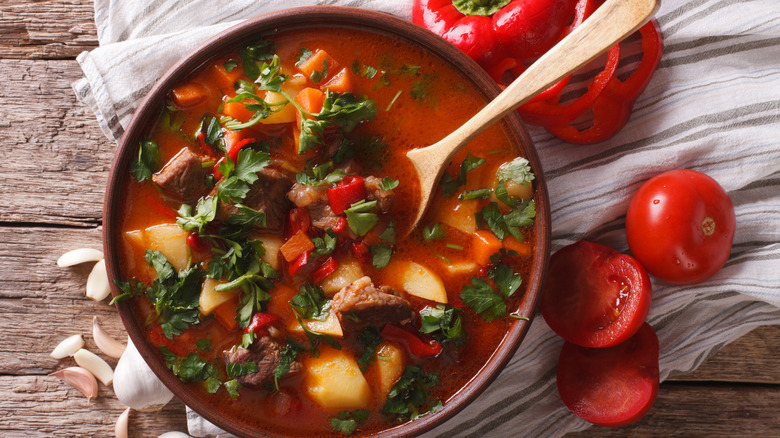
In culinary matters, the concept of authenticity is a tricky one. Recipes evolve over time, reflecting their historical context, shifts in popular taste, the rise of new techniques, or the availability of certain ingredients. But how much can a recipe change before it becomes something else entirely? Few dishes encapsulate this quandary more than goulash, and the question of whether this Hungarian classic should be a thick stew, or thin and soupy.
Much like varieties of borscht, you will find recipes for goulash vary wildly in consistency and ingredients, but to most Hungarians there is no argument: Goulash is not a stew. That said, even what purists would today consider authentic Hungarian goulash is the result of centuries of evolution. The etymological root of goulash is the gulyás — cowherds who drove long-horned cattle over the Great Hungarian Plain, and would boil their beef into a gulyásleves (goulash soup). But this dish has changed over time. Despite both onions and paprika featuring in most recipes for Hungarian goulash today, the earliest incarnation of the dish would have neither. Onions didn't reach Hungary until 1476, and paprika would not be properly refined until the 19th century.
Even the inclusion of paprika can be controversial. In his book "The Cuisine of Hungary", published in 1971, the Hungarian-born writer and restaurateur George Lang wrote that, when preparing goulash, "lard and bacon (either one or both) are absolute musts", but sternly instructs that one must never use any spice besides caraway, never use any flour as a thickener, and never "Frenchify" the soup with wine. Other Hungarian cooks hold that the common inclusion of tomatoes should also be eschewed.
American goulash differs from the Hungarian original, but remains delicious
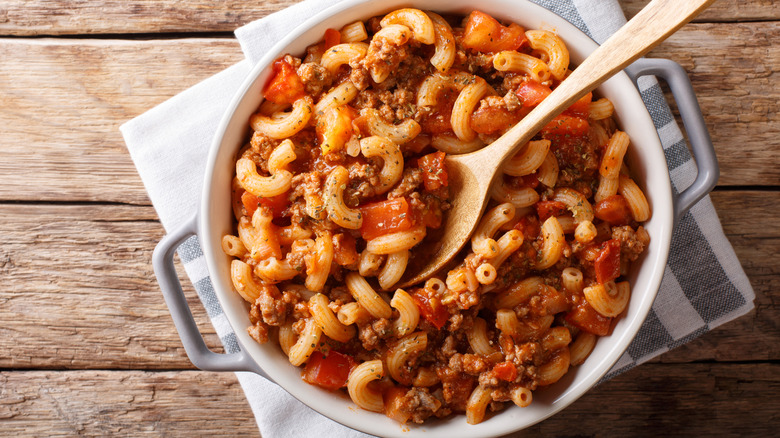
So what is American goulash, and what if any connection does it bear to the Hungarian version? In "The Cuisine of Hungary", George Lang noted that a 1969 Gallup poll listed goulash as one of the five most popular meat dishes in America, but expressed his disdain for "what is usually served under this name". It is unsurprising that Lang would not recognize this dish — similar to beefaroni and chili mac, American goulash is a hearty, one-pot comfort meal combining macaroni with a thick, tomato-based meat sauce, the name of which can likely be attributed to its use of beef, onions, and paprika. Recipes for American goulash can be found as early as 1909, and modern versions arguably owe more to Italian-American influence than Hungarian. To add further confusion, in New England it is common for American goulash to be referred to as American chop suey, despite any Chinese-American influence on the dish being even more negligible. One thing's for sure — it is definitely not a soup.
While you may want to avoid serving up American goulash as an exemplar of Hungarian cuisine, it remains a delicious dinner option that many regard with nostalgic fondness. If making the U.S. version at home, our American-style goulash recipe does make it a little more Hungarian by incorporating sour cream into the sauce. It's also super easy to customize, adding bell peppers, spinach, or broccoli perhaps — and given how much goulash has changed over the centuries, what could be more appropriate?