

Chick-Fil-A Is Breaking Its Promise To Only Use Cage-Free Eggs By 2026
Chick-fil-A consistently tops the satisfaction rankings of fast-food consumers, and its restaurants blow away the competition in per-store earnings, making it the envy of the quick-service food world. However, in 2016, it joined a host of other national chains in making a promise to have 100% of the eggs served in its restaurants be cage-free by 2026. Yet it has not fulfilled that promise, even as others have.
At the time of writing, Chick-fil-A still acknowledges its cage-free promise on its website: "Currently, our ability to meet this commitment in the stated timeframe is uncertain due to numerous industry dynamics and the significant impact the bird flu has had ... on our industry." Chick-fil-A has not stated what percentage of its eggs are cage-free, only that it continues to follow state-level laws, which means in states like California and Colorado that have mandated cage-free eggs, it would use them.
It may make some sense that bird flu delayed Chick-fil-A in fulfilling this promise, but the numbers on cage-free eggs say otherwise, and plenty of other chains have managed to hit that goal already. In particular, McDonald's eggs and Starbucks eggs — two huge chains with a lot more egg on their menus — both managed to hit 100% cage-free eggs by 2024. So it's clearly possible for large chains to pull it off with current supplies.
Chick-fil-A still not using 100% cage-free eggs doesn't add up
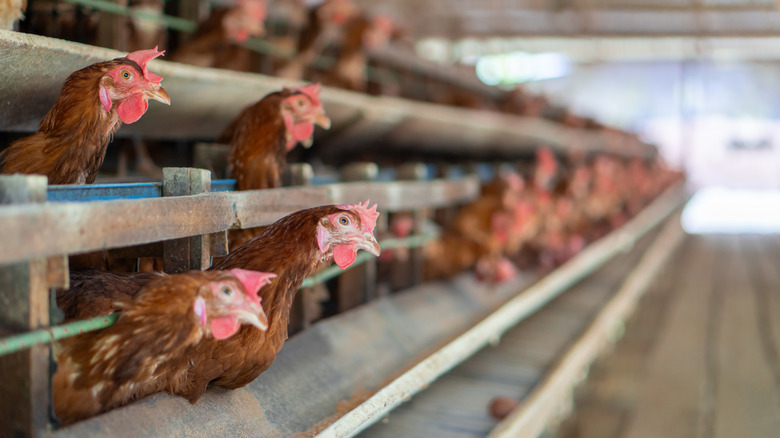
Bird flu certainly did affect cage-free eggs, but not nearly as much as conventional eggs. Roughly 75% of birds lost to the disease in recent years were caged, despite only about 55% of chickens being caged at the time. So not only was the egg shortage much more acute for caged eggs, but cage-free chickens were less likely to be affected by bird flu as a percentage of the total population. Never mind the fact that the supply of cage-free eggs overall, bird flu or not, has soared since Chick-fil-A made its pledge in 2016.
In 2025, almost 50% of the egg-laying flock in the U.S. was cage-free, which is an almost five-fold increase from 2012, and almost four times as high as when the chain made its pledge. Of course, other major chains have managed to find plenty of cage-free eggs — not just those noted above. Big names include Taco Bell, TGI Fridays, Shake Shack, Carl's Jr., Olive Garden, and The Cheesecake Factory. Cost isn't a major concern, either. While cage-free eggs are more expensive, they are not massively so, with the average cost being only 1.6¢ more per egg.
It's also important to note that this is the bare minimum for ethical treatment of chickens. Cage-free only means chickens have a little extra space and can walk around, but they often still spend their whole lives in crowded barns. This is far short of other standards of treatment, like pasture-raised eggs. That Chick-fil-A hasn't fallen short of such a basic goal certainly calls its commitment into question.