

Why Portillo's Hot Dogs Are So Iconic
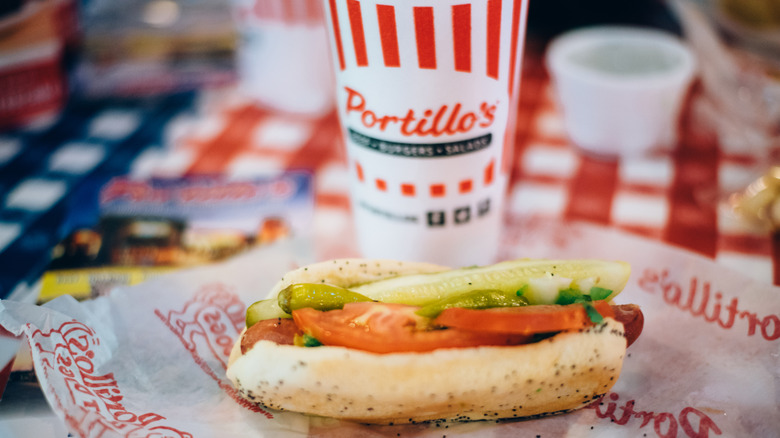
Hot-dog-heads far and wide recognize the name "Portillo's" as a craftsman of the authentic Chicago-style dog, and one of the top-rated spots to get one in the Windy City. However, "Portillo's" has also become synonymous with another name: Vienna Beef. The hot dog brand even inducted the first Portillo's location at 635 West North Avenue in Villa Park, Illinois, into its Hall of Fame.
Before Portillo's became what it is today, the eponymous Dick Portillo was peddling franks out of a trailer at that exact location — and ever since these humble origins, Portillo's has been serving Vienna Beef hot dogs. Clearly, this quality-frank-first model worked, because by 1967, Portillo's moved into a brick-and-mortar restaurant, and in 1994, the chain got its first Chicago-proper location.
In honor of this long-standing partnership, Vienna Beef awarded Portillo's its first-ever Legends Award, an especial honor within its already-prestigious Hall of Fame. Per Vienna Beef, "Vienna Beef is proud to have maintained a relationship with the Portillo's Restaurant Group during this legendary climb [...] We now take pride thanking, acknowledging and congratulating Dick Portillo."
Vienna Beef's story goes back even further than Portillo's. Hot dogs first arrived on U.S. shores with German immigrants in New York during the 1860s. Fast-forward to 1893, and thousands of franks were sold at the World's Columbian Exposition in Chicago — prepared by two Jewish immigrants from Austria-Hungary, who incorporated as Vienna Beef a year later.
Portillo's has been serving Vienna Beef franks since opening in 1963
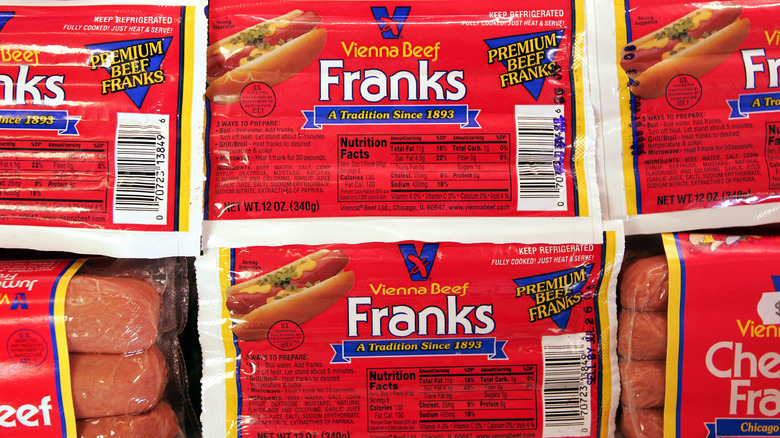
For the unacquainted, a Chicago-style hot dog comprises an all-beef "red hot" Vienna Beef rank, topped with a fully-loaded array of diced white onion, fresh tomato chunks, sweet neon green relish, pickled sport peppers, a whole Kosher dill pickle spear, a shake of celery salt, and yellow mustard — never, ever ketchup — all on a poppy seed bun. It's a little sweet, a little savory, and packed with international influence.
The fully-loaded dog evolved from the Chicago's immigration boom in the 1800s. As folks from Eastern and Southern Europe began to move into the city's working-class neighborhoods, so did the toppings. The all-beef frank, mustard, and pickles came from German and Jewish culinary influence. From there, the poppy seed bun was a contribution of Polish immigrants, the pickled sport peppers from the American South, and the neon relish, onions, and tomatoes from Italy and Greece.
All those veggies and condiments aren't just for taste; they fuelled Chicago's immigrant working class. During the Great Depression, that "dragged through the garden" hot dog was marketed as a nourishing "Depression Sandwich" and sold for a nickel. The fare is a symbol of Chicago's multicultural European history — completed with a Vienna Beef frank.