

Bologna Vs Spam: Here's What Actually Makes Them Different

Unfortunately, bologna and Spam are often united by a less-than-stellar reputation, unfairly maligned by many as cheap and unappetizing mystery meat, despite their enduring popularity. Yet those prepared to give these products a fair shake should understand that bologna and Spam are markedly different in their ingredients, the method of their production, and the many ways they can be utilized in the kitchen.
Firstly, bologna — much like hot dogs or cooked bratwurst – meets the USDA standard for cooked, cured sausage, whereas the USDA considers Spam a luncheon meat. Bologna is a uniquely American deli meat which, as the name suggests, drew its inspiration from Italy, and specifically the Italian sausage mortadella. However, though they share common ingredients, mortadella is distinguished by visible chunks of pork fat weaved throughout the sausage, while U.S. government regulations require that bologna has a more uniform texture.
Spam claims to only have six ingredients — a blend of pork including ham, salt, sugar, water, potato starch, and spice but it contains three stabilizers and preservatives (sodium nitrite, sodium ascorbate, and triphosphates). After the meat has been ground, the other ingredients are added, and the resultant mixture is vacuum-sealed inside Spam's distinctively shaped metal cans, then actually cooked in the can before being cooled. While Spam is exclusively made from the meat of pigs, bologna can draw from several different animals, usually a combination of pork with beef, turkey, or chicken. After being finely ground, the bologna mixture is packed into a sausage casing before being cooked or smoked, after which the casing may be removed.
Spam and bologna have inspired distinct recipes
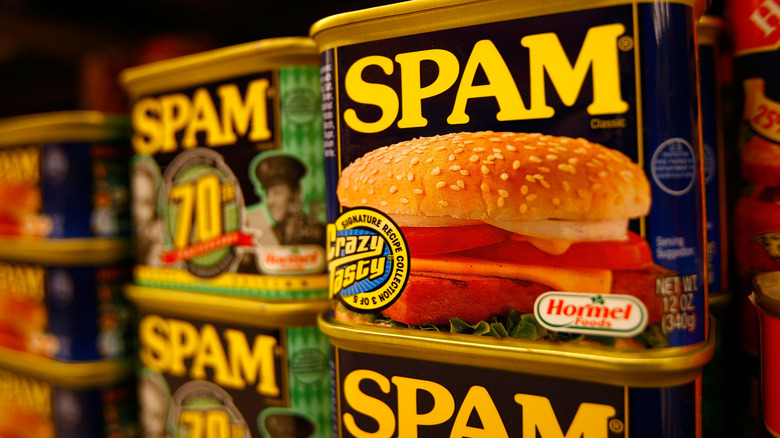
The differences between bologna and Spam go beyond their composition and manufacture, and have manifested in the wildly varying recipes which include them. These recipes reflect not just their enduring regional popularity throughout America, but often the unique historical impact these processed meats have had around the world.
When many of us think of bologna, we think of sandwiches, and in the American South, that tends to mean the simple, nostalgic, but undeniably satisfying fried bologna sandwich, crispy and browned from the skillet and accompanied by cheese, mustard, or mayonnaise. If you're looking to enhance the meat's taste with spice and piquancy, you might consider the Pennsylvania coal country favorite pickled bologna, including flavor boosters like jalapeños or garlic during the pickling process. Should you instead be in the mood for some real stick-to-your-ribs comfort food, bologna is always a budget-friendly base for a hearty casserole or hotdish.
Out of bologna and Spam, it is the latter that has developed the more international appeal. In Korea, Spam is a vital element of budae jjigae, or Korean army stew, a popular and nourishing hotpot that also typically features hot dogs, American cheese, ramen, and kimchi, first created out of desperation in the aftermath of the Korean War, when severe food shortages forced Koreans to resort to foodstuffs brought over by the U.S. military. Another blend of disparate culinary influences that emerged from wartime can be found in Hawaii, which since World War II has developed a passionate love of Spam that endures in unmistakably Hawaiian dishes such as Spam misubi.