

The Disappointing Truth About Blue Strawberries
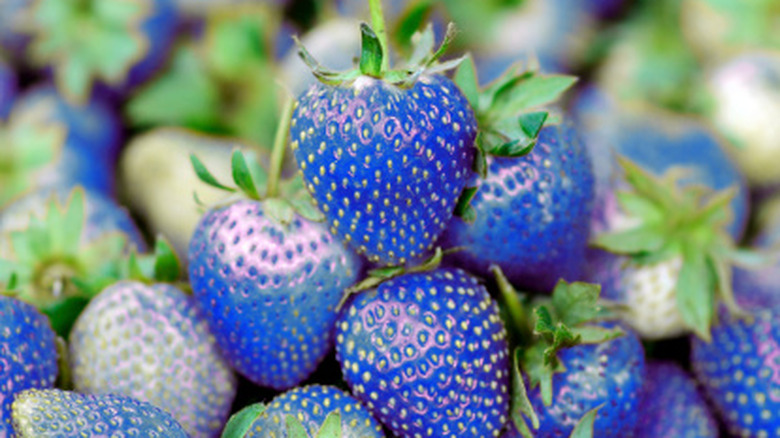
Every once in a while, particularly when the first warm breezes of spring start to blow and gardening fantasies grow in our collective mind, stories about blue strawberries make the rounds on the internet. There is, in fact, one particular day of spring during which you are mostly likely to see social media posts depicting strawberries that have swapped their signature red hues for a vibrant royal blue: April 1. As exciting as it might be to swap the color on this symbol of summer, we are sorry to say that blue strawberries are typically just an April Fools' Day joke. Indeed, they are no more real than the more mainstream blue raspberries. Hopefully, we're not delivering two blows here, but those are also fake, at least outside of the cocktail of artificial flavors and colors used in drinks and candies.
Unfortunately for both of these impossibly blue-tinged fruits, folks on the internet do, however, sometimes take matters beyond the realm of light-hearted joking. A quick search shows plenty of vendors trying to hawk seeds for strawberries and raspberries with this unnatural coloration, even on major e-commerce sites like Amazon. To the savvy shopper, it's clear that the photos have simply been altered to change the color. Given the number of listings out there, though, it seems that the scam must be fooling some rubes — and you can find their angry comments in the reviews.
This trick doesn't end with just blue, either. Perhaps to reach broader audiences, strawberry seeds are sold purporting to grow in all sorts of exotic colors, like yellow, purple, and black. However you choose to spend your money, though, you should never buy black strawberries — they simply don't exist.
It is true, though, that not all strawberries are red
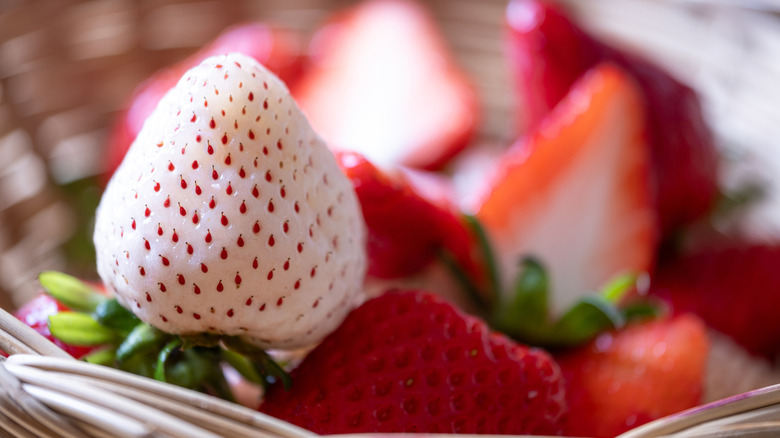
For those that prefer to dream of a more whimsical world — one in which fruits can easily be bred to grow in any color of the rainbow — we are sorry to burst your bubble. Even the origin stories of the blue strawberry that credit genetic modification for the color change are nonsense. But it is true that not all varieties of strawberries are red. Most are, but one region's special crop has now given rise to several white strawberry variants around the world.
In Japan, large white strawberries strikingly studded with red seeds can fetch as much as $10 for a single berry. Elsewhere, there is also a white-to-pale-pink strawberry variety with a slightly tropical flavor sometimes referred to as pineberries — a portmanteau of "pineapple" and "strawberry." Both of these fruits, however, owe their existence to cross-breeding with a South American fruit known as frutilla blanca, Fragaria chiloensis, or Chilean strawberry.
This unique fruit has been cultivated in Chile for centuries. Its fruits are smaller than standard garden strawberries, but bear the prized white coloration as well as the unique pineapple-like aroma. The fruits have been a part of the culture and diet of the region from the time of the Mapuche to the present, though these days larger variants of red strawberries have become the choice for most farmers. Interestingly, the strawberries that dominate agriculture these days are actually a cross between frutilla blanca and the Virginia strawberry. Fortunately for those who wish for a bit of variety in their strawberry coloration, Chilean strawberries are said to be fairly easy to grow. Though it might be a difficult prospect to hunt down a reputable seed dealer amidst all the blue strawberry scams.