

The 'Waffle House Index' FEMA Uses To Gauge Natural Disasters
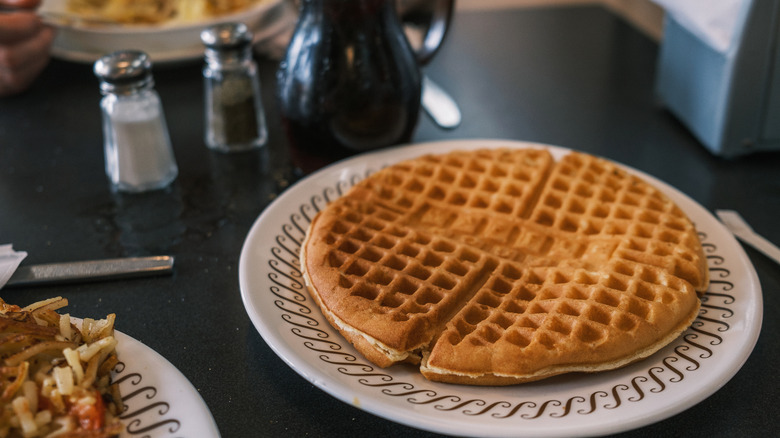
Late-night snackers, early risers, and third-shift workers know they can always count on Waffle House for a hot meal whenever they need it. The diner chain has been a 24/7 operation since it opened its very first location in Avondale Estates, Georgia, in 1955. Its reputation for never closing has become as iconic as its tried-and-true menu, with trends like the 24-hour Waffle House challenge drawing patrons as much as its classic waffle.
But it's not just hungry fans who esteem Waffle House's always-open policy. The Federal Emergency Management Agency (FEMA) rates it too, using the restaurant as one of many metrics to gauge the severity of natural disasters. Let us explain. Waffle House's more than 2,000 U.S. locations span regions prone to hurricanes, tropical storms, tornadoes, and severe flooding, being concentrated in the mid-Atlantic down through the Gulf Coast and across to the Midwest. Because of this, Craig Fugate, a former FEMA administrator until 2017, invented an unofficial "Waffle House Index" to determine just how hard an area was hit by the weather judged on whether an outlet was open and what it was serving. During his tenure, he led the federal response to natural events including the devastating Joplin and Moore tornadoes, Hurricanes Irene, Sandy, and Matthew, as well as the catastrophic Louisiana floods in 2016.
FEMA's informal three-tiered Waffle House Index works like this: If during a storm, Waffle House locations are operating as usual, the index is green, meaning damage is likely minimal. The index rises to yellow if a Waffle House is still open but serving a limited menu, which is often due to utility or food supply issues. If a Waffle House is closed, it's a code red, and FEMA knows they need to act. "If you get there and the Waffle House is closed, that's really bad," Fugate said. "That's where you get to work."
Waffle House prides itself in its natural disaster response
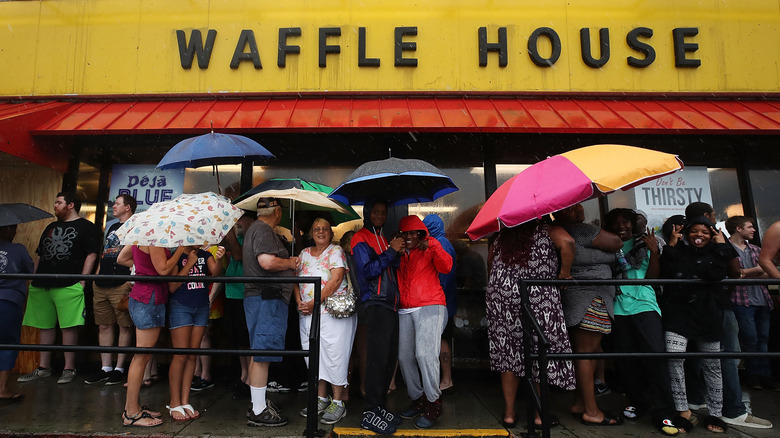
Of course, the Waffle House Index is largely hearsay, and FEMA utilizes far more sophisticated metrics for its robust natural disaster assessment. Still, it does take an awful lot for Waffle House to actually close its doors, and its ability to stay open in the wake of severe weather has become an effective business strategy for the brand. When Hurricane Katrina destroyed seven Waffle Houses and shut down 100 others in 2005, the locations that were able to reopen quickly saw a huge spike in sales as patrons had few other options, many having lost stockpiles of perishable food items to power outages, in addition to most restaurants shuttering indefinitely.
Realizing the chain was particularly adept at operating through natural disasters, Waffle House implemented crisis response and management processes, including equipping locations with portable generators, establishing a mobile command center, and drawing up a post-disaster manual to streamline reopening stores as quickly as possible. It even includes guidelines of what to serve (and how) in various scenarios, such as if a restaurant still has gas but no electricity. Pat Warner, former public relations director at Waffle House, was quoted as saying, "If you factor in all the resources we deploy, the equipment we lease, the extra supplies trucked in, the extra manpower we bring in, a place for them to stay, you can see we aren't doing it for the sales those restaurants generate." Rather, the company sees its disaster preparedness as a bid of goodwill that pays off through customer loyalty. Waffle House regulars know the best time to eat at Waffle House to get the full experience is from 10 p.m. to 5 a.m., but when natural disasters strike, the diner can become a lifeline any time of day or night.