

Jamie Oliver Stands By A Controversial Steak-Cooking Method
The English celebrity chef Jamie Oliver has long been known for offering stripped-down cooking advice that challenges traditional, old-school kitchen rules. So, it's no surprise that one rule he likes to frequently break involves a long-standing steak-cooking guideline that many home cooks have heard for years: don't flip your steak too often. According to this common belief, one of the best ways to cook a perfect steak is to place it in the pan or on the grill and turn it only once, so it develops a deep, even crust. Oliver, however, has publicly suggested the opposite.
In his "How to Cook the Perfect Steak" video on Facebook, he encourages cooks to flip their steaks frequently while cooking, rather than leaving them untouched for long stretches of time. The idea may sound counterintuitive, but Oliver says this technique can actually help produce a better result. The method itself is simple. Instead of placing a steak in a hot pan and letting it sit for several minutes before turning, Oliver recommends flipping the meat often while it cooks.
"I'm gonna turn it once a minute, every minute," Oliver explains while cooking a flat iron steak. "You want even cooking from both sides." When a steak sits on one side for a long time, the bottom layer can become extremely hot while the top remains much cooler. That temperature imbalance can sometimes lead to a thicker band of overcooked meat near the surface.
This is one meat method made to be broken
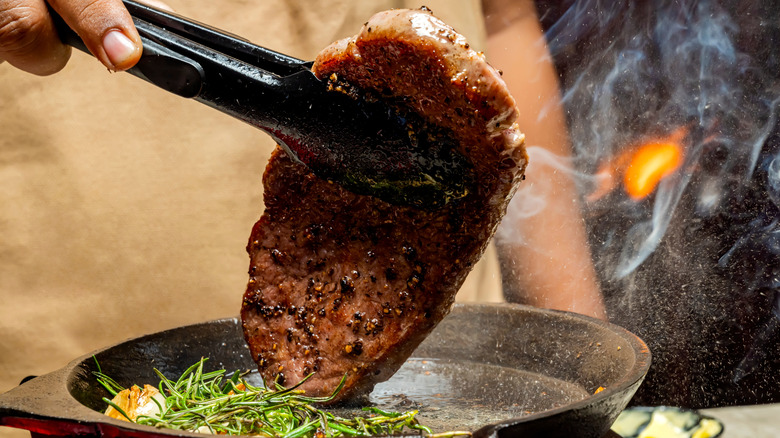
Another benefit to flipping your steak often is moisture retention. "Being equal with both sides keeps the moisture in the middle, which means when you rest it," Oliver elaborates. "It then comes back out again and gives you a beautiful, juicy steak." When the steak is turned repeatedly, juices inside the meat circulate rather than collect in one spot. This can help prevent the steak from drying out and produces a more evenly juicy result. The technique works particularly well when cooking steaks in a pan over high heat, and especially when using cuts that are relatively thick.
If you're cooking a ribeye steak, frequent flipping works because this cut contains enough fat and thickness to develop a crust while still cooking evenly inside. Thicker cuts also give cooks more flexibility with timing since they take longer to cook through. Thus, repeatedly flipping them doesn't interfere with browning as much as it might with very thin steaks. But if you're cooking a sirloin steak, Oliver has a cooking method for that as well.
The approach has sparked debate among cooks because it contradicts the traditional "flip once" rule that many chefs and grill enthusiasts still follow. However, food science experiments and cooking tests in recent years have suggested that frequent flipping can indeed produce evenly cooked steaks with good browning. So, the next time you decide to grill out, don't be afraid to flip.