

How Cake Type Impacts Your Choice In Baking Temperature
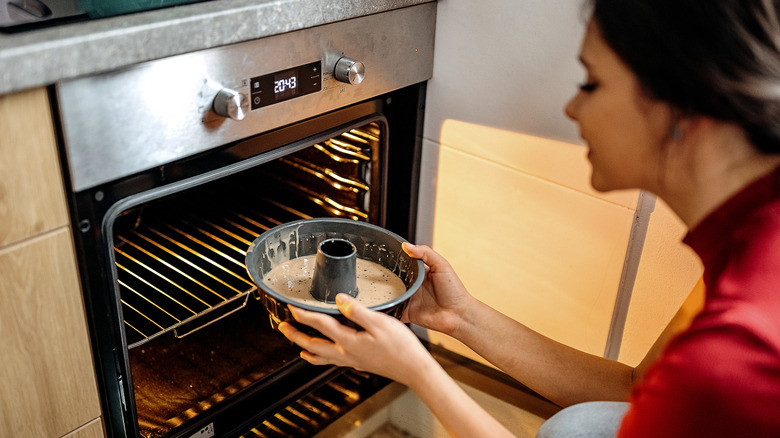
Making a cake is both an art and a science. The creativity component kicks in when you're trying to play with different flavors or upgrade your boxed cake mix with quality ingredients. On the other hand, you need to carefully measure out your ingredients (preferably using a baking scale) and take into account the balance of wet and dry in your recipe. Especially pertinent to the "science" component is, of course, deciding how long (and at what temperature) to bake your cake.
This number can seem quite arbitrary, especially on a cake mix. Why does a batch of cupcakes need to bake for 18 minutes, while a New York-style cheesecake needs to cook for an hour (and hang out in the oven for an additional five hours)? Why do you need to bake one at 325 degrees Fahrenheit, but another at 350 degrees Fahrenheit?
In short, baking time and temperature are dependent on the type of cake you're making. A dense, heavier, and moister fruitcake is going to need to be baked longer and at a higher temperature than angel food cake, which you don't want to brown. A cheesecake, which isn't technically cake, needs to be baked low and slow so that it doesn't crack or curdle, which isn't something that you have to worry about for a standard layer cake. These examples illustrate why it's hard to make blanket recommendations for baking time and temperature, as it's wholly dependent on the cake type — among other factors.
Other considerations to make when setting your timer
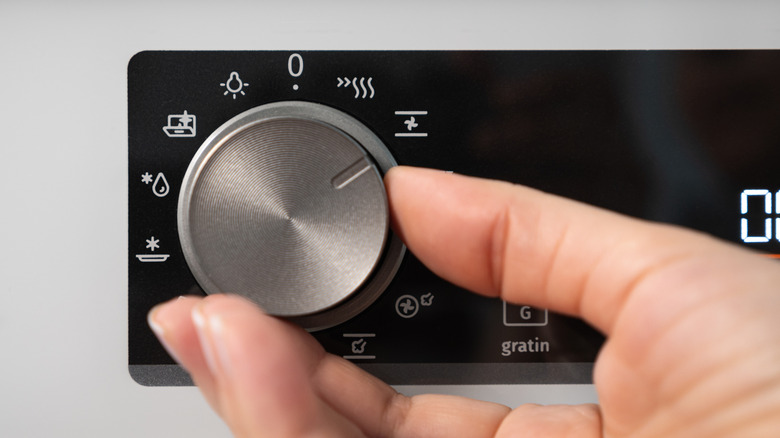
The "type of cake" you're making is going to give you a very broad approximation for bake time and temperature, but beneath that, there are several considerations you'll want to think about when deciding how long and how hot to set that oven. The first is size. Cupcakes, for example, can be made from most cake batters, but their small size means they cook through faster than a standard-sized cake. You may also want to consider the type of vessel you bake your cake in. The color of your baking pan matters because darker surfaces absorb more heat, so it isn't uncommon to knock the temperature down 25 degrees when you're using a darker pan over a standard metal one. The shape of your pan is also worth considering, as some ring-shaped pans, like Bundts, cause the cake to bake faster because there is more surface area (though this isn't a hard-and-fast rule, as Bundt cake batter tends to be pretty dense compared to standard cake batter). Oh, and don't get us started on high-elevation baking.
With all of those caveats in mind, how do you decide how long to bake your recipe? Well, if you're trying a cake for the first time, we recommend triangulating your bake time and temperature with several other recipes (considering the moisture content and ingredients in those bakes). Setting timers and checking the cake regularly, as well as using a thermometer to determine doneness, can also help.