

The Chicago Bottled-In-Bond Bourbon That Drinkers Say Carries A Sweet Heat

If you're looking for a relatively young whiskey that has nevertheless been made by faithfully sticking to some very old rules, you might want to try FEW bottled in bond bourbon. With its distinctive blend of spice and sweetness, FEW has distinguished itself among bourbon drinkers, just as the Evanston grain-to-glass distillery that produces it has made its mark on Chicago's thriving whiskey scene.
The distillery itself proudly refers to the "beloved spice of FEW straight bourbon" that gives the whiskey its heat, while many critics have emphasized the complex sweetness that accompanies it. The Whiskey Wash's Carin Moonin detected rooibos tea and Oreo cookies in the bourbon's nose, which one Reddit user described as "almost aggressively sweet, spicy, definitely some vanilla, and a not-unpleasant hint of something vegetal, like walking in the woods after a rain." Nick Beiter's review at Breaking Bourbon echoed this, noting a "pervasive earthy undertone throughout", with a flavor profile that is "complemented by sweeter cherry, cinnamon, caramel, and raisins along with a healthy amount of oak."
The bourbon was first released to mark the 125th anniversary of the 1897 Bottled In Bond Act, the U.S. Government legislation which set the standards under which various alcoholic spirits throughout the country could be produced and sold. Prior to this, the American whiskey industry was shockingly unregulated, with unscrupulous practices rife among distillers, and much of what was then sold as "bourbon" would be unrecognizable to modern drinkers. The Bottled In Bond Act, however, paved the way for the high standards of quality modern whiskeys aspire to, which is why FEW Spirits' bourbon is made in strict accordance with the Act's specifications.
The Chicago bottled-in-bond bourbon that drinkers say carries sweet heat
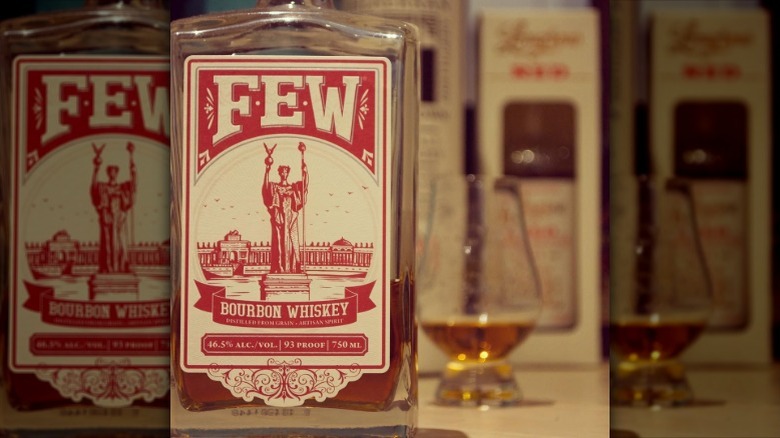
So what qualifies a bourbon as bottled in bond? According to the 1897 act, the whiskey must abide by four rules. Firstly, it must be bottled at 100 proof (or 50% ABV). In order to ensure uniformity in the distilling process, the whiskey must come from a single distilling season. So customers can be certain of the whiskey's provenance and that it contains no unknown adulterants, the whiskey must be produced by one distillery. Finally, the whiskey must be aged for a minimum of four years in a special bonded warehouse, so immature whiskeys cannot be sold by fraudulently claiming to be older than they are.
History informs not just the whiskey-making process at FEW Spirits, but also the story behind its creation. The artisan distillery can be found in Evanston, Illinois, about half an hour's drive from Chicago. It is an ironic location, given that Evanston was once a key headquarters of the Woman's Christian Temperance Movement, which was instrumental in agitating for Prohibition, the effect of which turned Chicago into a hotbed of organized crime. Evanston would remain a dry town until 1972, and according to FEW Spirits, no alcohol head ever been produced there before the distillery's establishment in 2011.
FEW Spirits was also inspired by the personal history of its founder Paul Hletko, who stepped down as president of the distillery earlier this year. Before World War II, the family of Hletko's grandfather owned a brewery, which was confiscated once the conflict began. "After the war, my grandfather spent the rest of his life trying to get the brewery back — unsuccessfully," Hletko recalls. "I started FEW Spirits in order to bring back this family legacy, and honor my grandfather's memory."