

Give Ceviche A Flavor-Packed Upgrade With This Tangy Liquid
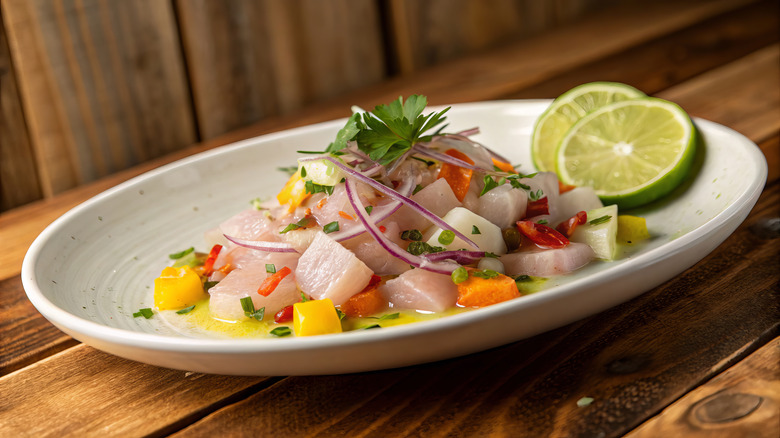
Ceviche has one rule and, as long as you're using fresh ingredients, you're abiding by it. (Well, with raw fish, there's also food safety to consider, but that's more of a law). Pay those (two) things mind, and you have a dish that simply does not miss. Acid, seafood, a pinch of salt — a simple ceviche is classic. Yet it also lends itself as a canvas. You can embolden it with onions and chiles. Now it's Peruvian. (It's always Peruvian). Of course, there are vegan ceviches, or others that include fish as one of a dozen other components. Apart from the protein, you can modify the base juice of ceviche easily, and one way to infuse yours with a tangy profile is to add a dash of kimchi brine.
The liquid that you brine ceviche in is otherwise known as leche de tigre. In order to denature the proteins that turn raw fish, shrimp, or octopus into safe-to-eat ceviche, your leche de tigre must have a high acid content and completely cover your seafood during the "cooking" phase. Depending on how much kimchi brine is in the jar or can you intend to use, you may not be able to replace it one-to-one with lime juice. In any case, it becomes a modifier that can give your ceviche a funky new dimension. There's always room to consider the best ways to pair the type of kimchi you have with the type of fish you should use for ceviche.
Pairing kimchi with ceviche
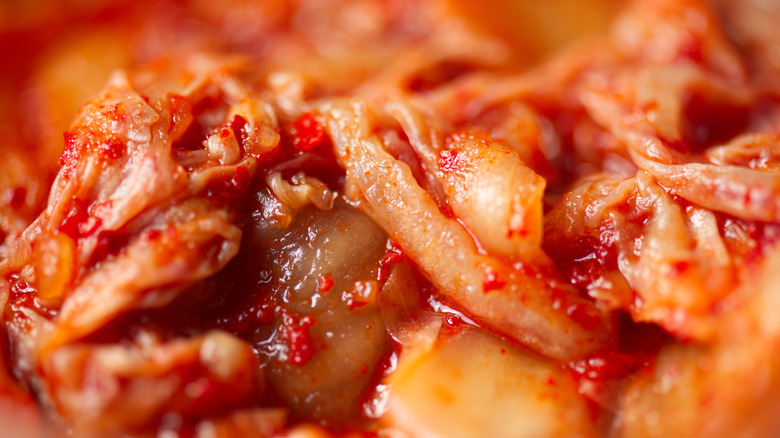
You can choose a wide array of fish for ceviche, so long as they meet the first rule (fresh) and then fall into a general vibe of being lean and flaky. Varieties like fluke, flounder, snapper, and sole are typical because they have lower fat content as opposed to fish like salmon. Shrimp are also fairly lean, which is why they make good ceviche, too. The main problem is that with more fat comes more oil, and oily fish inhibit the ability of acid to penetrate protein cells and cook them.
Once you've evaluated the type of fish you want to use in your ceviche, you can begin to mix and match the style of kimchi you're going to mix in. For example, brine from white radish kimchi, also called dongchimi, is great for fluke. As a sweeter white fish, fluke will be complemented by dongchimi because it is a subtler kimchi that is salty and aromatic rather than super chili-forward. On the flip side, if you're looking for a leftover use for your heat-packed baechu kimchi, a robust shrimp or octopus ceviche may hold up better against the intense heat this style is known for.