

The Canned Bean Mistake That's Been Hurting Your Wallet For Too Long
We may receive a commission on purchases made from links.
Cheap, plentiful, and you can do a ton of things with it, from a hearty pan of refried beans to a few fancy servings of Italian-Style White Bean And Tomato Skillet, canned beans are undoubtedly a pantry staple. If you're counting on them to give you the cheapest, protein-packed meal for the money, though ... you're getting ripped off because, as it turns out, dried beans are just so much cheaper.
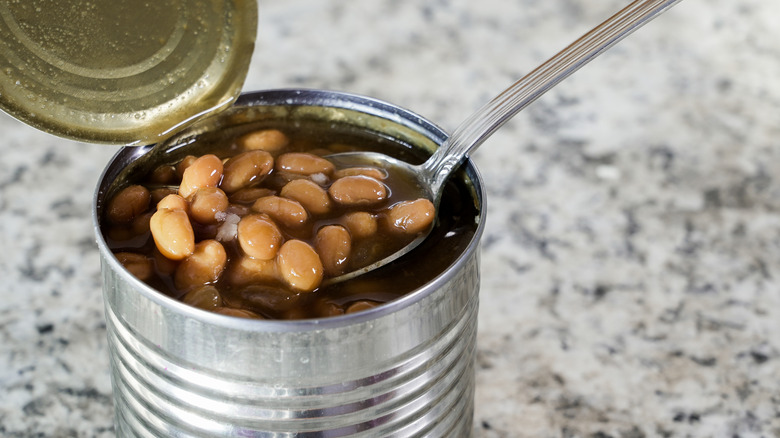
Consider this: You can buy 4 pounds (about 8 cups) of dried Iberia-branded pinto beans from Amazon right now for $6.29. Dried beans usually triple in size once hydrated and cooked, so if you cook the whole bag, those 8 cups will yield as much as 24 cups of cooked beans — about 26 cents a cup. A 15.5-ounce can of organic pinto beans from 365 by Whole Foods costs $1.39, and since it's already cooked, that's the full yield. Once you drain out the salty canning liquid, you get about 1.5 cups of beans — roughly 93 cents a cup.
To put this into perspective, if your household eats beans once a week, you're burning through an extra $35 a year for the convenience alone. Doesn't sound that bad on paper, but it smarts a bit when you're trying to tighten your belt. But the kicker? Canned is way less nutritious and even sodium-heavy.
The dramatic nutritional gap between canned and dried beans
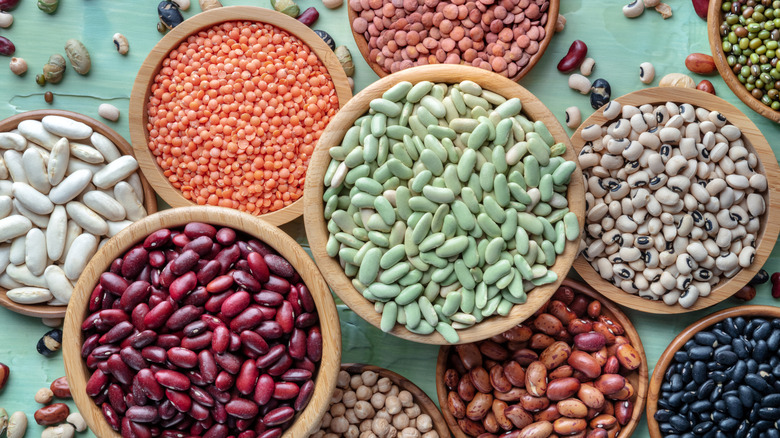
Fortunately (for us), much of the legwork was already done by researchers. A study published in the Food and Nutrition Sciences journal used the Nutrient-Rich Food Index (NRF 9.3), which is a metric that measures how densely packed each food is with nutrients relative to its calorie load, to settle the canned-versus-dried-beans debate once and for all. The gap was pretty wild when they ran the numbers: Dried, cooked beans scored a 7.3, while canned beans landed at just 2.8. That drop basically comes down to the canning process itself, which essentially flushes a good chunk of the nutrients right out.
Canned beans do win in one category, though it's not exactly a prize: Sodium. You're looking at around 200 milligrams per half-cup serving with canned, while dried beans start with a clean slate at virtually zero. Yes, you can rinse canned beans to knock some of that salt off, and sure, low-sodium options exist, but since they're still processed in salted liquid, you can never truly be "sodium-free" when you go with canned. If you're the type who reads labels, dried beans just give you one less thing to worry about.
Look, we aren't trying to knock on canned beans. Nor are we saying that you should avoid them for good. They're still perfectly nutritious and a convenient way to add protein to your diet. Plus, more than anyone, we understand that not everyone has two or three hours a day to cook dried beans from scratch. But if you've got the time and want to stretch your grocery budget, dried beans come out far ahead.