

The Expert-Approved Ratio For Crafting Your Own Signature Cocktail
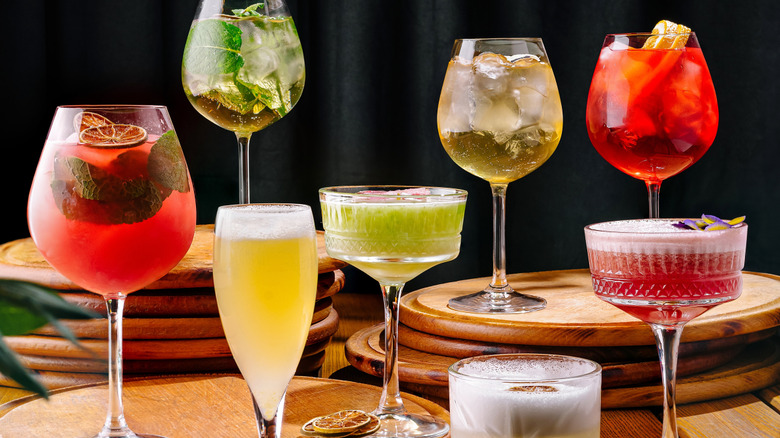
If you're hosting a dinner party or cocktail hour, you might be daunted by the idea of mixing drinks. After all, it can be quite a task. For an expert-approved ratio for crafting a signature cocktail at home, we spoke with sommelier and mixologist Cody Nicoll — the owner of Hospitable Nicoll Inc., managing partner of Ember Live Fire Grill, and co-owner of Bar Ocelli — who offered some insight.
"An approachable strategy for making cocktails at home would be to follow a standard 2 oz pour of your base spirit along with ¾ to 1 oz of an acidic ingredient (citrus juices), and ¾ to 1 oz of some kind of sweetener component (simple syrup, honey syrup, etc.)," Nicoll explains. This squares with the golden ratio of 2 parts liquor, one part sweetener, and one part sour that tends to comprise most of our favorite cocktails, from a classic whiskey sour to a perfect homemade margarita. Of course, there are countless combinations of spirits and mixers, which Nicoll says gives you free rein to "plug-and-play with different flavors and ingredients."
While bartenders tend to pull out an armory of mixing tools, Nicoll reassures us that you don't have to buy a fancy mixologist kit to make a great cocktail. You can fashion mixing tools out of receptacles and tools you already have lying around your kitchen. "Without bar tools," says Nicoll, "a Mason jar with some ice can do that trick! You can also use a spoon and any kind of fine mesh strainer to strain your cocktail."
Premade cocktails and more crafting tips
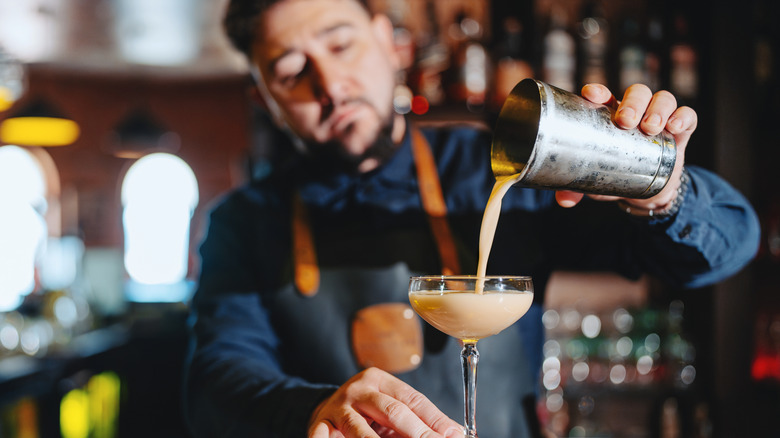
Following Nicoll's ratio is a simple jumping-off point to create a solid scratch-made cocktail, but there are plenty of tips for crafting a homemade cocktail that'll impress even the most pretentious drinkers. You can start by doing a little research, reading up on famous new cocktail recipes, or visiting a few bars to peruse their cocktail menus. Sweeteners, spirits, and acids are the foundation, but you shouldn't discount other elements like liqueurs, bitters, and vermouths, either. These ingredients will bring nuanced flavors, adding sophistication and depth to the sweet, sour, and alcoholic components.
If you're feeling overwhelmed, start by choosing a spirit. Booze is, after all, the star of the show. Once you've chosen your spirit and sipped it neat to savor its tasting notes, you'll have a better idea of flavors to pair it with. If you don't want to spend all of your time behind the bar, Nicoll recommends pre-batching your cocktails.
"You can pre-mix all of your ingredients together and add water to your desired dilution," he explains, "typically 40 to 60% the total volume of your ingredients (depending on the cocktail recipe and desired taste)." After calculating how many cocktails you're batching and scaling the recipe to accommodate that amount, it's important to store it properly. "You can bottle your cocktail and keep it cold in the fridge," Nicoll adds, "simply pouring your cocktail over ice when your guests arrive."