

The Polarizing Food Network Show Its Host Didn't Even Want To Do
Food Network is home to a variety of reality shows focusing on food, cooking, and culinary history. Yet it may be equally well-known for its controversial Food Network chef departures. However, one of the most surprising stories about the network doesn't involve a host's departure, but instead a once-popular show that, at the time it was conceived, even the host herself didn't want to do.
Sandra Lee, the host of Food Network's "Semi-Homemade," was staunchly against doing the show when it was first pitched to her. At the time, she was a bestselling author of three cookbooks that celebrated fast, simple recipes that were not made from scratch. When representatives of Food Network first approached her in 2003 about doing a show, she wanted to host a home and garden show. She ended up spending nine months negotiating the premise of the show, successfully arguing for the inclusion of her elaborate tablescapes and a cocktail hour segment. Lee was eager to be the first Food Network host to include a cocktail segment, while the network continually pushed back at the idea, claiming that the audience wouldn't be interested in it. She thought it would be a hit, however, and turned out to be right.
Lee obviously ended up winning her argument, as "Semi-Homemade," which aired from 2003 until 2011, featured an iconic cocktail segment that quickly became the most popular part of the show. Over its 15 seasons, Lee taught viewers how to make over 100 cocktails. In fact, even on Food Network's webpage for the show, the top recipes listed are almost all drink recipes.
Semi-Homemade (and its cocktail hour) weren't without critics
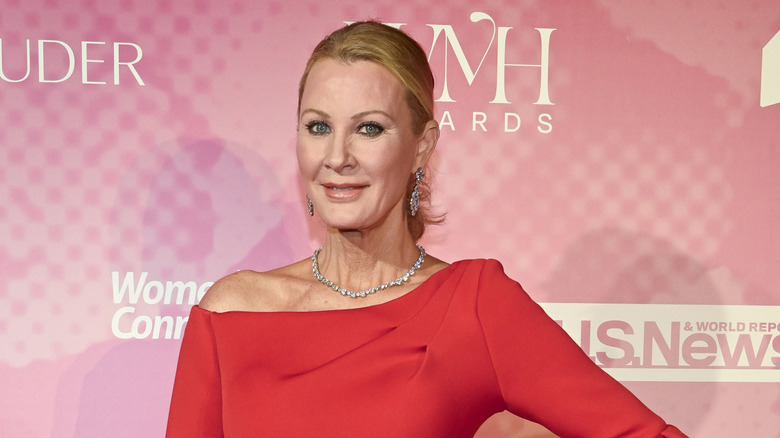
Though "Semi-Homemade" was a popular show that ran for 225 episodes, it certainly wasn't without its critics. Sandra Lee faced backlash for cultural appropriation (not until "The Great British Baking Show"), accused of mishandling the presentation of ethnic dishes on the show by simplifying or adapting the recipes to the point of over-the-top Americanization. The biggest example of this was her controversial Kwanzaa cake.
In her 2003 holiday show, Lee made a Kwanzaa cake decorated with pumpkin seeds, popcorn, corn nuts, and seven Kwanzaa candles. The recipe, which was developed by Denise Vivaldo, was widely criticized. While the other recipes from that episode still appear on Food Network's website, including the Star of David cake and Holiday Wreath cake, the Kwanzaa cake does not.
Some also accused Lee of being overly enthusiastic about enjoying a boozy afternoon of cooking. Even other Food Network stars shamed her, including Anthony Bourdain, who once called her pure evil. In 2003, The New York Times even published a take-down of her show, criticizing its embrace of convenience foods and cooking shortcuts, and arguing that it was emblematic of America's culinary downfall.
However, the reason "Semi-Homemade" ended after its 15-season run, and why you don't see much of Sandra Lee anymore, was due to her personal commitments and health. In 2011, Lee was dating then-governor of New York Andrew Cuomo and committed herself to the role of First Lady, promoting various charitable endeavors. Then, in May 2015, she announced a cancer diagnosis and battled the disease for the next two years. In 2024, Lee returned to hosting with her Netflix show "Blue Ribbon Baking Championship" and the Roku Channel's "Dinner Budget Showdown."