

How Sugar Could Actually Be Messing Up Your Homemade Cookies
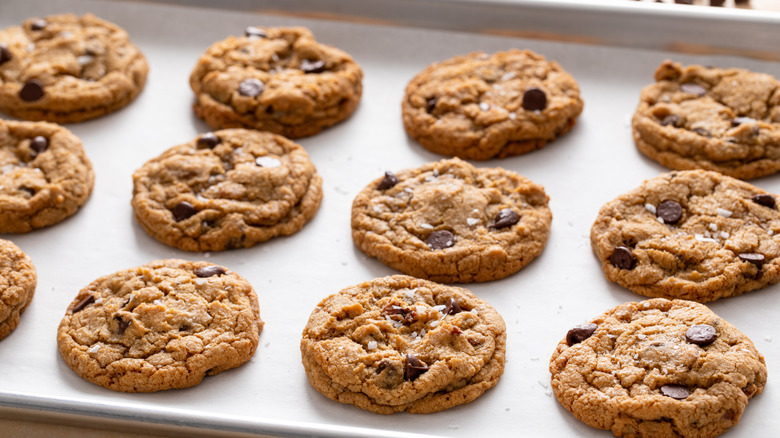
Baking your own homemade cookies is nothing short of a magical experience. Not only do you get to enjoy the tasty fruits of your labor afterward, but there is something very comforting about preparing a recipe and camping out next to your oven door, watching your cookies spread out on the baking sheet as they bake and brown. While a little spread and a little brown are to be expected, you don't want your cookies to turn out flat and crunchy like brittle. If you are noticing that they are browning and spreading far too much, there is one potential culprit: the amount of sugar you used.
Sugar is an important addition to cookies, as it gives them flavor, contributes to the Maillard reaction (browning), and traps air when creamed with butter. But as Samantha Merritt, creator of Sugar Spun Run, explains, you don't want to have too much of a good thing. "In the oven, the sugar melts and then caramelizes. This causes the cookie dough to spread more as the ratio of sugar to other ingredients increases, resulting in thinner cookies," she says. She advocates measuring your sugar carefully, like with a scale, in order to prevent excess spread from occurring. Baking with a scale allows you to get more precise measurements than using cups.
Can you tell you've added too much sugar before your dough hits the oven?
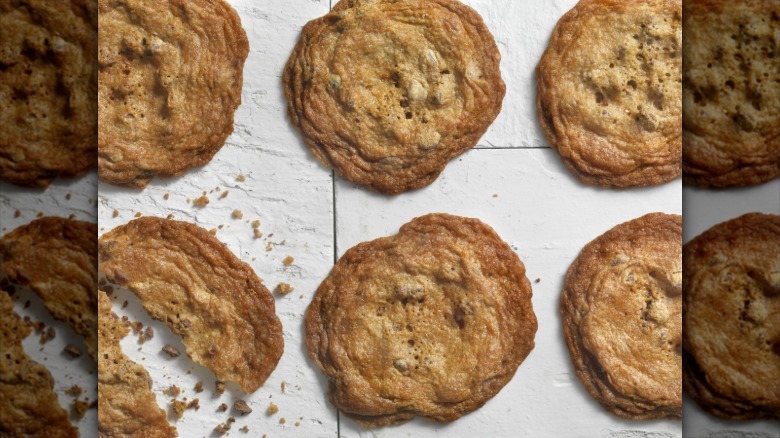
Samantha Merritt explains that one of the challenges of working with sugar and cookie dough is that it's hard to tell you've added too much sugar before your cookies are in the oven — and the damage is already done. "While the dough might feel slightly more sticky or tacky, generally it doesn't look all that different from dough with less granulated sugar, even if you've used 50% less or 50% more," she says. This is where taking the time to double-check your measurements against your recipe may pay off.
The outcome of your cookies can tell you a lot about how much sugar you added, though. Not only will your cookies taste sweeter than they should, but as Merritt explains, they will also be crisp on the edges (and potentially underbaked in the center) and darker in color.
What if you want crunchy cookies? Rather than playing with the amount of sugar in your cookies, your best bet for crunchier cookies — that don't taste too cloying or burnt — is to play with the oven time and temperature. Use a low oven temperature to dry out your dough slowly, rather than cause an uneven bake between the centers and the edges. On the other hand, if you're after a fluffier cookie, use a higher-moisture sugar, like brown sugar, alongside cake flour to keep your treats soft and pliable.