

9 Of The All-Time Biggest Meat Industry Lawsuits
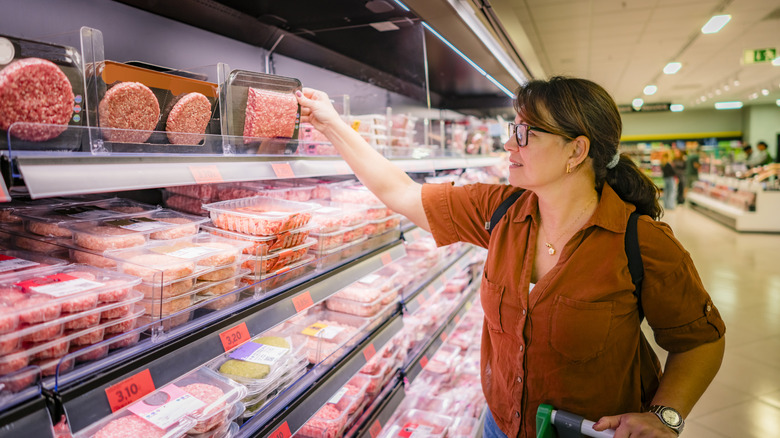
Unless you're among the roughly 13% of Americans who follow a vegan or vegetarian diet, the chances are you interact with the meat industry pretty regularly. Grocery store aisles and restaurant menus are filled with everything from fresh chicken to pork sausages and beef burgers. Meat is a normal, everyday part of most people's lives. But the industry that is responsible for producing all of this animal protein is far from perfect.
In fact, over the years, some of the world's biggest meat companies have been involved in some pretty major lawsuits. Plenty of these lawsuits surround overcharging consumers through price-fixing, but others include wrongful death, corruption, greenwashing, and even terrible smells. Below, we are lifting the veil on the meat industry's pretty scandalous past. Keep reading to dive into some of the all-time biggest lawsuits to impact the meat industry, most of which involve paying out millions of dollars in compensation.
Tyson Foods and Cargill pay $87.5 million to consumers over price fixing
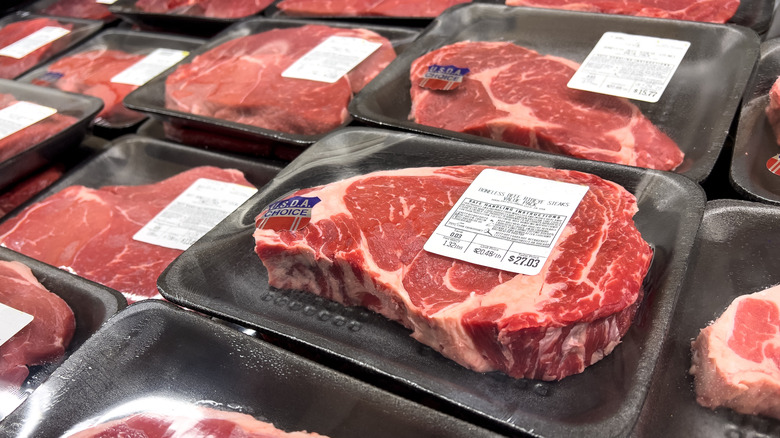
The U.S. beef industry is huge. According to Fortune Business Insights, it was valued at more than $113 billion in 2025. Despite its size, only a few key companies compete for the biggest slice of the market; among them are Tyson Foods, National Beef Packing Company, JBS, and Cargill. But they may not always play fair. According to a lawsuit, all of these beef producers are accused of price fixing.
For the uninitiated, price fixing happens when industry competitors band together to raise or maintain prices. It's usually illegal: It eliminates competition between companies, but it often means that consumers have to pay more. This is what the beef producers are accused of — artificially raising profit margins and forcing customers to pay more for their products. Understandably, when customers realize that price-fixing might be at play, they're not too happy about it, and some take serious action. In fact, the beef lawsuit was actually filed by a group of angry customers.
None of the beef producers has actually admitted to price-fixing, but two of them, Tyson Foods and Cargill, have agreed to pay out millions to consumers to settle the lawsuit. Tyson will pay $55 million to anyone who purchased its fresh or frozen beef in any of the relevant states from August 2014 to December 2019, while Cargill will pay $32.5 million. Consumers have until June 2026 to claim a share of the settlement.
Chicken producers settled a price-fixing lawsuit for more than $203 million
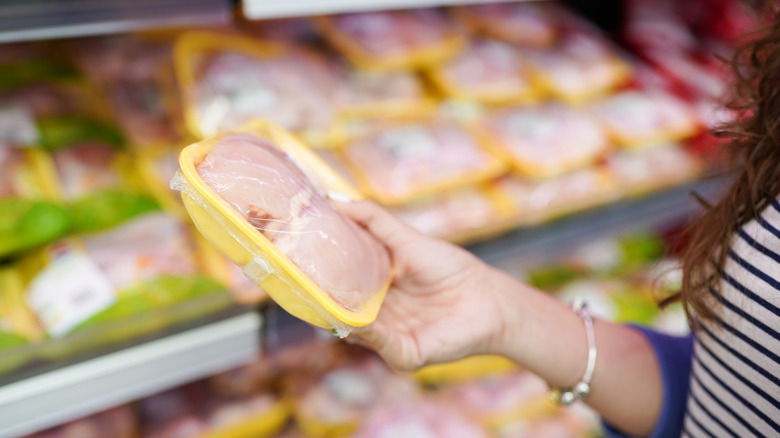
It's not just beef producers that have been accused of messing with market prices to boost their own profits. In 2025, multiple major chicken producers, including Pilgrim's Pride (a leading chicken producer and subsidiary of JBS), settled a very similar lawsuit for more than $22.5 million. This was combined with a previous lawsuit settled in 2021, in which several major chicken producers agreed to pay $181 million to settle price-fixing allegations.
This, of course, brings the combined total of the settlements to more than $203 million. Once again, Tyson Foods was implicated in the lawsuits. Just like with the beef price-fixing lawsuit, the money will go to consumers, but it is not proof of wrongdoing. Despite agreeing to pay out millions, the chicken producers have not actually admitted to intentional price fixing.
The chicken industry is frequently plagued by allegations of price fixing. In 2016, for example, Pilgrim's Pride was sued by its own shareholders for $41.5 million. The shareholders claimed they had been financially harmed by a price-fixing scheme that had been going on within the company for more than 10 years. And in 2020 (yes, there's more), Pilgrim's Pride had to pay a $110.5 million fine after it was accused of artificially inflating restaurant prices.
Chicken producers paid out $169 million for allegedly suppressing farmer pay
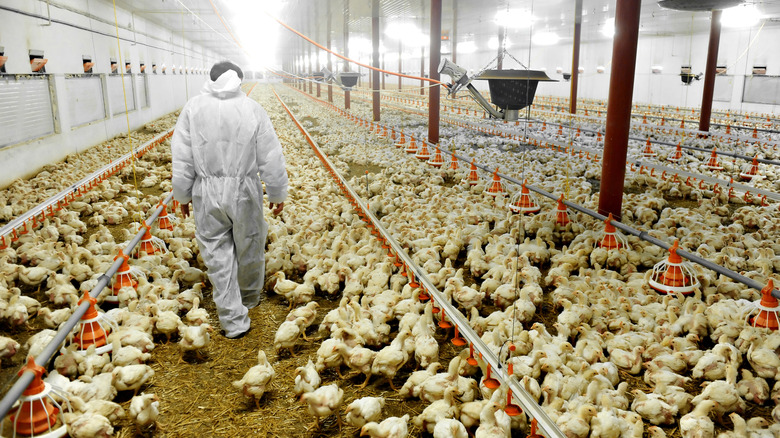
We're not done with Pilgrim's Pride yet. Price fixing is one example of an antitrust lawsuit, but it's not the only way companies try to artificially inflate their profit margins. In 2024, a slightly different kind of antitrust lawsuit was brought against the chicken company. And this time, it wasn't the consumers who had suffered, but agricultural workers.
According to the lawsuit, which represented more than 24,000 farmers, Pilgrim's Pride deliberately colluded with other chicken producers to keep their pay as low as possible. It claimed that the company had done this by sharing confidential information about pay with competitors. To settle the lawsuit, Pilgrim's Pride agreed to pay out $100 million, which also happens to be the largest amount ever paid out by a single meat company in a single settlement.
Pilgrim's Pride wasn't alone, though. The same case also saw major settlements from other chicken producers, including Sanderson Farms, Koch Foods, Perdue Farms, and, once again, Tyson Foods. Together, these companies paid $69 million to settle the lawsuit, bringing the total paid to chicken farmers to $169 million, combined with Pilgrim's Pride's total.
Smithfield Foods settled pork price-fixing lawsuits for $125 million
If you were thinking, "Surely, we're done with price fixing," then we're sorry to say there is more to come. Just like in the chicken and beef industries, major pork players have also been accused of using underhanded tactics to inflate their profits.
In 2022, for example, Smithfield Foods had to pay $42 million to restaurants and caterers to settle a price-fixing lawsuit. Again, the settlement wasn't an admission of guilt from the pork giant. That said, the lawsuit followed another similar settlement in 2021, in which Smithfield Foods paid out $83 million to buyers over price-fixing allegations. At the same time, JBS also agreed to pay $12.75 million to restaurants and retailers, and $45 million to wholesalers and consumers, in price-fixing settlements.
If you're wondering: How have all of these meat giants been price fixing for so long? You're not alone. It turns out, it's had a lot to do with one data company, called Agri Stats. In fact, in 2023, the Justice Department actually filed a civil lawsuit against the data company for actively enabling major meat companies to share sensitive information with each other on prices, cost, and output for many years.
Boar's Head privately settled a wrongful death lawsuit after it caused a huge Listeria outbreak
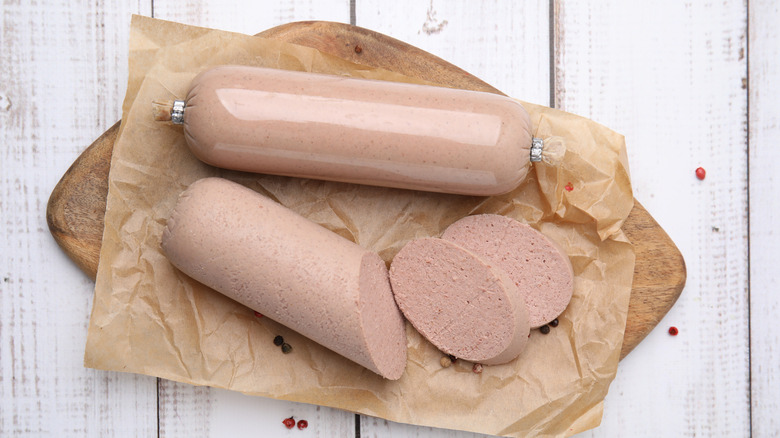
Artificially inflating profits has been the subject of many huge meat industry lawsuits in recent years, but it's far from the only issue that has landed companies in hot water with the law. Back in 2024, for example, Boar's Head settled a wrongful death lawsuit for an undisclosed amount of money, after a man died as a result of consuming a sandwich made with Boar's Head liverwurst.
The deli meat had been contaminated with Listeria, a type of foodborne bacteria that can be very serious for vulnerable individuals, including pregnant people and the elderly. In some cases, it can be fatal. The individual, named Gunter Morgenstein, was rushed to the hospital after he started experiencing breathing difficulties. Tests revealed Listeria was the cause of his symptoms, and he died 10 days after being admitted to the hospital. The family of Morgenstein, who was a Holocaust survivor, filed a lawsuit in a bid to hold Boar's Head accountable for his death.
Morgenstein wasn't the only person affected by the contaminated liverwurst from Boar's Head. Around 59 people in total, across 19 states, experienced serious symptoms of Listeria poisoning, and 10 people died. The outbreak, which was one of the worst in history, resulted in a huge recall, involving around 7 million pounds of meat. A subsequent investigation revealed the cause was likely to be poor sanitation at the Boar's Head liverwurst production facility in Virginia.
Tyson Foods agreed to stop telling people its beef was 'climate smart'
Research suggests that, in general, industrial meat production isn't good for the planet. It is a leading cause of greenhouse gas emissions, for example, and a major contributor to water pollution and rising levels of deforestation. But in terms of environmental impact, the beef industry, specifically, is one of the worst offenders. This is why, when Tyson Foods tried to claim that its beef was "climate smart," environmental experts weren't about to let the meat giant get away with it. At this point, it's worth mentioning that Tyson Foods alone is responsible for producing more emissions than a small country's entire livestock sector.
The Environmental Working Group filed a lawsuit against Tyson Foods in 2024, alleging that while it claimed its beef was "climate smart" and was trying to reduce its greenhouse gas emissions and reach net-zero emissions by 2050, it wasn't actually doing anything to back up those claims. As a result, it was deliberately misleading consumers into thinking its products were more environmentally responsible than they actually are.
Likely as an indication that it knew its climate promises weren't achievable, Tyson Foods agreed to stop making the claims. The lawsuit dictated that if the meat giant wanted to make future claims of a similar nature within five years of the settlement, it would have to actually back them up with appropriate evidence.
JBS settled a New York greenwashing case for $1.1 million
Tyson Foods isn't the only company to be caught out by a greenwashing lawsuit. In 2024, JBS was sued by the New York Attorney General, Letitia James, for making similarly misleading claims about its environmental impact. Just like Tyson, JBS was pledging to reach net-zero emissions by 2040, but it didn't have any real plan in motion to achieve this goal.
JBS is a leading driver of deforestation in the Amazon. And in 2021, it pledged not only to try and achieve net zero by 2040, but also to crack down on rainforest destruction. However, in 2025, frontline workers said that the meat company was on track to break that promise. In fact, many felt it was actually impossible to prevent beef-related deforestation in the Amazon.
In a bid to hold JBS accountable for making environmental promises it can't keep, the New York Attorney General instructed JBS to pay $1.1 million to support science-based climate programs for New York farmers. The programs are designed to help farmers reduce emissions while enhancing productivity. On top of this, JBS agreed to report its environmental practices to the Attorney General for three years and reform its marketing strategy.
JBS shareholder had to pay $3.2 billion in corruption fines

As if greenhouse gas emissions and deforestation weren't enough, JBS has also been linked with child labor, the sale of diseased meat, cattle laundering, and government corruption. Yep, it turns out the world's biggest meat company has also been caught out for bribery. In fact, in 2017, the owners of J&F Investimentos (that's JBS's biggest shareholder) had to pay $3.2 billion in fines after a police investigation revealed that they had bribed around 2,000 politicians to the tune of around $150 million in exchange for government support.
It wasn't the only major company to get caught out for corruption at the time. Odebrecht, a construction giant in Latin America, was also forced to pay fines for its role in the corruption scandal. Odebrecht's corruption dominated headlines, but at $2.6 billion, its fine was nearly $1 billion less than JBS's.
You'd think that the owners of J&F Investimentos, Joesley and Wesley Batista, who also went to prison briefly for insider trading after their bribery scheme went public, would be blacklisted from the meat industry, right? Wrong. In 2024, they were both re-elected to the JBS board of directors.
Smithfield Foods had to pay over $473 million for bad smells, flies, and noisy trucks
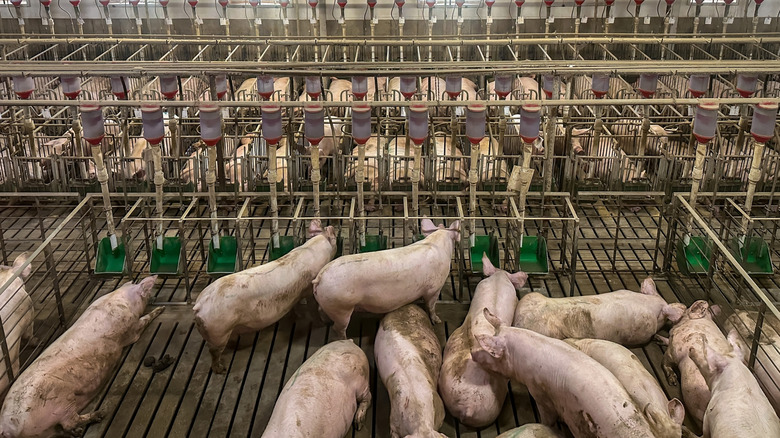
When you picture an American farm, you might think of green fields, an abundance of fruitful crops, sweet animals grazing, and a smiling farmer. Sure, that's the case in some places, but actually, most American farms don't live up to this idyllic image. North Carolina, for example, is full of so many industrial hog farms, that you can actually see the air pollution they emit from space. It's unsavory to think about, but most of that air pollution comes from the waste of nearly 10 million pigs.
Living near a hog farm that produces that much waste is particularly unpleasant for neighboring communities. In fact, it's so unpleasant that in 2018, pork giant Smithfield Foods was ordered to pay people living near its hog farms in North Carolina over $473 million in compensation. The money was to make up for the stench, but also for the noises of the trucks and the flies that all the waste inevitably attracted. Some said the smell was so bad, it was like living next to corpses. According to the lawsuit, Smithfield hadn't even tried to cover up the waste pits near people's homes.
While the jury ordered Smithfield Foods to pay $23.5 million in compensatory damages and $450 million in punitive damages, it didn't actually have to pay out that much. In accordance with North Carolina laws, the final amount was reduced to $94 million.