

What's The Difference Between Thai And Indian Curries?
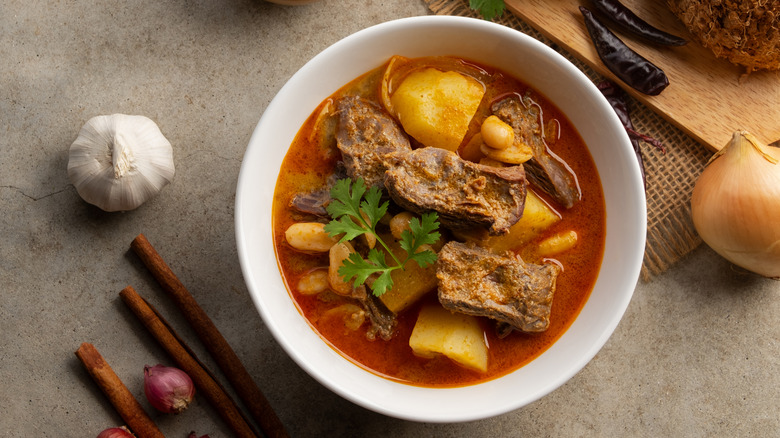
Curry is something of a paradox. It's a word that was born of misunderstanding between cultures, and yet it has come to name and define dishes all around the world. Indian and Thai dishes are often labeled as curries, but so too are dishes from Japan, the Caribbean, and everywhere in between. To understand the differences between Thai and Indian curries, as well as all of the other types of curry the world over, we must start with the history.
Before colonizers arrived in South Asia, there was no such thing as curry. Some of the modern dishes that we think of as curry already existed — saag has been around for several millenia at least — but they were known by the specific names of each dish. There was no broad category of "curry" within which to lump them. That came about from colonizers misunderstanding the meaning of the Tamil word "kari."
In short, "kari" means "black" in Tamil, but the word was likely being used to describe a saucy dish stewed with spicy black pepper. A lack of understanding of the language both changed the form of the word, with the Brits turning it into "curry," and led to that term being used to describe all manner of South Asian dishes that were made with a spicy sauce. With the loose origins of the term "curry" in mind, it becomes easier to see how it came to describe such a wide variety of foods in so many cuisines.
What defines Indian curry dishes?
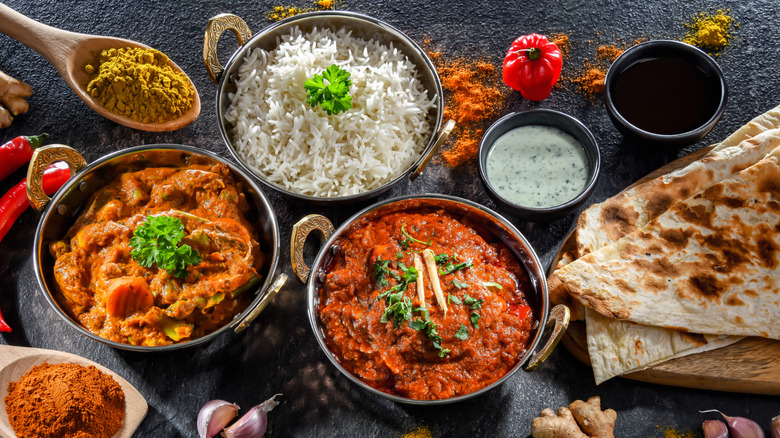
In similarly paradoxical fashion, Indian curries both do and do not exist. The term was a British invention, and that concept became simply a convenient way for outsiders to categorize dishes that they otherwise did not understand. The unfortunate result of this term being used as a catch-all, however, is that it doesn't give much clarity to the dishes it covers.
As a general rule, any Indian dish with a spiced gravy served over rice can be called a curry. In this sense, fragrant chicken korma is a curry, spicy lamb vindaloo is a curry, and chicken tikka masala — a dish thought to have been invented by a Pakistani chef in Glasgow — is a curry. Though, at the same time, none of them are curries. Well, maybe the tikka masala is, as that one came about in an English-speaking country long after the word "curry" went mainstream.
There are certainly some individuals who are bothered by the use of this colonial term to describe dishes that would not have been lumped into a single category beforehand. At this point, though, it's likely far too late to shut the door on its usage. And while some may not like the term, others see it as simply an entryway into the cuisine. When someone sits down at an Indian restaurant for the first time, they'll almost certainly peruse the curries. By their tenth meal, however, they may instead be deciding between the dal and the rogan josh, now knowing the dishes by their true names.
How Thai curries are different
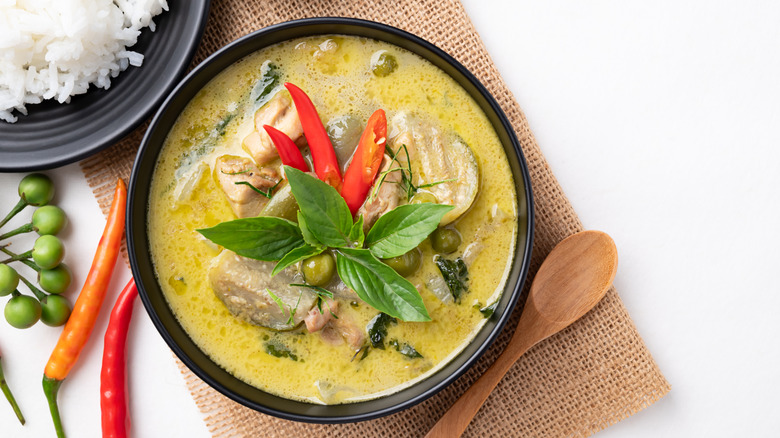
The story of the term "curry" in Thai cuisine is both similar and different to its usage in Indian food. It's not known exactly when the word was first slapped onto Thai dishes by outsiders, but the reason was similar to that of Indian curries: It was an easy way for English-speakers to categorize and understand the cuisine. The difference with Thai cuisine is that, in this case, the dishes that fell under this linguistic umbrella were already considered to be closely related.
Sometime around the 13th century, nam prik was developed in the cuisine of the region, the root of what would eventually become dubbed as "curry pastes." At the time, this was a thick paste made with ingredients like lemongrass, shallots, fish sauce, and pepper — all of which are still present in many Thai curry pastes. The specifics often varied, however, and they evolved over time as ingredients like spicy chilies arrived from elsewhere in the world. These variants of nam prik became the bases for dishes called kaeng, which eventually came to be known as "Thai curries."
Thai curries can vary quite a bit, but the pastes are commonly made with ingredients such as garlic, ginger, shallots, lemongrass, galangal, chilies, kaffir lime leaves, lime zest, shrimp paste, and a variety of spices. The finished dishes are typically filled with meat and vegetables, thinned with coconut milk, and served with rice. So, while "Thai curry" is still a catch-all term slapped on to help foreigners make sense of the food they're eating, it is a little closer to an actual categorization in Thai cuisine.