

For Better Homemade Pizza, Reach For Parchment Paper
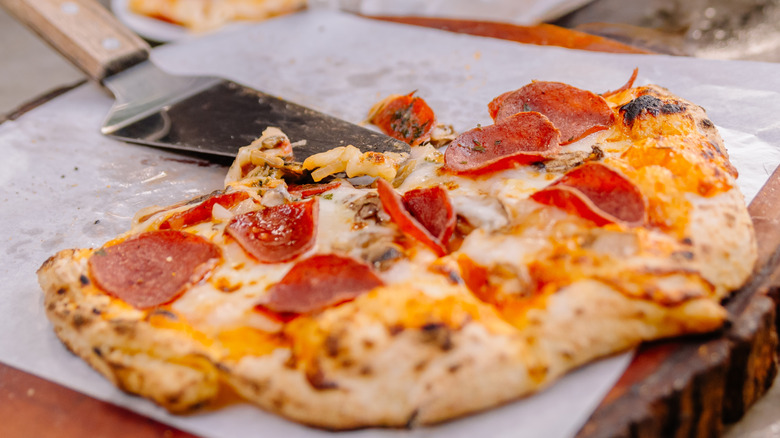
Everybody loves pizza — literally, it's one of the most frequently consumed foods in the United States. And for many pizza fans, the DIY route reigns supreme. Every state in the U.S. has incredible pizza purveyors, but home chefs find making their own a satisfying project where they get to control all of their ingredients, add their own flair, and maybe even save a few bucks. Pizza-making is easy enough once you get the hang of it, but the process has a few idiosyncrasies to navigate. One of the most important factors for achieving great homemade pizza is figuring out how to transfer your dough without it sticking and ripping — shifting it from your workspace to your oven can make or break your meal. So, we turned to an expert for help mastering this move.
"I love using parchment paper for transferring any sort of raw dough onto a cooking surface," says Mike Fadam, executive chef at New York City's pizza and wine spot Ops East Village, currently collaborating with local restaurants like Cervo's, Adda, Hags, and more. "It makes a very scary task into a relatively easy one." Even with flour on your workspace and then a good-quality peel to get your dough onto your pizza stone, the dough's gluten creates stickiness that can get stubborn. For the same reason you'd line a baking sheet with parchment paper when baking cookies, for example, parchment paper can come to the rescue with pizza dough.
Tips for best using parchment paper with pizza
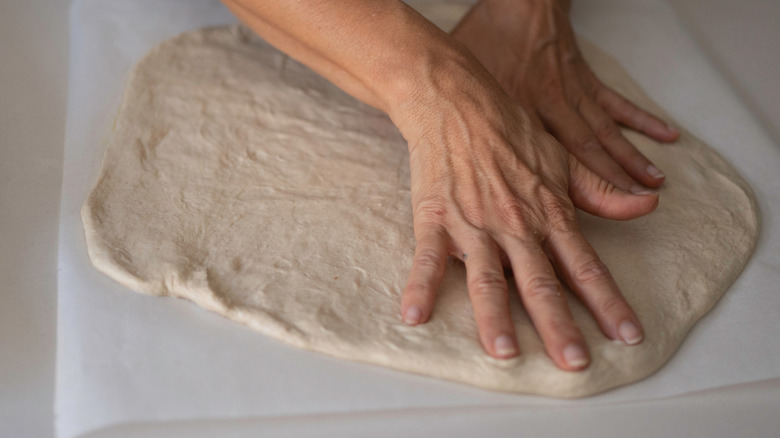
Fadam calls the dough-transfer stage "definitely one of the most stress-inducing parts of making pizza, if not the most stress-inducing part." His advice? "Focus and take your time. If you don't have a lot of experience, and you rush it, this is usually where things go wrong."
Patience and parchment paper together create a recipe for success. So, we asked Fadam if he also has any tips for working with parchment paper here. "I would recommend sticking to temperatures below 700 degrees Fahrenheit when using parchment paper," he says. "If you're working with temperatures higher than this, I would hope you are a little more experienced and can handle getting dough into the oven without parchment paper."
Temperature ranges themselves are crucial things to know when making your own pizza. Neapolitan- and New York-style pies typically bake between 500 and 650 degrees Fahrenheit, while deeper-dish Chicago- and Sicilian-style pizzas tend to cook at lower ranges, around 400 to 450 degrees. But if you're working with a wood-fired oven specifically, these can reach up to 1000 degrees. Brick and conventional ovens hover more around 550 to 700 degrees, meaning that if you're still on the less experienced side and figuring out your dough-moving and parchment-paper technique, you're better off sticking to these. Parchment paper is made to withstand cooking temperatures, but shouldn't be pushed much past 450 to 500 degrees. Use it to make your dough transfer smooth and easy, and tap back into that patience, baking it lower and slower for safe, tasty results.