

The Diet Coke Safety Myth You Should Stop Believing

Many people are familiar with the phrase "the dose makes the poison," a basic tenet of toxicology, which is the study of how chemicals, drugs, and other substances affect living systems (beyond just humans and animals). A proper recommended dose of Tylenol is generally harmless, but 50,000 milligrams of acetaminophen will likely do a lot of damage to your liver. The same is true for a wide array of controlled substances in our day-to-day lives, including ingredients in our food and drinks, such as aspartame — the sweetener used in Diet Coke, which has caused some to wonder if the popular soda is a risky refreshment to sip.
While aspartame has been identified a posing a possible cancer risk, studies have indicated that this is based on limited evidence and is not conclusive. In 2023, the Food and Agriculture Organization and the World Health Organization's JECFA (Joint Expert Committee on Food Additives) released a statement saying that "the evidence of an association between aspartame consumption and cancer in humans is not convincing," citing the need for better studies.
According to the American Cancer Society, the JECFA — which has evaluated aspartame in 1981, 2016, and, most recently, 2023 — states that the acceptable daily intake for aspartame is between 0 and 40 milligrams per kilogram of body weight for adults. The FDA is slightly more generous with its allowance, saying that consuming up to 50 milligrams of aspartame per kilogram of body weight per day is acceptable. With all this in mind, the aspartame content in Diet Coke is, well, pretty tame.
Moderation is key when it comes to aspartame
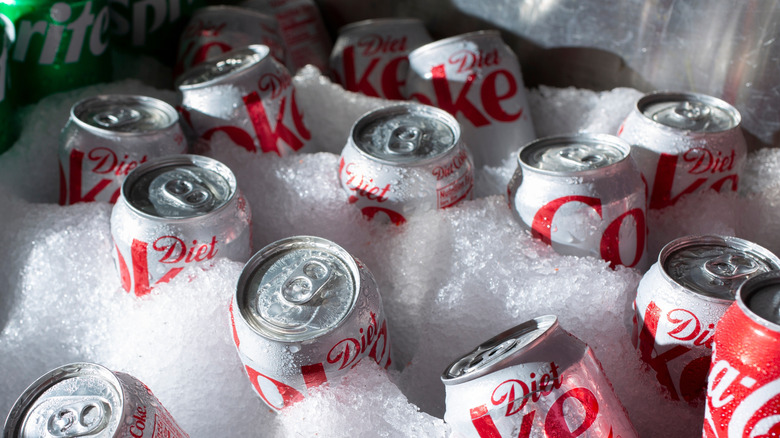
A 12-ounce can of Diet Coke contains less than 200 milligrams of aspartame. By World Health Organization standards, a 150-pound person would need to drink about 14 cans a day to hit the 40 milligram per kilogram of body weight threshold. So with aspartame, the dose does indeed make the poison, and having an occasional can of Diet Coke shouldn't worry you. As with many things in life, moderation is key. (On that note, when you're deciding between sodas, keep in mind that Diet Coke has more caffeine than regular Coke.)
One important disclaimer is that people with phenylketonuria (PKU), an inherited but rare disorder, should avoid all aspartame, even below the acceptable daily intake suggestions. Aspartame contains an amino acid called phenylalanine, that those with PKU have a difficult time metabolizing, which can result in brain damage and seizures.
Otherwise, it's thankfully widely believed that sodas with aspartame, like Diet Coke, can be safely enjoyed in moderation. The only time we firmly recommend avoiding diet sodas is when cooking with them, especially in slow-cooked pot roasts, when the real sugar from traditional sodas is essential.