

This Old-School BBQ Sauce-Like Condiment Seems To Have Vanished
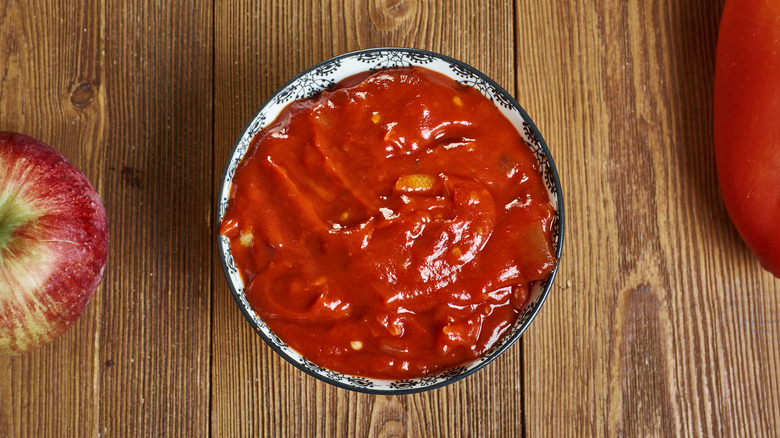
Unless you are South African or are particularly well-versed in old-school condiments, you're likely unaware of monkey sauce. Once you've tried it, however, you may be surprised that it hasn't already made a comeback.
First things first: Even the most cursory glance around the internet will reveal that virtually every account of monkey sauce –- known in South Africa, even more confusingly, as "monkey gland sauce" –- feels obliged to confirm that no, it does not contain actual monkey (do recipes for monkey bread need to offer this reassurance?). Rather, monkey sauce is a deceptively simple yet hugely adaptable accompaniment to meat, and no traditional South African braai (the local style of barbecue) is complete without it.
Monkey sauce did enjoy some popularity in the United States in the 1950s and 1960s. This is not surprising, as its flavor profile — a mixture of sweet and savory, spicy and piquant — is similar to many BBQ sauces. At its simplest, monkey sauce is a mixture of chutney, tomato ketchup, and Worcestershire sauce, though much like burger sauce or Thousand Island dressing, this commonly agreed upon base can be endlessly modified.
Its origins are unknown, with most accounts carrying a heavy hint of the apocryphal. One popular theory is that a chef created it to mock the supposedly unsophisticated South African palate by mixing together some pantry staples as a joke, but inadvertently produced an instant classic. Another enduring legend claims that the sauce was invented in London's Savoy Hotel and named for Dr. Serge Abrahamovitch Voronoff, a controversial scientist who experimented with using monkey glands to combat impotence.
Chutney is the key to monkey sauce's versatility
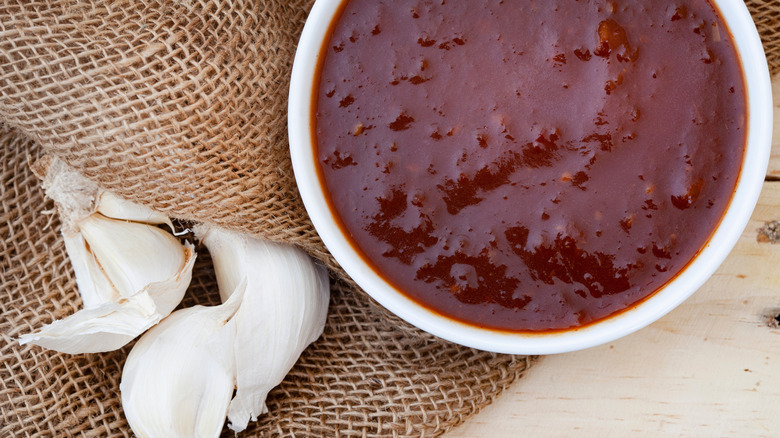
A quick monkey sauce can be as simple as mixing together ketchup, Worcestershire sauce, and chutney, whereas more complex versions allow the sauce to simmer and reduce. What's important to remember is that there is no single, authentic recipe for monkey sauce, so you should feel free to experiment until you find what works best.
Beyond the method of its preparation or any additional ingredients –- which can include onions, garlic, mustard, herbs, chili, chopped tomatoes, or red wine vinegar –- the key to monkey sauce's versatility is the chutney you use. Every devotee of monkey sauce will have their favorite, but whether you prefer the South African standard Mrs Balls or the British classic Branston pickle, your choice of chutney will allow for great control over how sharp, spicy, or fruity your sauce turns out. While monkey sauce is most often served with steaks or burgers, which are well complemented by its intensity and flavor, it can also be used on hot dogs, pork chops, or even a grilled cheese for a rare non-meat pairing. Whatever you pair it with, monkey sauce is one old-school condiment well worth rescuing from obscurity.