

I Made Spaghetti In Every Way Possible. One Way Reigns Supreme
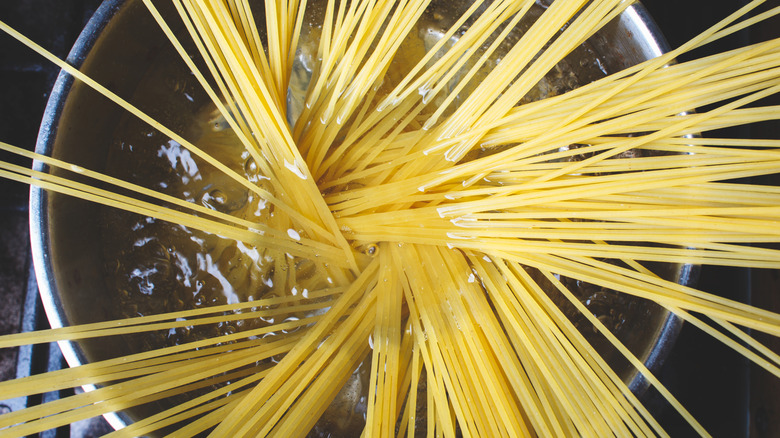
I've been a food writer for almost 30 years, so you can imagine how many times I've cooked spaghetti. Let's assume I've prepared pasta once per week — and I can assure you, I don't relegate pasta to once per week, I'm Italian — that equates to more than 1,560 instances. Over the last three decades, I've tried countless techniques for cooking the long, twisty noodles: I've boiled the strands in salted, unsalted, and olive oil-spiked water; I've gone old school and filled the pot with plain water; I've tried newer recommendations that suggest reducing how much water your put in your pasta pot so much that it barely covers the pasta; and I've also dabbled with the cold start method of cooking.
All the cooking methods above worked just fine — the pasta was always al dente and the starchy pasta water was nice to have on hand in case I wanted to stretch or loosen my sauce. But I found a completely different technique that worked much better: cooking my spaghetti directly in the sauce. It's practically the only way I cook my pasta now, yielding perfectly tender and ultra-flavorful pasta every time, with just one pan to clean.
Maybe not traditional, but this method is a game changer
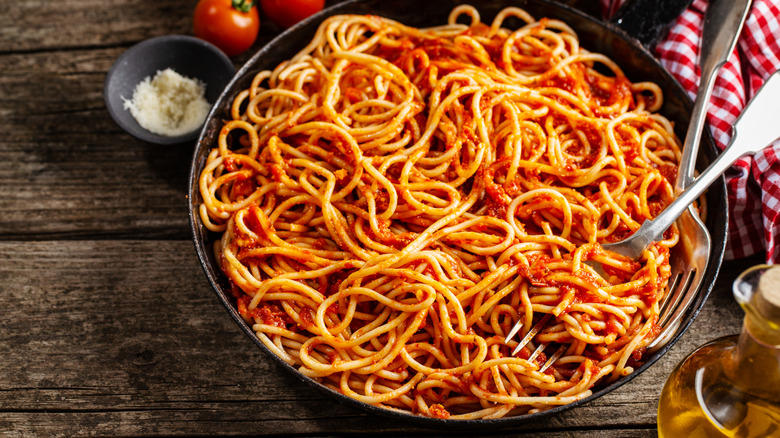
Rather than water, I cook my pasta directly in the sauce, whatever sauce or pasta noodle that may be. Cooking spaghetti in pasta sauce infuses each noodle with deep, rich flavor. Pasta releases starch as it cooks, so the sauce becomes extra creamy and luxurious. I've used this method with every conceivable pasta shape, from long, thin strands to wide ribbons, twists, tubes, elbows, bowties, and wagon wheels. Not surprisingly, it also works with soup pastas too.
The instructions for cooking your pasta directly in the sauce doesn't change much, but I do have some tips. For every pound of pasta, use 3 to 4 cups of sauce and 3 to 4 cups of liquid (I prefer broth but water also works). Combine the sauce and water or broth in a large saucepan, set the pan over medium-high heat, and bring the mixture to a high simmer. Then, add the pasta and cook until al dente, stirring frequently and adding more broth if needed to create a thick sauce.
Pasta cooked in sauce may take a few extra minutes to reach al dente, but the extra time is worth it. Even before you taste the noodles, you can tell they're different — they're vibrant in color and the whole dish is more cohesive, especially when compared to water-boiled noodles doused in sauce.