

8 Iconic Denver Dishes Everyone Should Try At Least Once
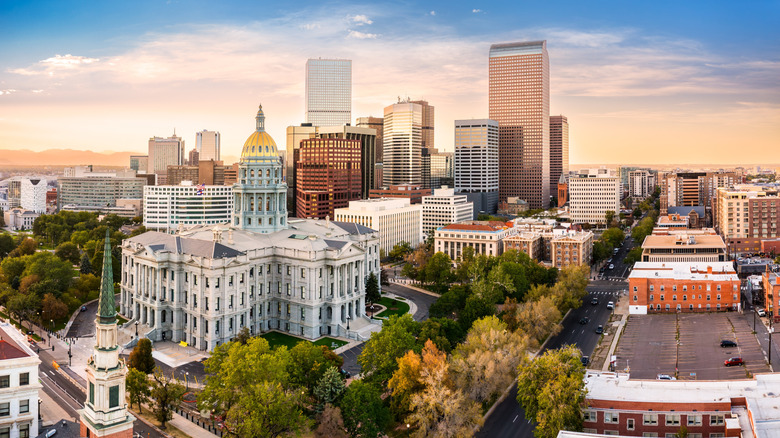
Many regions, states, and cities have food items that are highly specific to that area, and often held near and dear to their citizens' hearts. Some dishes are recognizable around the globe — Chicago deep dish, Philly cheesesteaks, and Louisiana gumbo are all great examples. On the flip side, countless hyper-regional plates are known mostly to locals and travelers who happen to pass through. It wouldn't be unreasonable for someone born and raised in California to be unfamiliar with the incredible Iowan Scotcheroo, or for a Hawaiian to be baffled when asked their thoughts on Boston brown bread. The food scene in Denver, Colorado, generally falls into the latter category.
People who've never lived or spent much time in Colorado may be hard-pressed if asked to think of "classic Denver dishes." The Denver omelet and green chile may come to mind, or perhaps the fabled Rocky Mountain oysters, but the Mile High City actually has plenty of lesser-known plates that deserve a moment in the spotlight. Several, like fried tacos and sugar steak, originated right in Denver and its surrounding suburbs. Others' roots stretch far away and, in some cases, date back centuries, but have become so intertwined with the city's culinary landscape and history that they're widely recognized as classic D-Town dishes.
Colorado's history and ties to the railroad and mining industries play a starring role in the story of some of Denver's most recognizable dishes, and the influence of the city's sizable Latino community is easily perceptible in its dining and home cooking scene. From the ordinary-but-tasty to the outright bizarre, soldier on to find out which iconic Denver dishes you need to try on your next visit.
Denver Omelet
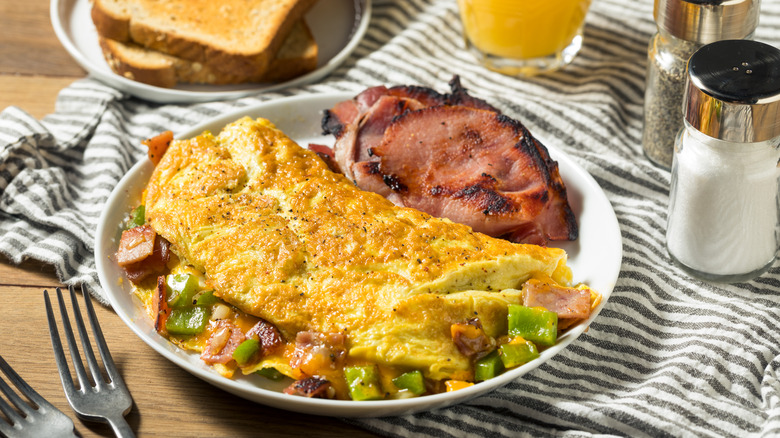
Due to its name and omnipresence on diner menus, the Denver Omelet (consisting of eggs, cheese, diced ham, green peppers for crunch, onions, and mushrooms) is perhaps the most recognizable "classic Denver" dish. This breakfast staple may be uncomplicated, but its origin is a fascinating, albeit murky, tale. Some swear the omelet was invented by a crafty pioneer woman who received a wagon shipment of rotten eggs and attempted to disguise the taste and smell by way of cheese, ham, and diced veggies — a whimsical story backed up by an actual plaque downtown. However, historians have put the kibosh on the legend, arguing that A) it's highly unlikely that green peppers were available in Colorado during this period, and B) no amount of meat, cheese, and vegetables could mask the nauseating odor of rotten eggs.
There are several other hypotheses on the dish's origin, but the most plausible postulation is that the Denver Omelet was actually inspired by Chinese cuisine. The Gold Rushand subsequent Colorado Silver Boom led to an unprecedented population explosion in the Centennial State and drew many underprivileged groups, including loads of Chinese migrants, to the area, many of whom found work in the railroad and mining industries. Egg foo young, an omelet made with eggs, ham, chopped protein (often pork or shrimp), and greens, was a popular meal for these workers. It's speculated that over the years, egg foo young evolved into the Denver Omelet.
We may never know the true story of the Denver Omelet, but the folklore surrounding this humble Denver staple sure is a delight.
Rocky Mountain oysters
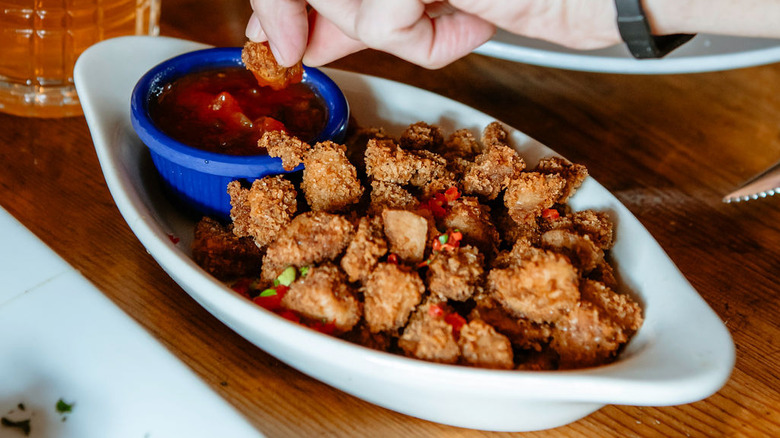
Mile High newbies might be surprised to find Rocky Mountain oysters on menus around town — that is, until they figure out where this classic Rockies dish comes from. A far cry from Kumamotos or Blue Points, Rocky Mountain oysters are actually deep-fried bull testicles. At first glance, cooking and consuming bull testes may sound disgusting at worst and kitschy at best. However, the practice stretches all the way back to ancient Rome, when animal genitalia were frequently consumed in an effort to reduce waste and, legend has it, believed to cure certain ailments and amplify virility.
Rocky Mountain oysters (also known as prairie oysters, cowboy caviar, lamb fries, and a host of other names) may not be native to the 5280, but through the years, they've definitely become a signature Denver dish. While not exactly common, Rocky Mountain oysters are easy to find in the area, particularly at restaurants such as The Fort and Buckhorn Exchange that lean into the schtick and sling novelty Colorado fare — you can even find them at Denver's Coors Field. Supposedly, the taste of prairie oysters is quite good. Upon trying a trio of "oysters" (lamb, bison, and cow), NPR's Luke Runyon reported that "they were surprisingly juicy ... the bison tasted like chicken. The lamb was similar in taste and texture. But the beef were in a league all their own, chewy and meaty and full of a unique flavor somewhere between liver and gizzard."
Mountain pie (Colorado-style pizza)
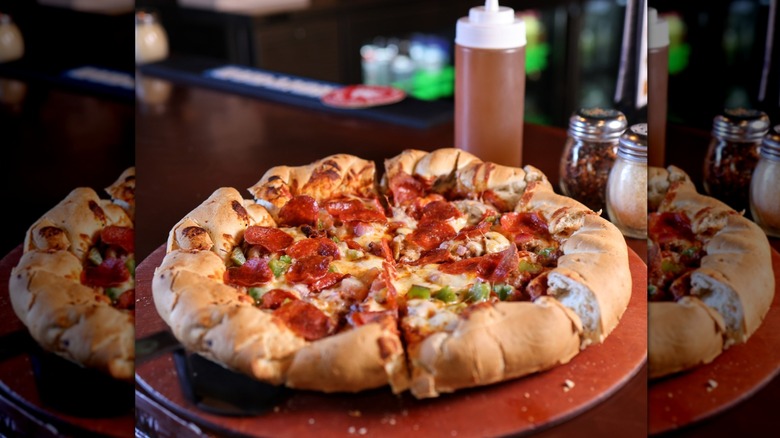
There are infinite regional variations of pizza, and each country, state, or city claims its pies reign supreme. Unlike places like New York or Chicago, Colorado is not generally lauded for its pizza scene; hop on any social media thread or group dedicated to Denver restaurants, and you'll be bombarded by transplants whining that there's no good pizza to be found. However, Colorado does have a signature pizza style, and it all goes back to Beau Jo's. The brainchild of Brooklyn-born and Minnesota-raised Chip Bair, Beau Jo's originated in the quiet mountain town of Idaho Springs, where Bair purchased a 15-seat pizza shack from owners Beau and Joanne (Beau and Jo) Foulk. Bair rebranded as Beau Jo's, elevated the ingredients, and invented the soon-to-be-Colorado-famous mountain pie in 1973. Today, the pizzeria boasts seven locations, including a Denver outpost.
Colorado-style pizza is unique in a number of ways: Its dough is made with honey rather than sugar (there's also a whole wheat version sweetened with agave), the edges are rolled by hand for a unique, plait-like crust, and drizzling the pizza and dunking the crusts in honey is basically a requirement. While a handful of restaurants around Colorado serve pizza in a similar style, Beau Jo's trademarked the term "Colorado-style pizza" in 2004. Regardless, if you crave the true mountain pie experience, Beau Jo's is a no-brainer.
Green chile
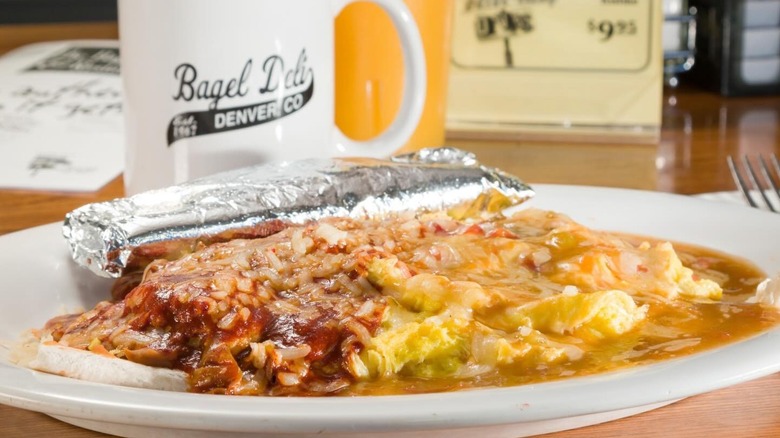
The differences between New Mexico and Colorado green chile are subtle yet noticeable to the trained palate. Both states' signature green chile recipes feature hot peppers as the headliner, but New Mexico New Mexico favors terroir-rich hatch chileswhile Colorado opts for bold, thicker-skinned, and far spicier (at 5,000-20,000 SHU) Pueblo chiles. Colorado- or Pueblo-style green chile recipes vary between families and restaurants, but generally include Pueblo green chiles as well as pork, chicken broth, flour, tomatoes, oil, aromatics, and salt. That said, the term "chile" — the preferred spelling for the dish, not just the hot peppers themselves, in Colorado — is a bit ambiguous.
Colorado green chile may be eaten as a sort of soup or stew right from the bowl, but the same stuff is often served as a dipping sauce for sandwiches, breakfast burritos (another Denver classic), and more. Hearty, spicy, and earthy green in color, Colorado green chile can be found on everything from breakfast cafe menus to high-end restaurants in Denver. You can kickstart your morning with a smothered breakfast burrito from Santiago's or warm your bones with a bowl of green chile after a day on the slopes. If you dig spicy, brothy soups, be sure to seek out green chile the next time you find yourself in Denver. You won't need to look far!
Mexican hamburger
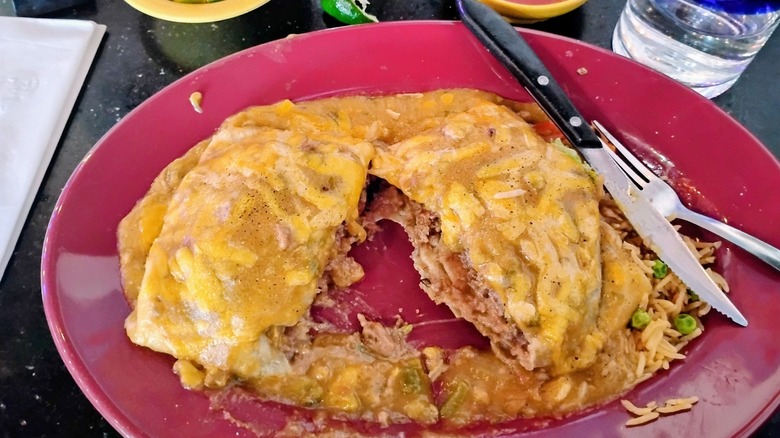
Denver is home to a reasonably large Latino population (around 28% of the greater Denver area), so it should come as no surprise that Mexican and other Central and South American foods are abundant. Most well-loved classics like enchiladas, chile rellenos, and pozole have roots south of the border, but there's one Mile High menu item that's uniquely Denver: the Mexican hamburger. This Frankensteinic mixtape consists of a grilled hamburger patty enveloped in a large, burrito-sized tortilla, the inside of which is spread with refried beans before the whole kit and caboodle is slathered with copious quantities of green chile and cheese. Lettuce, tomatoes, sour cream, and guacamole are often accompaniments.
There's some squabbling over the origin of the Mexican hamburger, but most lore leads back to the long-defunct Joe's Buffet. One popular speculation is that a waitress named Linda invented the dish, which subsequently made its way onto the menu at Chubby's (a Denver St landmark since 1967) when former Joe's customers demanded "Linda's Mexican Hamburger." While the burger-burrito hodgepodge isn't too common outside of the greater Denver area, you'll find this outrageously delicious heart attack on a plate at plenty of Mexican restaurants around town.
The Mexican hamburger may seem straightforward, but as longtime Westword columnist Gustavo Arellano explained, "that's what made the Mexican hamburger so brilliant: its simplicity, its utterly unremarkable nature, the effortless mixing of traditions, [including Mexican, American, and Den-Mex] ... the Mexican hamburger reaches every overblown food cliché one can imagine."
Fried tacos
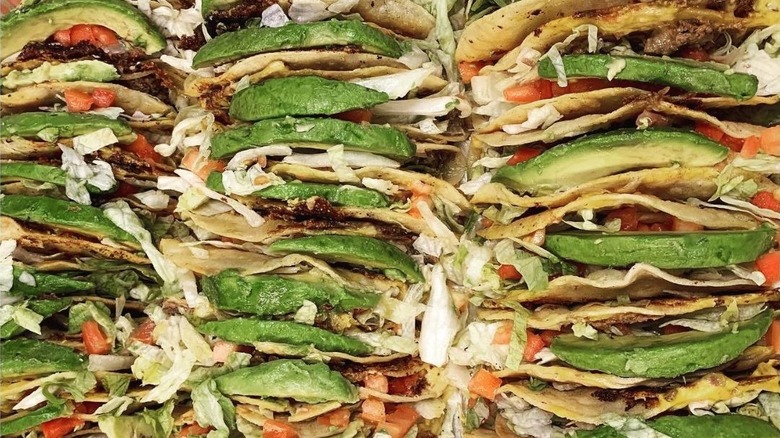
Speaking of Den-Mex, we can't talk about iconic Denver dishes without mentioning fried tacos, and the cream of the deep-fried crop can be found at one of the best Mexican restaurants in Colorado: Mexico City Restaurant and Lounge. The family-owned restaurant has occupied prime real estate on downtown Denver's storied Larimer Street since the 1960s and is, by all accounts, the home of the fried taco. By "fried tacos," we're not just talking about a crispy shell. Mexico City's famous fried tacos are built with a white corn tortilla, stuffed to the bursting point with cheese, loaded up with protein of choice (chicken, steak, shrimp, carnitas, beef, or beans), and finished with lettuce and tomatoes before being fried to the crispiest of crisps.
Third-generation owner Bob Muniz credits his uncle and grandfather, Mexico City Restaurant founder Willie Garcia, with fabricating this quintessential Denver grub. As Muniz told the Denver Gazette, "I think they came up with a way to make them faster, pre-make them with meat and cheese and fold them, slap them on the grill ... (American cheese) was probably the cheese that was cheaper at the time, or it melted better. But it worked." There are a handful of other restaurants peddling fried tacos around town, but for the real deal, a trip to the Ballpark neighborhood is necessary. Frequently touted as a hangover cure (with or without an ice-cold margarita), fried tacos at Mexico City are the best way to get ready for a Rockies game.
Sugar steak
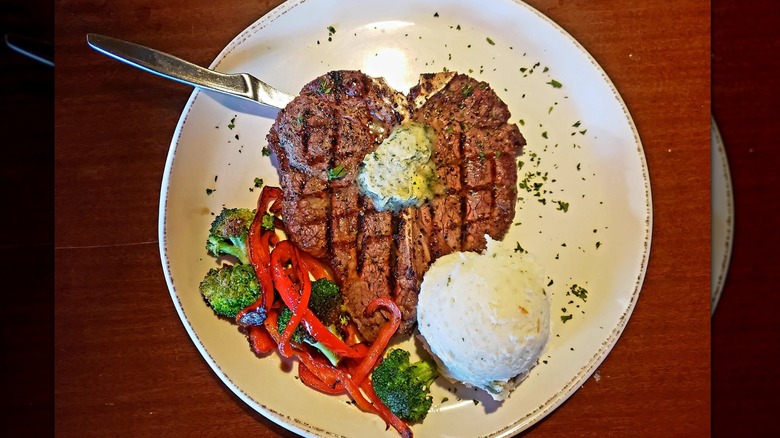
Marked by an unmissable retro, neon pink sign on East Colfax, family-owned Bastien's Restaurant has been one of Denver's best-loved steakhouses since 1958. From the old-school sunken bar to the bubbly wait staff to the delightfully unpretentious vibes, there's much to love about Bastien's, but its greatest contribution to Denver's culinary history is the sugar steak. Most people prefer to save their sweets for after a nice, big steak dinner. It seemingly makes sense — meat and potatoes for dinner, sugar for dessert — but why not both? That's the question Bastien's founders asked, and by God, did it pay off. It may sound like an odd combo, but preparing a steak with a sugar rub turns out to be both mouthwatering and scientifically effective.
Bastien's prepares its signature sugar steaks with a rub made from a mixture of sugar and undisclosed spices. This preparation style is available only for steaks cooked rare or medium-rare and strictly applied to marbled cuts like ribeyes and New York strips, which are the best cuts for sugar steak. While on the grill, the sugars in the rub begin to melt, and with the help of the fat from the steak, this results in a mind-blowing caramelized effect on the crust. The actual flavor of sugar on the beef is barely perceptible, and the additional spices lend even more brilliant nuance to the finished product. There are now restaurants outside of Denver capitalizing on the technique perfected by Bastien's, but there's no doubt that the roots of this iconic D-Town dish are firmly planted in the Mile High City.
Fool's Gold Loaf
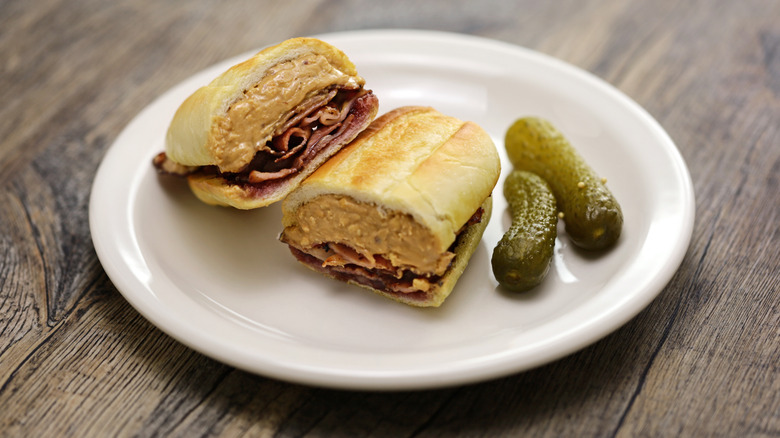
Elvis Presley, may he rest in peace, had some peccadillos that extended far beyond his bedazzled outfits and scandalous stage performances, one of which was an impressive appetite. His best-known culinary affinity was for a gargantuan sandwich cobbled together with an entire loaf of bread, a full pound of bacon, two tablespoons of margarine, and one whole jar each of peanut butter and Dickinson's blueberry jelly. The Brobdingnagian hoagie — officially christened the Fool's Gold Loaf — was suggested to the singer by a teenage cook at the long-closed Colorado Mine Company in the Denver suburb of Glendale. Nick Andurlakis, who recalls being 16 or 17 when he first met the King, is responsible for Elvis' beloved Fool's Gold Loaf. The Colorado Mine Company was a hotspot for celebrity clientele, and reportedly, Andurlakis first introduced Presley to the sandwich when the singer was in town for a show in 1976.
Recommending a peanut butter, jelly, butter, and bacon sandwich to a high-profile VIP is decidedly gutsy, but the gamble paid off — Elvis loved it so much that he flew his private jet to Denver and back in one night just to get the real-deal Fool's Gold Loaf for his daughter Lisa Marie's birthday. Andurlakis went on to open Nick's Cafe in Lakewood, where the Fool's Gold Loaf was a featured menu item, but unfortunately, the restaurant was shuttered in 2022. Still, it's relatively easy to find Elvis-inspired sandwiches and other delicacies on menus around Denver and beyond (though many commit the crime of adding bananas) or to whip up this colossal and iconic loaf at home.