

Here's Exactly How Many Onions You Need To Chop To Equal A Cup
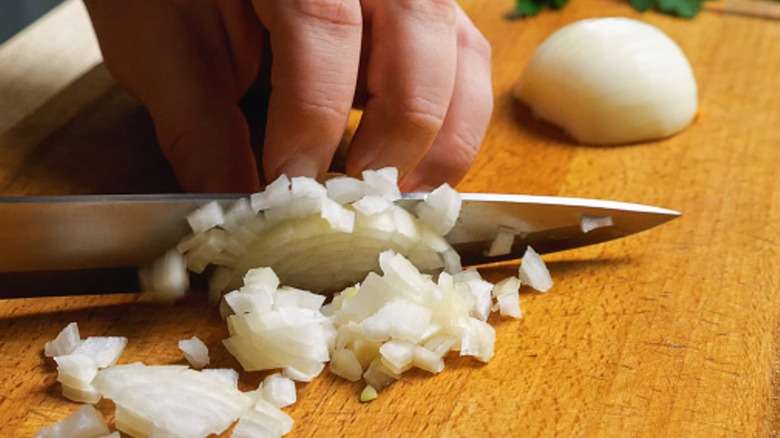
Onions are one of the most basic and versatile staples used in cooking. Whether raw, sauteed, grilled, roasted, caramelized, or fried, they impart their unique flavor in subtle and not-so-subtle ways in everything from French onion soup to Tennessee onions. But following a recipe that calls for these aromatic, allium bulbs (as many do), can certainly bring one to tears for more than one reason, like the fact that many recipes have less-than-stellar instructions. For example, if a recipe calls for 1 cup of chopped onions, do you know exactly how many onions you'll need to buy or ultimately, chop?
Often, you won't know until you get deep into your recipe's ingredient list, whether you'll need a specific volume or number of onions (sometimes with a size specification, but oftentimes — annoyingly — without). This leads to further confusion as small onions weigh around 6 ounces, medium about 8 ounces, and large roughly 16 ounces. While cooking doesn't require the precision of baking (for which some believe you should be weighing your ingredients), having a basic understanding of approximate onion quantity conversions is useful kitchen knowledge to have.
According to America's Test Kitchen, one medium-sized onion (think: tennis ball-sized), yields about 1 cup of chopped onions, which can range between smaller, finely chopped ¼-inch chunks to larger, roughly chopped 1-inch pieces. But what if the recipe calls for 1 cup of minced onions or even sliced ones? Does the one medium onion calculation hold true?
Onions minced, sliced, or diced — better think twice
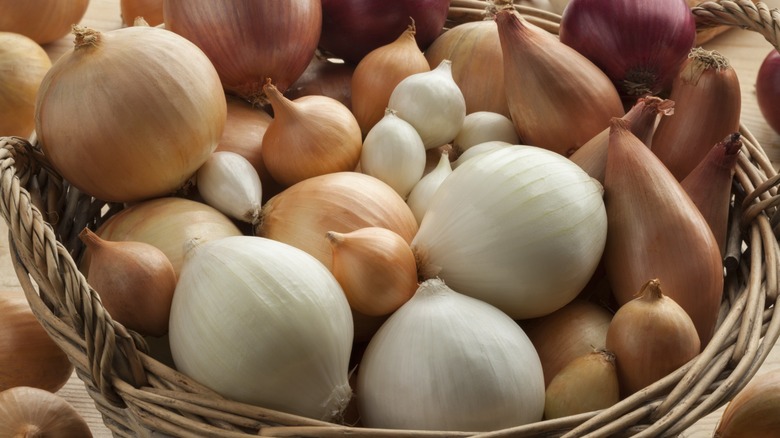
When it comes to measuring by volume, the weight or number of ingredients can vary. That's because volume is all about density. In the baking world, 1 cup of flour does not weigh the same as 1 cup of sugar. The same is true when it comes to the most popular types of onions. It matters how they're cut, because this alters how tightly they can fill the measuring cup. With larger pieces, like chopped onions, there's more space left in between, while preparations like dicing, slicing, or mincing produce smaller pieces that are more compact, leaving room for less space — hence, the need to add more to completely fill that cup or tablespoon.
Of course, just as with its pungent cousin, garlic, the amount of onions required can easily be adjusted, according to taste. And while this information may be useful to keep you in the general ballpark, a little more or a little less onion isn't likely to make or break your dish. However, it can help you gauge just how many onions you'll need to buy on your next trip to store, or figure out if you have enough on hand to make dinner without having to leave home for more.
Need ideas for what to do with your cup of onions? Try combining them with carrots and celery to prepare that savory trinity, mirepoix, for a delicious bowl of chicken soup. Or upgrade your next cheeseburger with these foolproof caramelized onions.