

Keep An Eye Out For This Seafood-Label Red Flag At The Grocery Store
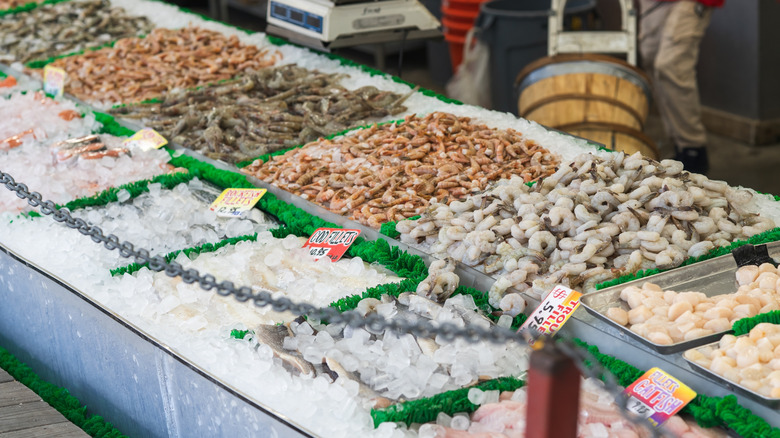
Seafood industry experts recently talked with us about red flags to help you avoid bad seafood. These include an off smell and color, price that doesn't seem right, unsanitary displays, and a lack of meaningful certification. They also highlighted that seafood might have additives you'll want to watch out for on the label.
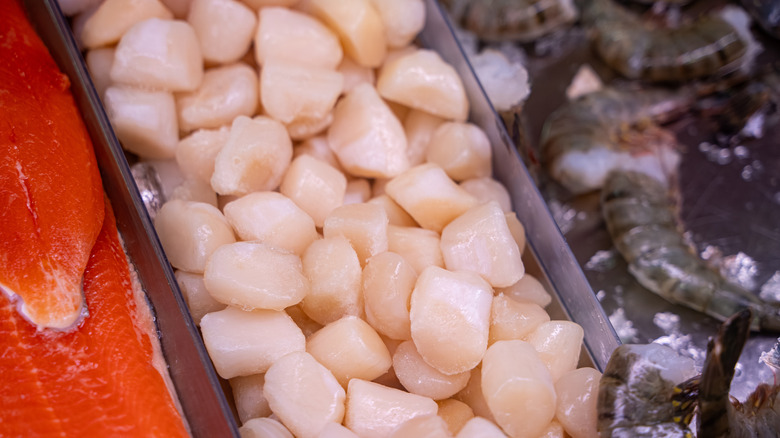
Knowing what additives to look for can keep you from eating chemicals you might be sensitive to, and it can even save you money. Take phosphates in scallops for instance. "'Wet' or 'juiced' scallops are a racket," Will Plamondon, director of wholesale operations at Chicago's The Fish Guy, told us. "They've been soaked in phosphates to retain water, so you're paying $25 a pound for tap water." We'll get more into phosphates in a bit.
Keep in mind that some seafood labels may be incomplete, or even falsified. Mislabeling is unfortunately widespread in the seafood industry. Shopping with a reputable fishmonger is one of your best defenses against seafood fraud as is checking the label for an Aquaculture Stewardship Council, Marine Stewardship Council, or Best Aquaculture Practices certification. It's also common for fish or shellfish to not have a complete label if they're kept on ice in a display counter. A knowledgeable fish seller will be able to fill you in on the additives that were on the original packaging before the seafood went into the display case.
Water, water everywhere
With that in mind, let's dive deeper into additives so you'll feel more confident next time you're looking to buy fresh fish and shellfish.
The marine food chain lives in water, so it might come as a surprise that the seafood industry has a long history of adding water to products. Methods for increasing water — often in a brine solution — in fish often include direct injection with needles, tumbling, or glazing with a layer of ice. Added or retained water generally should be declared on the label, but fraudsters add water and don't report it to boost their profits in seafood sold by weight. That leaves customers with a product that loses lots of water upon cooking and has been described as looking like it's been power washed.
Often water added to seafood contains phosphates, commonly a food-grade preservative called sodium tripolyphosphate (STPP) that helps ward of freezer burn. In many cases, phosphates are fine, improve texture and taste, and lengthen shelf life. But phosphates can also be used to beef up profits by retaining water. While phosphates are essential nutrients for humans, excess amounts may adversely affect your bones, kidneys, and heart, and can be particularly problematic for people with chronic kidney disease. STPP can also leave a soapy taste in your mouth.
Bubble gum tuna
Monosodium glutamate, more commonly known as MSG, is often added to seafood to add umami. Thinking MSG is always bad is one of those iconic food myths, although some people have reported sensitivities to the additive. Yeast extracts are also used in seafood for umami and act as a sodium reducer because they're an alternative to MSG. They also add protein and vitamins.
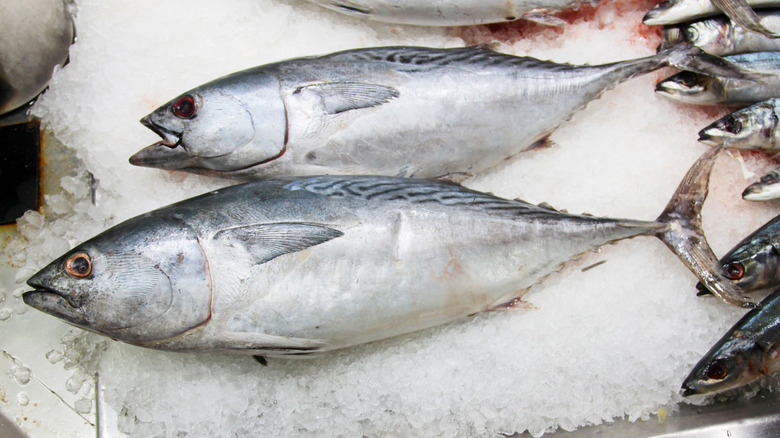
Another common additive, at least in the United States, is carbon monoxide. It's used as a color preservative. CO is controversial and has been banned in some other countries because it keeps the fish flesh pink even as freshness deteriorates. Stateside, carbon monoxide must be declared on the label, but enforcement varies. You might also see something about color not necessarily being an indicator of freshness. If tuna is more bubble gum or watermelon pink than maroon, it may be treated with CO. In these cases, rely more on use-by dates than what the fish looks like.
All of these additives are classified as "generally recognized as safe" by the U.S. Food and Drug Administration. That means they've been vetted by experts and shown to be adequately safe for their intended use. But some critics of the GRAS system say the designation isn't enough because companies can self-declare their additives safe to avoid government review before going to market.