

6 Iconic Dishes Popularized By NYC's Legendary Delmonico's Steakhouse
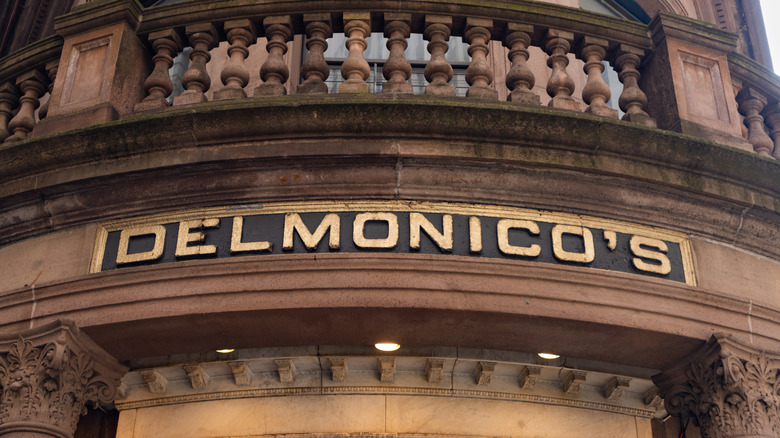
There was a time when the simple act of going to a restaurant, sitting down with your loved ones, and ordering off a menu was a novelty experience in the United States. But Delmonico's — the New York City-based restaurant that first opened in the 1830s — changed the game. In fact, Delmonico's, founded by Swiss-Italian brothers Giovanni and Pietro Delmonico, was the first modern restaurant in the U.S. And with the help of French chef de cuisine Charles Ranhofer, it pioneered the fine dining scene in many ways.
For one thing, having the option to choose and order from a list of individually priced dishes (as patrons could do at Delmonico's) was a new and exciting concept at that time. But the restaurant didn't just offer menus with well-known items; it also allegedly created some of the most famous dishes in the U.S.
While Delmonico's has had a tumultuous history — closing and reopening several times in various different places over the course of the 19th century — it's still operating under the Delmonico's name in the 2020s. Even if it's no longer run by the Delmonico family, it's still serving up many of its original dishes. From lobster Newberg to eggs Benedict to chicken a la Keene, keep reading to find out more about some of the most iconic dishes made popular by this legendary New York steakhouse.
Lobster Newberg
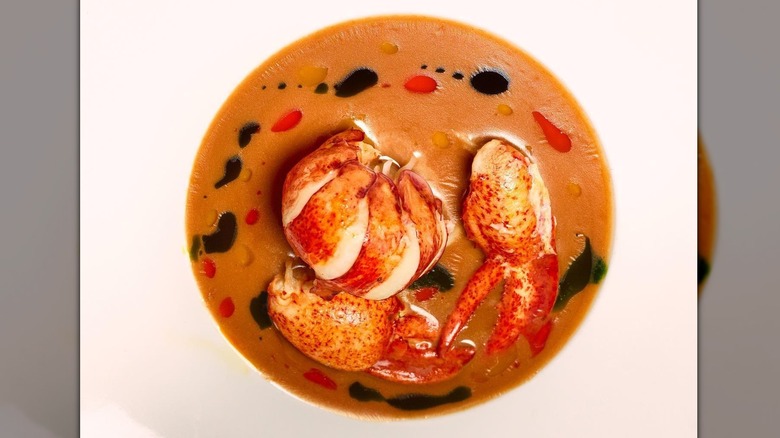
If you like the sound of tender lobster meat slathered in a sauce that's rich, creamy, and boozy, then there's a good chance you'll enjoy lobster Newburg. The dish is elegant and sophisticated, and it's versatile, too; it can be served with everything from risotto to brioche toast to caviar. Given its decadence, you probably won't be surprised to learn it originated in the fine dining scene at Delmonico's.
Lobster wasn't always a rich person's food. Before the latter part of the 19th century, it was commonly eaten by poorer communities, who would gather up the shellfish from the shores of New England. But in the late 1800s, with the rise of tourism to Maine and food transportation, everything started to change. The hospitality industry took note of lobster's growing popularity with the upper classes.
In 1876, Delmonico's added lobster Newberg to the menu, after one loyal customer, a sea captain called Ben Wenberg, showed Charles Ranhofer how to make it. It was originally called lobster a la Wenberg in honor of the captain, but the name was changed to Newberg after Wenberg fell out with Charles Delmonico. This is one common theory about lobster Newberg's invention, but it's not the only one. Others believe it originated at a hotel in Milford, Pennsylvania, which was run by a former Delmonico's chef, called Louis Fauchere. Either way, the dish was a Delmonico's hit — it's still on the menu today.
Baked Alaska
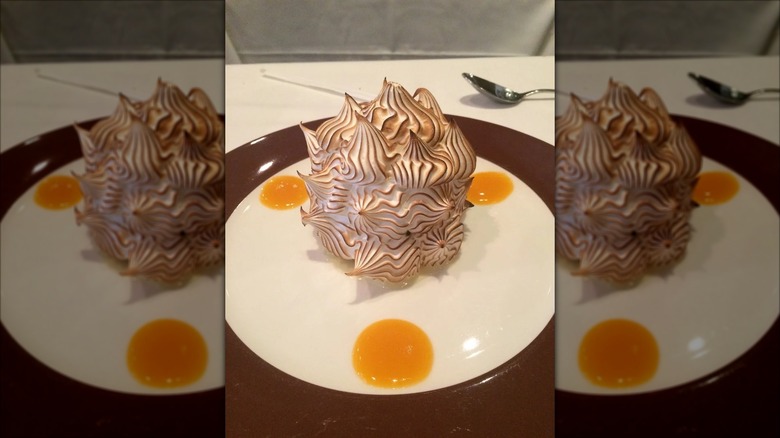
Delmonico's pioneered baked Alaska. It was likely served at the New York fine dining hotspot for the first time in 1867, made with meringue, banana ice cream, and apricot jam. By the 1880s, Charles Ranhofer was serving the meringue hot to contradict the cold ice cream. He called it Alaska, Florida, which many experts believe was likely for the simple reason that one has a cold climate and the other is notoriously warm. There are other theories behind the name, though. Plenty believe it was named in honor of the Alaska purchase (when the U.S. acquired Alaska from Russia), which also took place in 1867.
Delmonico's might have put baked Alaska on the culinary map (many still flock to the restaurant to try it today), but Ranhofer did not actually invent the concept behind the dessert. There is a lot of evidence to suggest that dishes similar to the baked Alaska were around before the 1860s. In 1804, for example, U.S. physicist Benjamin Thompson Rumford created omelet surprise, which is basically identical to baked Alaska in all but name.
Delmonico steak
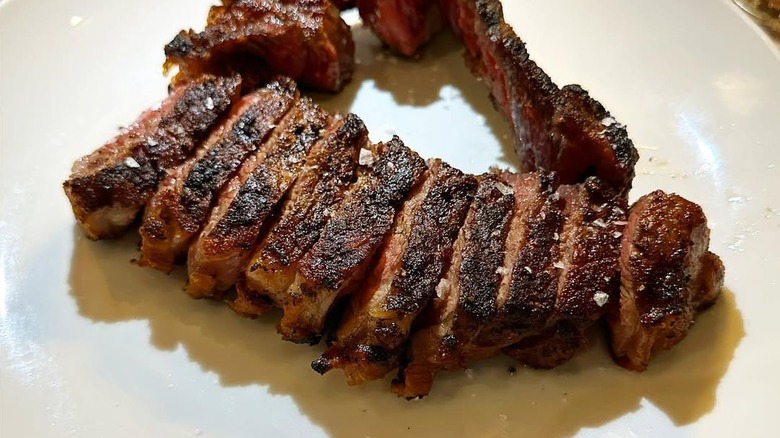
The clue is in the name, but there would be no Delmonico steak without Delmonico's. The fine dining restaurant probably served the famous cut of meat for the first time in the 1840s, and while there is no precise record of exactly how it was prepared back then, most agree it was large, thick, marbled, and incredibly tender.
You'll find several steaks on the modern Delmoncio's menu, including the Signature Delmonico Ribeye and the Delmonico Eye. In fact, Delmonico's claims that if you want authentic Delmonico steak, you have to go to its original restaurant in New York. There, it claims you'll find the steak prepared to the original (and seemingly secret) specifications and recipe.
That said, if you head to your local butcher and ask for a Delmonico steak, they'll likely give you their best-quality thick cut with lots of marbling. You can then take it home to prepare it from scratch, as there are plenty of Delmonico's copycat recipes floating around in Google search results. They're not authentic, but they are cheaper.
Eggs benedict
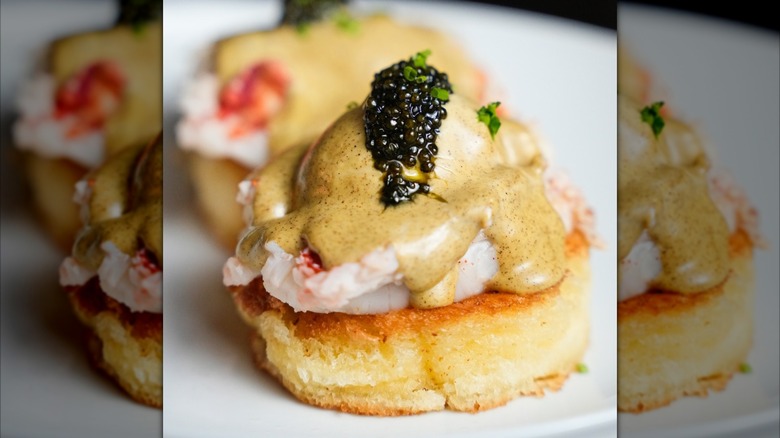
Delmonico's in New York credits Charles Ranhofer with creating many of its most famous dishes. But you might be surprised to learn that among them is the popular brunch dish, eggs Benedict. The story goes that back in the 1860s, Ranhofer created the dish to please a picky customer called Mrs. LeGrand Benedict. He then published the recipe for browned muffins, cooked ham, poached eggs, and hollandaise in his 1894 cookbook, "The Epicurean," and named it eggs a la Benedick.
But as is so often the case with Delmonico's dishes (and much of food history, to be honest), there is some debate over this origin story of eggs Benedict. Another theory claims that the popular egg dish was actually created by a Wall Street broker named Lemuel Benedict, who requested a chef at the Waldorf Hotel make it for him in 1894.
Regardless of whether Delmonico's actually invented eggs Benedict, the truth remains that many reviewers believe the restaurant is one of the best places to find the dish today. Every weekend, you'll find it served on Delmonico's dinner and brunch menus. At the time of writing, you can either order the classic original version, or opt for the royal eggs Benedict, which comes with a poached duck egg, king crab and lobster terrine, and is topped with caviar.
Chicken à la Keene
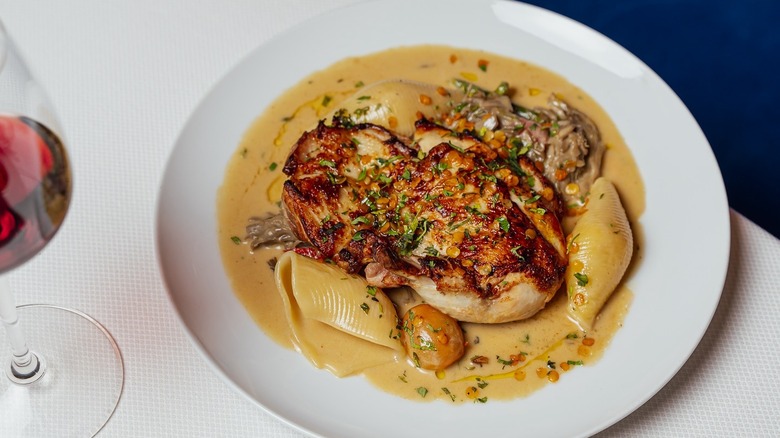
Many people who grew up in the 1950s and 1960s remember eating chicken a la king. The dish was at peak popularity during these decades, and would often be prepared at home with ingredients like canned soup and a side of peas and carrots. But, according to Delmonico's, the dish has fine dining roots.
One origin story claims that Charles Ranhofer created an early version of chicken a la king, called chicken a la Keene, for a customer called James R. Keene in the 1880s. That version is still on the menu today, and features either chicken (or plant-based protein) with English peas, cherry tomatoes, asparagus, piquillo, and sherry sauce.
But (surprise, surprise) there is more than one theory about who, exactly, invented chicken a la king (or chicken a la Keene). Claridge Hotel in London has also laid claim to the same dish, and so has Brighton Beach Hotel in New York.
Wedge salad
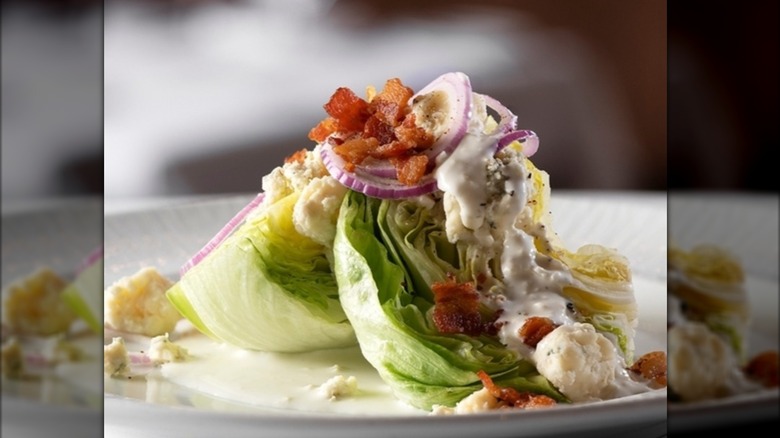
You'll find a wedge salad on most restaurant menus in the 21st century. When it's made well, the dish — which often consists of crisp lettuce, creamy dressing, bacon, and blue cheese — is flavorful, juicy, and satisfying. It's the perfect side or starter, but it holds up well as a main, too. You guessed it: We (might) have Delmonico's to thank for the classic, timeless wedge salad.
According to one origin story, Oscar Tucci (who purchased Delmonico's in the 1920s after it closed down amid prohibition) served the wedge salad at Delmonico's for the first time in the 1930s. His version, which his descendants claim is the original, was made with iceberg lettuce, tomatoes, crispy bacon, and blue cheese dressing. Unlike many other Delmonico's famous dishes, it wasn't for a particular customer, but because lettuce and tomatoes were the main ingredients available at the farmer's market on the day he decided to make it.
That said, many historians believe that the dish likely evolved over time, and was the result of many different similar recipes. There is also evidence to suggest that cookery editor Marion Harris Neil came up with the wedge salad, as a recipe appears in her 1916 cookbook "Salads, Sandwiches and Chafing Dish Recipes." But again, regardless of where it originated, the truth remains that the wedge salad remains a staple at Delmonico's. The menu even lists the option as Oscar's Wedge Salad.