

Why You Should Always Let Food Rest After The Microwave
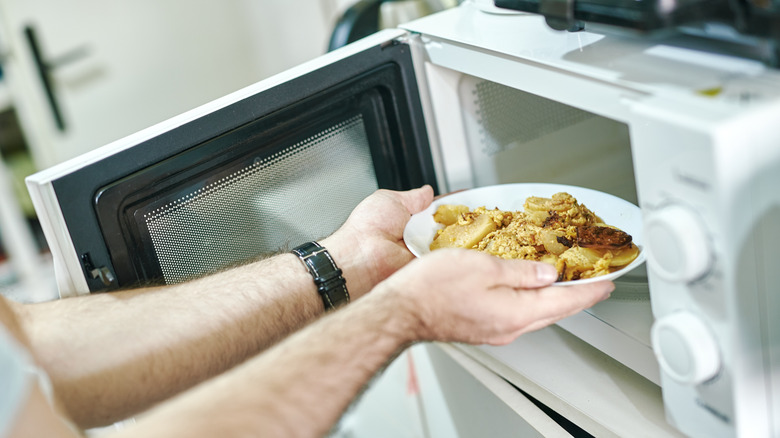
You've probably noticed how a bowl of soup heats differently than a burrito just like a frozen dinner reheats differently than leftovers pulled straight from the fridge. This is because, on a fundamental, scientific level, microwaves don't work the same as ovens or stovetops. Because of this, resting microwaved food is crucial. Instead of heating the air around food or heating the pot from below, microwaves excite water molecules inside the food. Those molecules vibrate rapidly and thus generate heat, but this process isn't uniform. Even if your microwave has a turntable, it can only heat about one-and-a-half inches deep, so it doesn't penetrate food completely evenly. This is especially true for dense or irregularly shaped portions. Areas with more moisture heat faster, leaving drier or denser parts out in the cold. Differences in container material and food composition all affect how energy is absorbed and heat is distributed to varying degrees.
When you take food out of the microwave, the heating process hasn't fully resolved itself yet. Heat continues moving from hotter areas into cooler ones, a process driven by basic heat transfer. This post-microwave moment is sometimes called resting, standing time, or carry-over cooking. Nothing especially mystical is happening; the energy has already been delivered, it just continues distributing after removal from the heat source as temperatures even out on their own. Stirring your leftovers can speed up this distribution, which is why many microwave instructions suggest stirring halfway through and again after heating. But even stirred food benefits from a short rest. Without it, you're left judging doneness by surface heat, which can be misleading. That's how you end up with food that feels scorching outside but underdone in the middle.
Hot and cold microwaved food
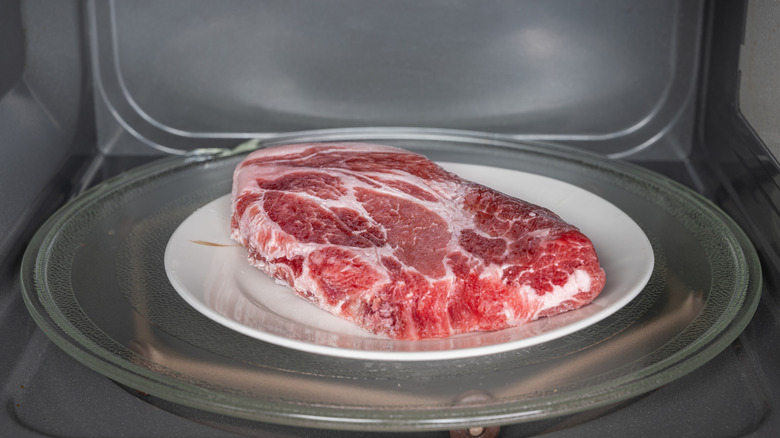
Letting food rest after microwaving is also a food safety issue. Standing time allows temperatures to equalize throughout the food, reducing cold spots where bacteria can survive. This makes it especially important for leftovers, frozen meals, meats, casseroles, and anything thick or tightly packed. You want the heat to have fully penetrated every element of your meal, nuking any potential bacteria colonies. If you're at all unsure, you can always use a thermometer to measure the internal temperature of your meal when standing time has completed; all leftovers should come to at least 165 degrees Fahrenheit, according to U.S. Department of Agriculture (USDA) guidelines.
When food rests, the heat continues moving inward, raising the temperature of cooler areas while slightly lowering overheated ones. This balance makes food safer to eat and more pleasant to handle. Without resting, many try to compensate by overheating their food, which truly does "nuke" it. In the end, this results in dried-out edges as the meal's center struggles to catch up.
Let microwaved food rest for at least one to three minutes, longer for large portions. If the instructions mention standing time, follow them. Stir whenever possible, then cover loosely and wait. That brief pause may save you from reheating the same dish twice. Microwaves are efficient tools, but they demand a little patience — that's where these microwave tips and tricks come in. Just remember, skipping the resting period doesn't make eating faster; it usually just makes it a worse experience overall. Taking a minute to let food settle finishes the job the microwave started.