

The Alarming Prices Of Groceries In Rural Alaska — And Why They're So Expensive

Many households across America have been struggling with their grocery bills due to inflation that hit the global markets after the COVID-19 pandemic, but for families in Alaska, especially in rural communities, the prices of basic goods have reached alarming heights. Alongside inflation, the main issue for the climbing prices is Alaska's distance from the rest of the U.S., which influences the cost of transport that's required to deliver the supplies.
Given that Alaska is a non-contiguous state, any trucks delivering grocery stock have to first cross Canada before reaching Alaska, which requires a very valuable resource: time. According to Alaska Beacon, "It takes around 40 hours of nonstop driving to cover the more than 2,200 highway miles from Seattle to Fairbanks" on the Alaska Highway. That's why a fairly small percentage of the state's food comes in on the road. For the most part, groceries are shipped in on barges and are then flown to more remote areas, since "82% of the state's communities are not reachable by road," per Alaska Beacon. As such, even takeout in Alaska is sometimes delivered by plane.
Planes, trucks, and boats all cost money, but they are also all vulnerable to extreme weather conditions, which are not uncommon in Alaska. Sometimes local stores are unable to restock basic staples like bread and milk for several weeks, so Alaskans struggle with high food insecurity.
How much do groceries cost in Alaska?
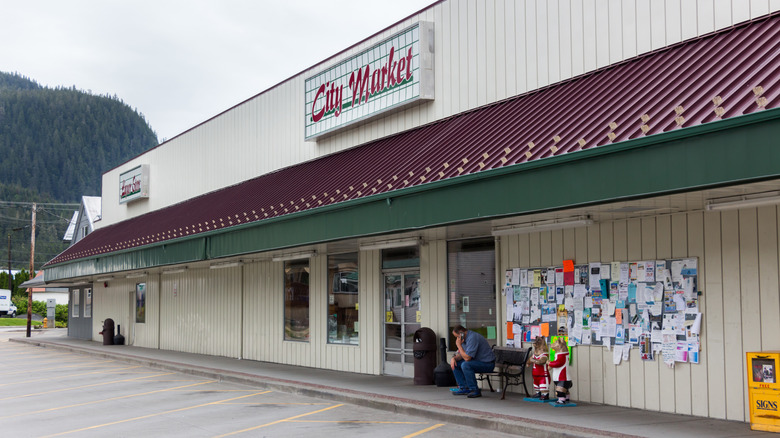
Groceries in Alaska cost significantly more than in the rest of the U.S., but even within the state itself, the prices vary based on remoteness. You'll find that prices of the same items can double or even triple, depending on how inaccessible a certain area is. The New Republic reported that prices in Unalakleet, a remote village that's only accessible by plane, can be up to 80% higher than in Anchorage, Alaska's most populated city. For example, the outlet cited Campbell's Tomato Soup costing $1.69 in Anchorage and $4.25 in Unalakleet. Even more staggering is the price of apple juice: $3.29 in the city, $10.65 in the village. Such prices might make our jaw drop, but they're a daily reality for many Alaskans.
As one resident shared on TikTok, butter in his local store costs $8 per pound — almost twice the national average. Fresh produce is even more expensive, with bananas going for $3 a pound, approximately five times the national average. It's therefore not surprising that most of the people who live in Alaska have learned to rely on nature to survive.
Subsistence living has great importance for many communities. They hunt their own meat, forage for plants, and nurture their deep cultural connection to sourdough. For rural Alaskans, living off the land is a deep philosophy that embraces connection with nature and hones the survival knowledge that's passed down through generations — including how to make Alaska's traditional akutaq ice cream.