

How A Slice Relates To The Subway: NYC's Long-Standing 'Pizza Principle' Explained
On December 31, 2025, New York's MTA system said "so long" to its iconic yellow MetroCards. Tap-and-go fare technology is usurping paper cards — the fiercely protected wallet fixture and symbol of the "I am a New Yorker" title that millions of stubborn passengers protect just as fiercely. Now, instead of singing "My, My MetroCard," New Yorkers are (apparently) singing "My, my $3 single-ride subway fare." NYC subway fare jumped up to a record-high $3 on January 4, and it's a grim figure for pizza-lovers.
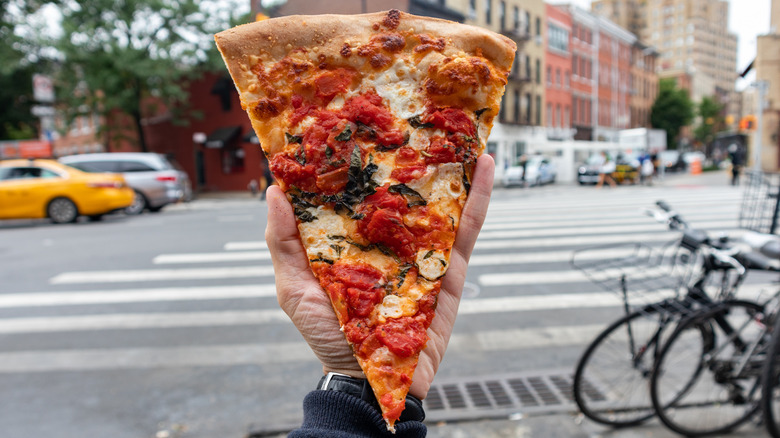
The "Pizza Principle" is an unofficial, decades-old metric for gauging the cost of living in New York City. Per the principle, a slice and a single ride on public transit clock in around the same price. But, in recent years, breakneck inflation has outpaced even America's most hustle-and-bustle metropolis. Woe to foodies in all five boroughs, as the average price-per-slice has disproportionately surpassed subway fare.
The previous most recent fare increase, a raise from $2.75 to $2.90, took place in 2023. In light of the jump to $3, however, it looks like the Pizza Principle is once again restoring parity and catching up with the rate of food inflation. (Balance can be a bad thing sometimes, we guess?) While subway fare and pizza are still not equal in 2026, they're getting closer, which means a lot more than a couple cents for inflation and life in NYC.
A single subway ride and a slice have cost roughly the same price over the decades
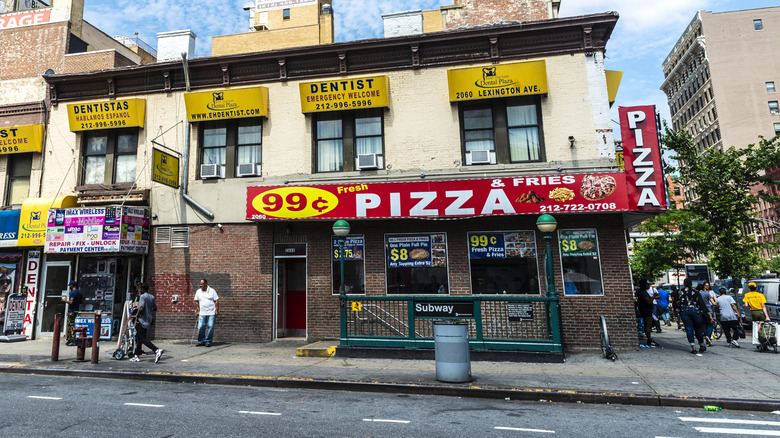
As a standalone figure, $0.10 may seem like chump change, but those precious cents are indicative of a larger and much costlier trend for the daily cost of living in The City That Never Sleeps. The principle is all about contextualizing inflation in light of the average cost of a pizza slice — which currently sits at $3.81, according to a study by intrepid freelance journalist Liam Quigley of Gothamist, who tracked the price of a New York slice over the course of eight years. Roughly a decade ago, in 2014, a slice cost about $2.54, not a far cry from the then-fare of $2.50 (Pizza Principle prevails). Much earlier, in 1973 (per the study), the average slice cost $0.30, matching the fare at $0.35. Even when subway fare jumped to $0.90 in 1984, a 257% increase in a decade's time, pizza prices increased correspondingly.
Fast forward to 2026, however, and the story becomes different. Even the once-sacred institution of the dollar slice hit a new average of $1.50 last year, as reported by the New York Post. The gradual extinction of a hot, foldable, affordable slice is more than just a recession indicator, it's a harbinger of unstable food prices and an end to democratizing food access. Now, the Pizza Principle's function may not be its contemporary accuracy, but its nostalgia factor ("I miss the old New York," or whatever...).
2026 inflation is pushing the Pizza Principle into the past
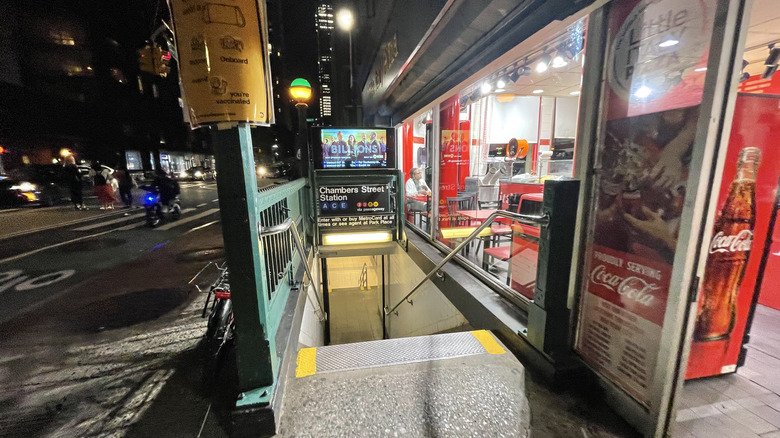
So, what does this mean in light of the $3 fare spike? Is it an ethical "attaboy" for the MTA, a nod to its work at keeping fares down as inflation rages? After all, NYC restaurateurs operating on razor-thin margins have less leverage in the fight against food inflation, as turning a profit is the only way to keep the lights on. Pizzaiolos citywide combat rent, labor, and supply costs for an economic ripple effect that doesn't necessarily apply to the MTA's daily operations. Although, a 1985 New York Times article titled "If You Understand Pizza, You Understand Subway Fares" argues that, under the Pizza Principle, New York City public transit and slice prices operate somewhat independently of the broader national economic climate: 'The transit token has no relationship to capital costs, union contracts, passenger miles, or depreciation schedules. Forget all that [...] Where, today, in 1984, can you get a decent slice of pizza in New York for 75 cents?"
As a rule, the subway doesn't get cheaper, and it doesn't look like pizza prices are going to drop any time soon, either. According to the Congressional Budget Office, "[B]y the end of 2023 [inflation] remained higher than before the pandemic," and another 2025 report by the Federal Reserve addresses the "post-pandemic U.S. inflation surge" and "the stability of longer-term inflation expectations." New Yorkers shouldn't expect to resuscitate the Pizza Principle with that brute willpower for which they're so famous.