

The Reason Behind Raw Milk Bans In Many Countries
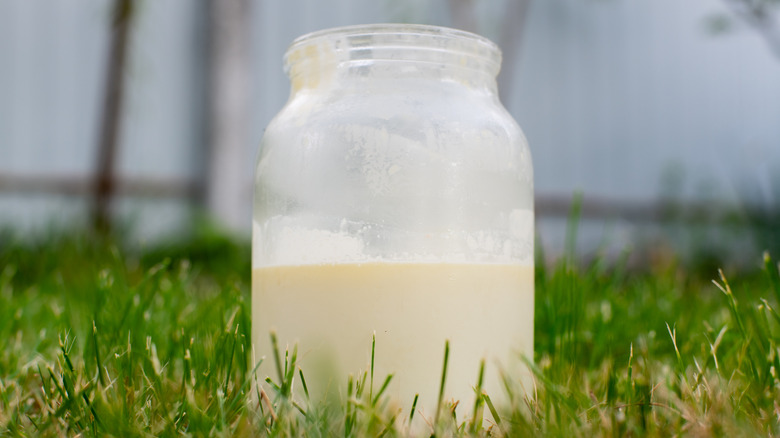
Raw milk is considered a gourmet food item as often as it's considered an outlaw. Food bans are far from rare — after all, even Corn Flakes are banned in some countries — but what's the big deal with non-homogenized dairy? Where raw milk is concerned, the issue is not one of product branding but one of consumer safety, as raw milk isn't pasteurized. Pasteurization kills harmful bacteria that can cause food-borne illness, including Campylobacter, E. coli, Listeria, and Salmonella. During the pasteurization process, milk is heated to a temperature high enough to neutralize dangerous pathogens and held at that temperature long enough to get the job done (ultra-pasteurized milk is heated to an even higher temperature). Without pasteurization, disease-causing microorganisms can enter raw milk and multiply.
For this reason, raw milk has a contentious legal status that varies from one country to the next. As of 2024, federal legislation has banned the sale of raw milk in Canada, China, and Scotland, while other countries still allow certain retail channels to endure. Brazil, for instance, permits raw milk sales in areas without steady access to pasteurized milk, and in Japan, farms that agree to random hygiene checks may sell it. Some foodies simply prefer raw milk's unique taste and mouthfeel to commercial pasteurized milk. According to Brown University Health, however, raw milk — despite its purported dietary benefits — has not been proven to cure lactose intolerance, prevent allergens, nor offer probiotics that can't be obtained from other foods.
Many federal governments outlaw the sale of unpasteurized milk
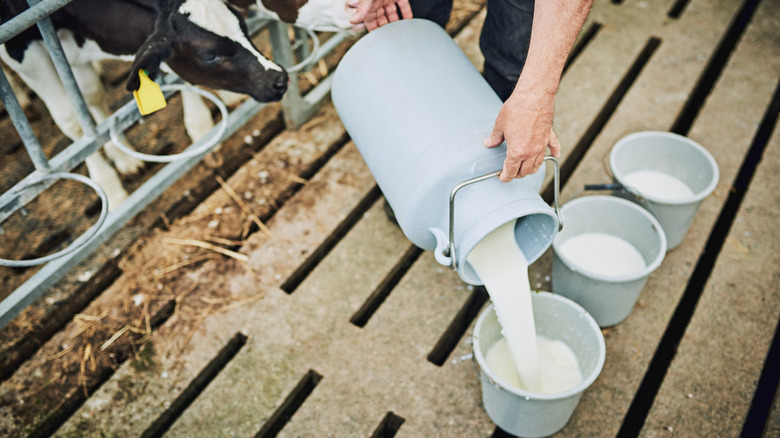
France, Italy, Germany, and parts of the U.K. (including Wales and Northern Ireland) have developed multiple controlled avenues for the retail sale of raw milk. Meanwhile, other federal governments have banned its sale due to past instances of harm. In 2015, for instance, the Australian state of Victoria broadened its raw milk restrictions to encompass cosmetic uses and human consumption after one child died and multiple others were hospitalized from ingesting bath water infused with a raw "bath milk" product. Still, exact restrictions vary between localities. In New South Wales Australia, as part of the Food Act of 2003, the sale of unpasteurized goat milk is legal, while selling raw cow, goat, and sheep milk remains illegal.
Around the world, raw milk also plays an important role in cheesemaking. Those intact enzyme cultures (which are denatured during the pasteurization process) are crucial in the development of flavorful, distinct terroirs in various cheeses. Indeed, raw milk cheese has emerged as a gourmet category with vocal fans around the world (including the late Anthony Bourdain) and just as many opponents. Beyond its sought-after taste, however, raw milk cheese is also a cultural pillar of countless global cheesemaking traditions, including Swiss Raclette, Spanish Cabrales, and French Blue de Auvergne. In the U.S., the sale of raw milk cheese has been outlawed since 1949 — unless the cheese has been aged for at least 60 days.
Legislative loopholes keep the global raw milk market alive
Other countries adopt a more nuanced stance. In Switzerland, for instance, raw milk sales are banned at the federal level, but some legislative loopholes make it obtainable in certain areas and under certain conditions. These "if you know, you know" stipulations join a subterranean menagerie of other loopholes around the world that impact the product's legal status. In Rhode Island (one of the U.S. states in which raw milk is banned), the sale of raw goat's milk is technically an exception to the law, but only if the consumer has a doctor's prescription.
In the U.S., raw milk is federally banned for commerce across state lines, leaving its legality up to state governments. In four states, it can only be sold for use in pet food. You can legally obtain raw milk for human consumption through direct farm-to-consumer sale in 20 states, while its retail sale is legal in just 12 states, with strict handling and labeling laws. As of September 2025, the sale or distribution of raw milk for human consumption is illegal in Nevada, Hawaii, Rhode Island, and Washington D.C. These state-by-state rules are typically specific about which sales channels have the green flag, although they're just as often unclear about under what conditions those channels are open (they're also subject to change under the pressure of lobbying groups). The U.S. has also banned the federal-level sale of unpasteurized apple juice over similar health concerns.