

America's Oldest Whiskey Brand Isn't Originally From Tennessee Or Kentucky
Maybe it has something to do with the fact that time is an ingredient for whiskey, but the entire category is deeply entrenched in history. It's fascinating to learn the stories of distilleries passed down through generations of different families, distilleries that survived the Prohibition, and so on — it's a delicious thread woven into the fabric of American history overall. Buffalo Trace Distillery is a national historic landmark because the Kentucky institution is the oldest continuously operating distillery in the United States. But did you know there's an even older American whiskey distillery, and it's not from the two most famous whiskey states?
Old Overholt Rye was officially established in 1810 in West Overton, Pennsylvania. That was 59 years before Buffalo Trace's own official founding in 1869. Buffalo Trace is often referred to as the country's oldest whiskey brand because it's the oldest continuously operated brand, meaning that its whiskey has been produced every year since 1859. Old Overholt is known as a "continually maintained" brand, meaning that while the company existed, it wasn't necessarily producing whiskey during all of its years in operation. This might be why Buffalo Trace tends to steal the spotlight, despite the fact Old Overholt's got its own intriguing backstory.
Henry Oberholzer settled onto farmland in Pennsylvania pre-1800 and began growing rye to distill with. The German "Oberholzer" name eventually Anglicized into "Overholt." In 1810, Henry's son Abraham took over the distilling business and really scaled it up. The rye whiskey developed a following, and increased from producing 12 gallons a day to 860 gallons a day in 1859.
How Old Overholt's business and legacy evolved
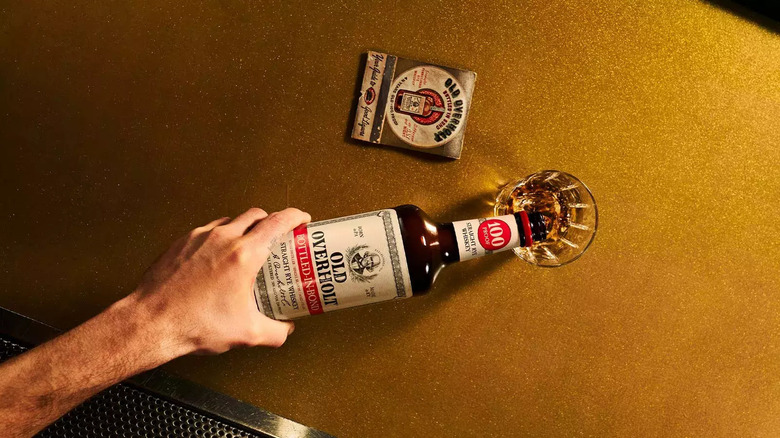
Old Overholt would be passed down into good hands for a stretch. Abraham Overholt's grandson happened to be the already-wealthy Henry Clay Frick, who took control of the whiskey brand in 1881 and recruited Andrew Mellon as a partner. Later, the brand was labeled according to the Bottled in Bond Act of 1897, ensuring high-quality whiskey. Things got complicated with the Prohibition looming, though. Mellon obtained a medicinal whiskey production license from the government in order to keep Old Overholt alive during the liquor ban, but after Frick's death, Mellon sold his shares of the company. In 1932, the National Distillers Products Corporation purchased the brand.
The brand continued changing hands, the rye's proof and age standards changing each time, too. In 1951, production halted at the original distillery. It's believed the whiskey was then made elsewhere in Pennsylvania, but the precise location is unclear. James B. Beam Distilling Co. bought Old Overholt in 1987, moving the operation to Kentucky.
Within the last several years, Old Overholt has returned to the spotlight. It's tasty on its own but also one of the best whiskeys for cooking and a great option to use in sazeracs. The shift arguably reflects the changing popularity of the overall rye category. Bourbon often gets the shine of being a quintessentially American spirit, but Dutch and German settlers used rye to make their whiskey in America as early as the 1600s. Because they landed around Pennsylvania, rye boomed there for generations. But post-Prohibition, there weren't as many rye distilleries left in the area as there were existing and new bourbon distilleries in the South. Bourbon dominated for decades, but many imbibers are embracing rye's unique spiciness again today.