

Are There Really Spiders In Your Cranberries? Here's What To Know
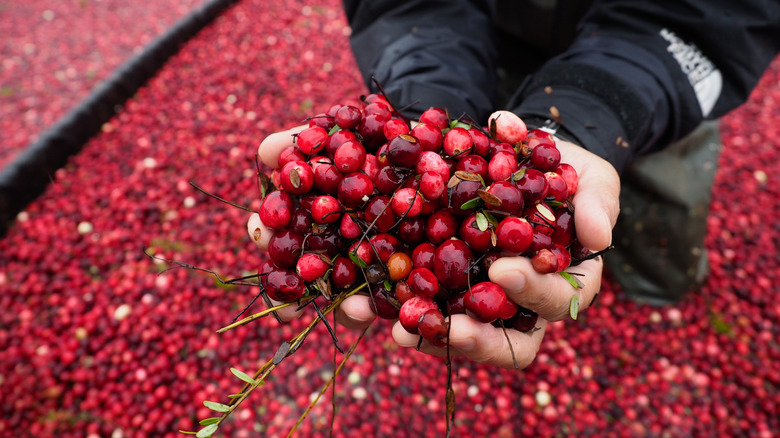
Most of us don't spend a lot of time thinking about cranberries. But, around Thanksgiving they always get a lot of attention — be it because of the family heirloom cranberry chutney recipe or the slices of jellied sauce that still bear the lines of the can it was shaken out of. The rest of the year, you probably only think about cranberries every so often, perhaps while you're enjoying a Cape Codder cocktail. At least, that was the case before the internet started spreading rumors that the cranberry harvest was a spider-filled nightmare.
The gist of the story that began to circulate across social media was that during the cranberry harvest hundreds of spiders float to the surface of the cranberry bog and beeline for the workers. Being the tallest thing around, the spiders are said to seek refuge from the high water by climbing up the terrified workers. Given the viscerally unpleasant images evoked by the idea of spiders climbing onto your face, it is no surprise that the social media posts went viral, racking up millions of views in the process and, in turn, spreading copycat videos. But is there any truth to these stories, or is this just another TikTok fairy tale?
You will be happy to know that, for the most part, those videos are nonsense. Claims that the first question cranberry farmers ask potential employees is about their fear of spiders, or that cranberry bog workers are compensated upwards of $150,000 for a short season due to the eight-legged menace, are patently false. It is not the spider-filled hell-scape that these videos describe, but that is not to say that arachnids are entirely absent in the cranberry bogs.
How the cranberry harvest works
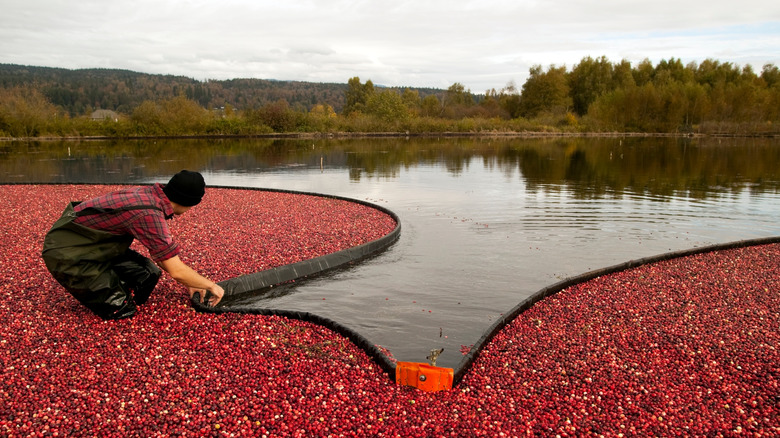
Because cranberry fields are at their most photogenic during the harvest, this is when most pictures of them are taken. This has, unfortunately, led to a misconception that cranberries grow in water. Cranberries do grow in wetlands, but these wetlands are dry during the growing season. The flooding is just a technique that simplifies harvest by making use of the cranberry's natural buoyancy. Fill the bog with water, and mechanically dislodged berries float to the surface where they can easily be scooped up.
Given that cranberries grow outdoors, there are going to be bugs in the environment — something true of every outdoor farming operation that's ever existed — and that's a good thing. Spiders living in the cranberry fields indicate a healthy, active ecosystem. However, this does mean that when the bogs are flooded, some of those bugs rise to the surface — and yes, workers in the water might run into a few spiders. But it is nothing like the stories you hear on social media. Most of the spiders in the flooded bog make their way to dry land as soon as possible, and spotting more than one at a time is a rarity.
It is also important to note that while there may be some spiders in the fields, there is a near-zero chance that one could end up in the cranberries you buy at the store. The populations of spiders in cranberry bogs are no greater than in other agricultural fields, and the sorting and processing of cranberries is sure to exclude spiders from the harvest. Arachnophobes should feel just as free to explore the many cranberry dishes of fall as they would recipes made with any other fruit.