

The Unique Plant-Based Milk You Probably Didn't Know Existed
We may receive a commission on purchases made from links.
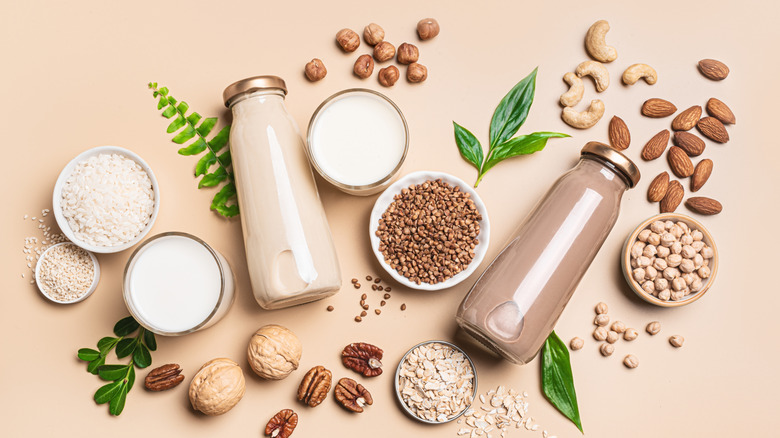
If you'd asked someone at the turn of the century what watermelons and sunflowers had in common, the answer likely wouldn't have been: "You can use the seeds of both to make milk." Plant-based milk has existed for thousands of years, and it's been sold commercially for more than a century, but the real boom has come only in the last decade. Suddenly, every nut, grain, seed, and bean seems to be lending its name to a milk carton (here's a list of 19 types of dairy-free milk explained). In this increasingly crowded marketplace, there's one plant-based milk that's got everything going for it, but continues to fly under the radar. We're talking about flax milk.
The plant-based milk industry is in the middle of a growth spurt. The market for non-dairy milk alternatives was estimated to be around $15 billion in 2020 and is expected to grow to $42.8 billion by 2034. This growth isn't just fueled by veganism going mainstream, but also by a growing push for climate-friendly foods, and, above all, a more informed view on healthy diets.
While the industry is dominated by oat, almond, coconut, and soy milk, flaxseed checks a lot of the boxes in terms of what people want. Not only does it have a natural earthy, nutty flavor, it also walks the thin line between milk and magic potion — it's low in calories, can promote heart health, trigger weight loss, and control blood sugar levels. It's dairy-free, gluten-free, lactose-free, allergen-free (the latter sets it apart from many dairy-free alternatives which depend on nuts). And on top of everything else, it's even good for the environment.
Short history, bright future
The long list of its benefits makes flax milk a viable alternative across generations. It works for both older consumers, who lean towards plant-based alternatives for health reasons, and younger ones, who make their choices based on concerns about the climate. The flax milk market was pegged at $2.1 billion in 2023 and is expected to grow to $4.3 billion a decade from now.
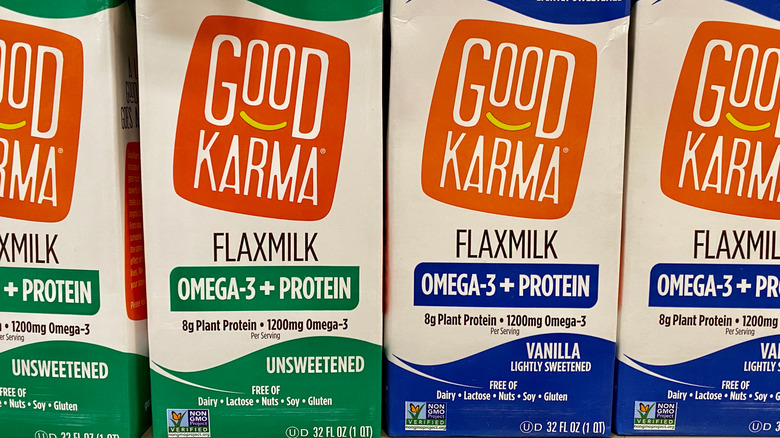
While flax milk has a bright future, it has a relatively short history. In 2011, Flax Usa Inc. introduced Flaxmilk to the American consumer as the "the first and only all-natural, dairy-free milk product made from cold-pressed flax oil". A year later, Good Karma Foods launched their plant-food brand with flax milk headlining the product catalog. The absence of cholesterol and presence of calcium and omega-3 fatty acids made it easy to pitch as a healthy choice, with one eight-ounce serving of flax milk coming in at just 50 calories. It matches cow's milk in calcium, but contains no cholesterol and no trans fats.
Today, flax milk is widely available online and in supermarkets, but you can also make your own. Redditor GeNeRAtionZ-11, who proudly displays a "VeganNewbie" flair, says they nailed it on their first attempt. They blended 4 1/2 cups of water with 1/2 cup of flax seeds for two-and-a-half minutes (taking breaks every minute), before adding vanilla and cinnamon and straining it. "Very delicious, especially the next day, once cooled," they posted. Flaxseed milk can be used in place of milk in any recipe, but there are some where this vegan alternative truly shines. Our Overnight Oats Parfait or Creamy Vegan Fettuccine Alfredo recipes are a couple of great starting points for your experiments!