

The Only Thai Dish You Usually Eat With Chopsticks
When you grab takeout from your favorite Thai restaurant, the bag may come with some wooden chopsticks tucked inside, no matter what you've ordered. This might lead you to think that most Thai dishes are commonly eaten with chopsticks, but according to Adipong "Boyd" Anantawut, manager of SaiTong Thai in New York City, that's a widespread misconception. In an exclusive interview, the expert explained which utensils typically belong with which traditional Thai dishes.
"In Thailand, most dishes are traditionally enjoyed with a spoon and fork, while chopsticks are used only for specific noodle dishes," Anantawut said. The manager named noodle soups, pad thai, pad see ew, and drunken noodles (aka pad kee mao) as examples. All four of these dishes are descended from Chinese cuisine introduced to Thailand by immigrants and missionaries, who also brought chopsticks to the country. It makes sense that Chinese-influenced noodles are still eaten with chopsticks in Thailand.
What about other Thai hallmarks like stews, curries, and fried rice? "All rice dishes, curries, and stir-fries are eaten with a spoon and fork because they're easier for scooping and mixing flavors," Anantawut explained. To eat these dishes, you're supposed to use the back of the fork to maneuver food onto your spoon, then bring the spoon to your mouth — Thai people do not typically eat food off the fork. However, Anantawut said that diners shouldn't worry excessively about eating exactly the right way at Thai restaurants.
Is using chopsticks for Thai food a massive faux pas?
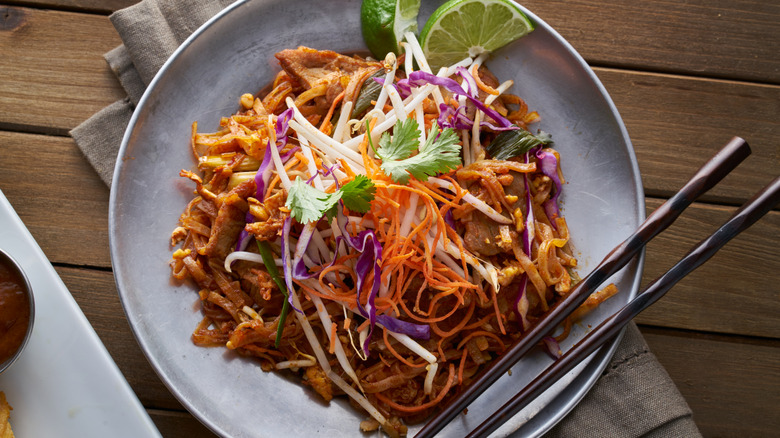
Nobody wants to come off as ignorant when eating food from a different culture, and there are indeed some mistakes to avoid at Thai restaurants. But in Boyd Anantawut's opinion, using chopsticks to eat a curry or stir-fry isn't likely to offend anyone. "Thai people generally don't see it as rude or childish," the expert said. "While it might signal that you're not familiar with traditional Thai dining customs, it's never viewed negatively. Thai culture places great importance on hospitality, so guests are never judged for using the 'wrong' utensil."
The reason you shouldn't ask for chopsticks at a Thai restaurant is that you might not need them. Plus, eating dishes as they are enjoyed in their countries of origin enriches the dining experience and makes your meal tastier. For instance, many Thai dishes like chicken Massaman curry or moo palo are served with jasmine rice, and the fluffy, loose grains are hard to pick up with chopsticks. Plus, Thai people enjoy eating a bit of rice and a bit of a main dish in every mouthful. The spoon-and-fork allows you to compose perfect bites in the easiest, neatest manner.
There's another staple of Thai cuisine that is eaten with no utensils at all: sticky rice. Often served alongside dips or meat dishes, these delightfully sticky grains are supposed to be picked up with your hands and rolled into a ball. You then rip off pieces and use them to sop up sauces or cooking liquid.