

Why It's Important To Dine With A Group When Eating Korean BBQ
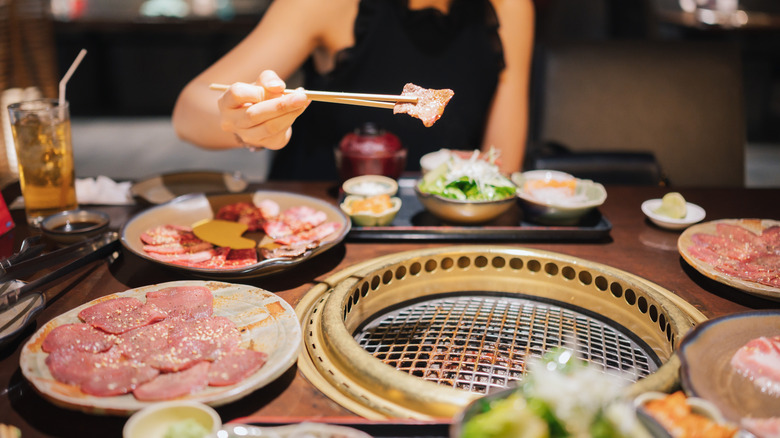
Over the past few decades, Korean barbecue has become a global hit. And it's easy to see why: The food is delicious, the variety of meats seems endless, and the interactive dining experience is fun. But, while solo dining has become one of the coolest dining trends in recent years, this is one meal you still may want to round up your family and friends for. To better understand why, we spoke with food and cooking content creator Alissa Nguyen (@alissanguyen_) at the New York City Wine and Food Festival and Sam Yoo, chef and owner of Golden Hof in New York City.
So, why exactly is Korean barbecue best enjoyed with others? According to Yoo, it's so you can get the most out of your dining experience. "I do think Korean food is typically a better fit for group dining just because there's so much variety, there's so much to share," Yoo tells us. If you really want to get that classic Korean barbecue experience, Yoo recommends grabbing a few different cuts of meal, a variety of banchan (grilled kimchi is the best for Korean barbecue beginners), and share a starter or two. All that food may be a bit of a tall order solo.
Practicality aside, Korean barbecue is also an inherently social endeavor. "Korean barbecue is one meal that will bring everyone together," Nguyen shares. "You can sit around for hours, talk, eat, drink, and just hang out." The dining experience is designed to be savored with people you know and love and that community is a big part of what brings diners back.
Tips for enjoying Korean BBQ on your own
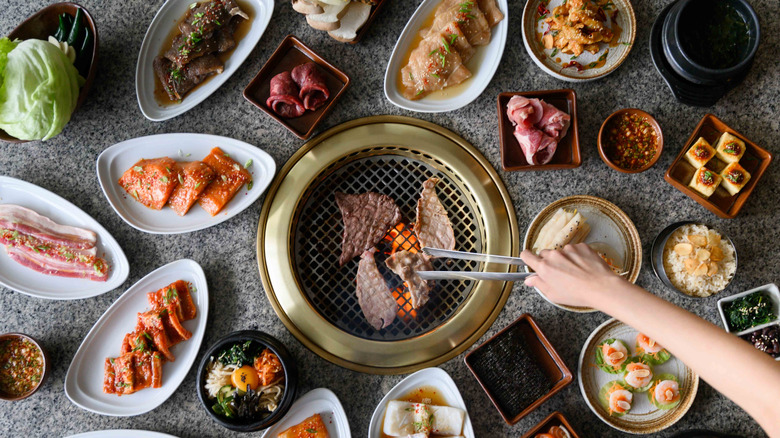
While Korean barbecue may be best enjoyed in a group, that's not to say that guests who want to dine alone aren't welcome. Korean barbecue is a meal that should be enjoyed by all — regardless of party size. But if you're planning to take on the ambitious meal alone, there are a few tips you may want to keep in mind.
According to Yoo, the key is to "keep it on the lighter side." Traditional fare typically includes several cuts of meat and is usually going to come with a variety of banchan, or side dishes, which you may not have the appetite for on your own. Instead, Yoo suggests ordering individual meats. "Depending on how hungry you are, just get an à la carte meat, which may or may not come with a jjigae," he says, referring to the Korean stew he personally likes to include when eating the meal. If you're in the mood for an appetizer, you'll want to keep that light as well. Yoo recommends a Korean pancake, kimchi pancake, or Japchae (sweet potato) noodles as dishes that aren't too heavy yet still satisfying for a solo diner.