

How To Know If Stainless Steel Pots And Pans Can Go In The Oven
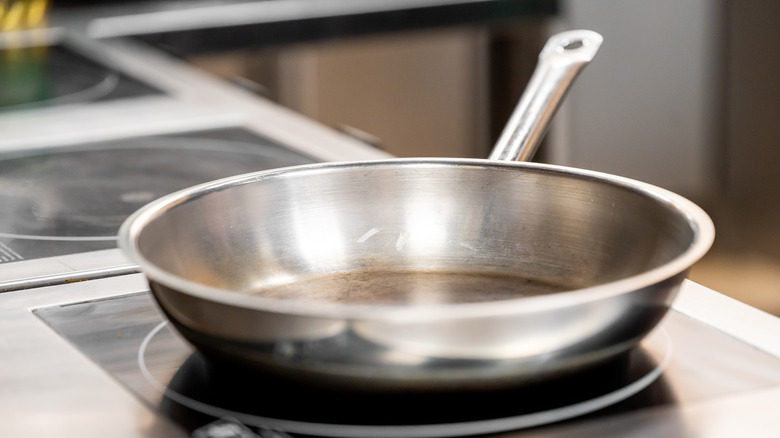
Stainless steel is maybe the single most popular material used in modern cookware because of its versatility, but its lighter weight can still make some hesitant to throw it in the oven. While dark, heavier materials like cast iron seem ready-made for the higher intensity heat, it feels a little wrong to throw a bright stainless steel sauté pan right into the oven without concern — and that worry isn't totally unfounded. Since stainless steel pots and pans come in different styles, they have varying levels of heat tolerance. To clear this up, we reached out to Julien Djadane, the managing director at the cookware brand Cristel, to inquire about the easiest ways to tell if your pans and pots can go in the oven.
First off, Djadane assures us that as a baseline stainless steel is oven-safe. "It's one of the main advantages of using stainless steel, as it remains the most stable cooking material," he explains, "even at very high temperatures." Djadane notes that stainless steel pots and pans can start to change color at very high temperatures above 779 degrees Fahrenheit, but even at those intense levels they stay stable.
However, he does admit that while stainless steel pans are oven safe, "not all stainless steel cookware is recommended for oven use" due to their construction qualities. "Check the manufacturer markings," Djadane suggests. "Many pans will have icons or text on the underside or packaging that indicate they are oven safe." Although most stainless steel pots and pans will be oven-safe, it never hurts to double check.
Stainless steel cookware is oven-safe by nature, but some handle heat better

There are a few aspects of stainless steel construction that Djadane says you can look at when worried about using pans in the oven. The most obvious would be the use of other materials on different parts of the pan. "Even though the pan itself may be oven safe, its handles or lids may be made up of other materials like silicone, plastic, or glass, which can melt or warp when it hits a certain temperature," Djadane notes.
The other visual clue is the thickness of the pan. Thicker steel will be more stable and rigid, while Djadane warns that "cheaper or more basic stainless steel products can have thin bases and are at risk of warping in the oven or under broilers, even if they are technically oven-safe." Djadane also recommends checking manufacturer's notes. "Even though stainless steel is naturally oven safe, each manufacturer may have a specific temperature limit," he adds. Oven-safe stainless steel pans can vary in tolerance from 450 degrees up to 800. These numbers are often listed on labels or on the product's website.
So, what's the ideal to look for if you don't want to worry? Djadane recommends looking for different cookware brands that use a stainless steel called 18/10. "It will be more stable than others due to its strong structural integrity," he explains, adding that the even heat distribution leads to fewer hotspots. Like other characteristics, 18/10 should be noted somewhere on a pan's label.