

For Perfect Prime Rib Every Time, Always Use This Kitchen Tool
We may receive a commission on purchases made from links.
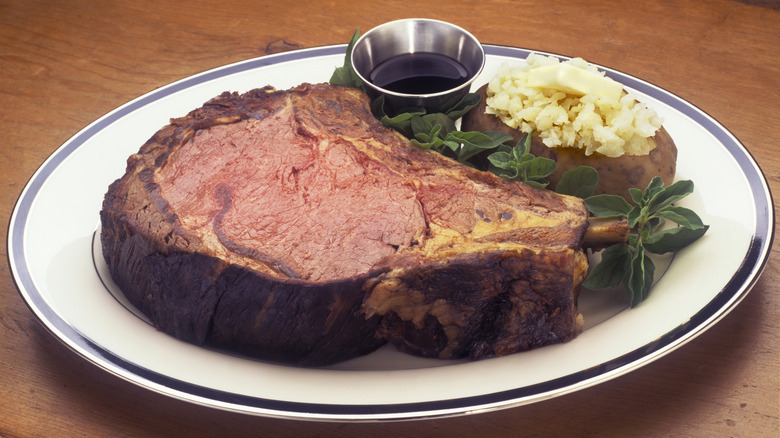
A plate of slow-roasted prime rib is a decadent dinner that takes some care and finesse to properly prepare. Between choosing the right cut, using a flavorful spice rub, and cooking your meat low and slow until it reaches an optimal level of doneness, there's a lot for you to consider. But, of all the tips you need to make the best prime rib, having a meat thermometer on hand is the most essential. Using the kitchen tool will ensure your beef is cooked to the correct internal temperature to prevent the risk of either over or undercooking.
Using a reliable meat thermometer like helps you to achieve the ideal roasting temperature for tender prime rib, which is around 120 to 130 degrees Fahrenheit for medium rare and between 115 to 120 degrees Fahrenheit for rare. Rather than attempt to guess the proper timing or proceed based solely on the weight of your meat, a thermometer gives you the exact temperature in real time as your prime rib cooks. Accuracy is key when it comes to internal temperatures, not just to gauge the doneness of your prime rib but also to ensure food safety of any cooked meats.
It's not vital to use a super high-tech, bluetooth enabled meat thermometer or anything that's particularly fancy. A simple and accurate tool like the ThermoPro TP19H Digital Meat Thermometer is all you need. However, when it comes to placement and setting, there are a few tips to keep in mind for a delicious prime rib cooked to your preferred temperature.
Tips for using a meat thermometer
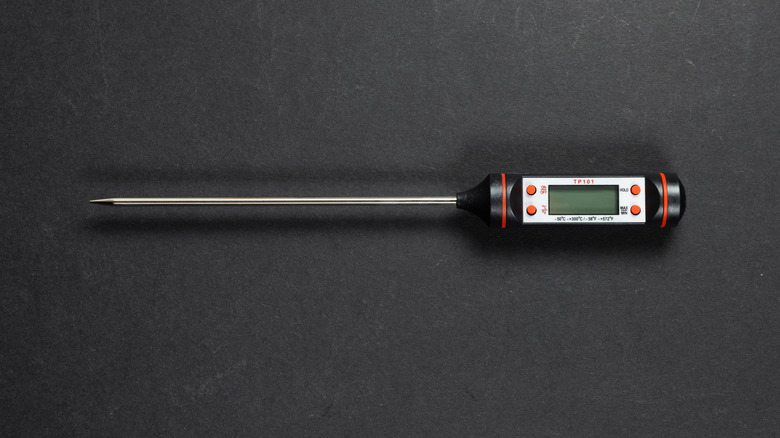
The real reason you actually do need a meat thermometer is to gain insight into accurate cooking times without the need to open your oven and disrupt the process. Further, because your prime rib will continue cooking after being removed from the oven, it's vital to leave the thermometer in place while your meat rests and before serve it. Though it's tempting to rush the process, having patience and minding your meat is of the utmost importance with prime rib.
When it comes to inserting the probe of your meat thermometer, stick it into the thickest part of your prime rib roast and avoid any fat and bone to ensure an accurate reading. Make sure to set the desired internal temperature on your probe so it will alert you when that temperature is reached. Once the alert goes off and your roast has reached the set temperature, remove it from the oven and let it rest for 30 minutes to an hour and a half.
Once your roast is finished resting, carefully remove the probe of your thermometer and set it aside for cleaning so you can slice your roast to your desired thickness. Then, plate your prime rib with au jus, horseradish, and any sides of your choosing. Albeit time-consuming, a slow-roast using a meat thermometer is the most effective — and arguably the most important — tool for achieving the perfect prime rib.