

How Bourbon Gets Its Distinct Amber Color
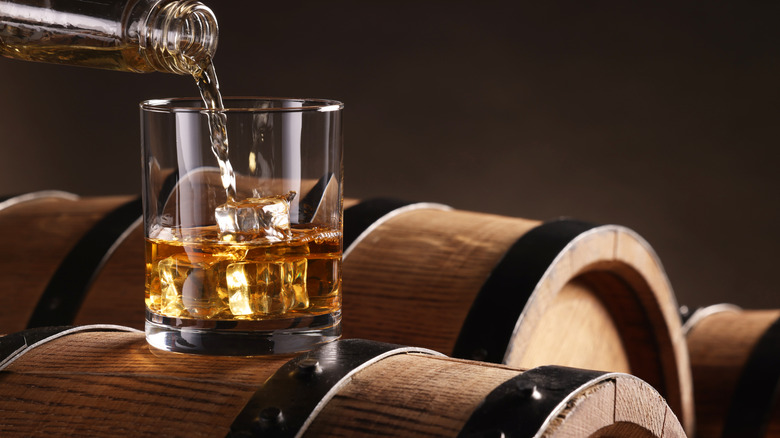
It's easy to surmise that bourbon gets its mesmerizing amber color from the distilling process, with all those earthy elements coming to a stunning crescendo in a blaze of autumn-hued color. A more cynical whiskey lover may instead sigh with sadness that it's likely an added coloring agent of mysterious origin. Truth be told, it's actually neither of those, but something much earthier and intriguing: Bourbon hues come from the merging of fire, wood, and time. Simply put, that rich amber hue comes from the barrel that the bourbon ages in.
Straight from the still, the bourbon is clear as rain — until it nestles in for a minimum two-year slumber in wood barrels, required by law to be new and made of charred oak. Since the insides of the barrel are charred before adding liquid, the characteristics of the wood get extracted by the spirit, impacting the bourbon flavor and creating its color. On a deeper level, charring new oak caramelizes the wood's natural sugars and opens up the wood fibers so the spirit can penetrate deeper. It typically picks up smoky, sweet flavors with hints of caramel, vanilla, and spice, while the liquid extracts the wood pigments into the bourbon.
In their roundup of the 15 facts about bourbon you probably didn't know, Tasting Table whiskey connoisseur Kenny Jarvis noted that the color becomes more complex the longer a bourbon ages. "There are exceptions to this rule, but young bourbon is usually light gold in color, with maturely aged bourbon having a dark amber hue," wrote Jarvis.
Bourbon law prohibits unnatural added colors
You can pretty much know that what you're seeing in a glass bourbon bottle is the genuine color derived from barrel aging. There are strict rules for adding color to whiskies and bourbons – and the ones for bourbon are the most stringent. Other types of whiskeys, like Scotch, are allowed certain percentages of added color, typically a caramel coloring known as E150a. The purpose of adding color is mainly for consistency across whiskey batches. Otherwise, the color can vary based on things like the barrel's age, the type of wood, what the barrel was previously used for (and how often), and even climate or storage methods.
Sometimes, with previously used barrels, the whiskey could fail to gain much color at all, even after aging for years. That's because the wood's extractives that typically add color are depleted by spirits that came before. But none of that comes into play with bourbon, because the barrels are required to be new. There's also the regulation from the Alcohol and Tobacco Tax and Trade Bureau (TTB) that states that "bourbon whisky may not contain any amount of added coloring, flavoring or blending materials" – except for water to adjust the proof.
If a bourbon producer were to add a coloring agent, the spirit would no longer meet the legal definition of bourbon and must be labeled accordingly. So, as Tasting Table whiskey expert Kenny Jarvis put it: "When you next pour yourself a glass, you can be content that what you are tasting is 100% natural."