

The Actual Reason Your Pie Crust Is Shrinking (And How To Fix It)
We may receive a commission on purchases made from links.
There are many challenges that you might encounter when making pie crust from scratch. Some of the most common ones are a crumbling crust, a dry or flavorless crust, and perhaps even a shrinking crust. To make sure you have everything you need to make holiday pies this season, Tasting Table spoke with an expert to get fail-proof tips for homemade pie crusts and find out how to prevent them from shrinking when baking.
Samantha Merritt is the creator of Sugar Spun Run, a baking website known for reliable made-from-scratch recipes, who says that the best way to avoid shrinking pie crusts is to start by taking care when making your dough and forming your crust. "You can avoid shrinking by using cold ingredients [and] not overworking the dough (handle just as much as needed and no more)," Merritt explains. This checks out, as one of the biggest mistakes that everyone makes with pie crust is using room temperature or warm butter or lard.
Pie crust ingredients should always be ice-cold to ensure the fat, whether butter or lard, stays solid until it bakes. Then, as it bakes, it will melt, releasing steam that creates that perfect, flaky pie crust texture that you want. Also, cold ingredients don't blend as easily as room-temperature, warm, or melted ingredients. This means that you're less likely to overwork your dough, which could cause dry, crumbling dough that is hard to form into a crust. Finally, achieving the proper texture and temperature for your dough makes it easier to create a crust without having to handle it (i.e., touch it with your bare hands) as much.
Properly forming your crust and using pie weights to prevent shrinking
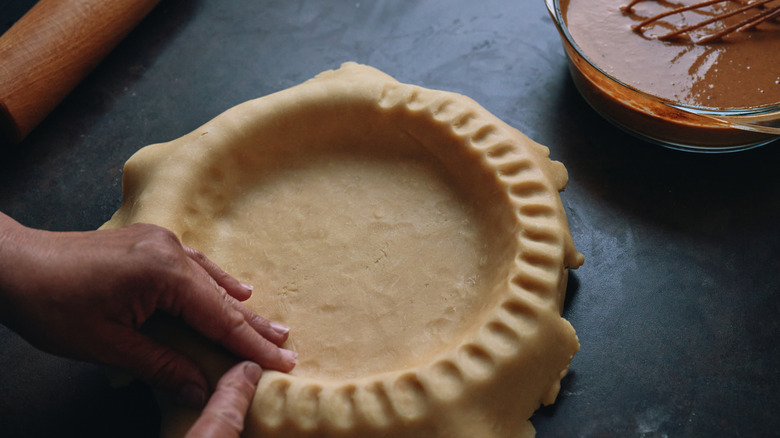
To properly form the dough, Merritt suggests "arranging the dough properly in the pie plate" and "[making] sure to flute or otherwise anchor the edges." You can use your bare hands to gently press the pie crust into the bottom and sides of the pie plate, taking care not to create holes or dimples. Anchor the dough to the dish by creating a rolled crust along the edges, then pressing it down with your fingers or the tines of a fork.
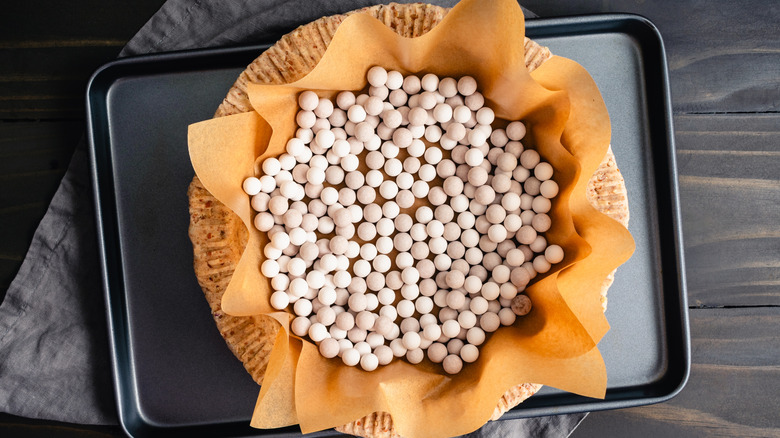
When you bake a fruit pie, the filling is added to the raw crust before baking. The weight of these ingredients will hold the dough down so that it resists shrinking. But if your recipe calls for blind baking or par-baking your crust, you will need to add weight to it to prevent shrinking. "Using pie weights and baking the crust in a hot enough oven so that the crust sets before the fat melts" can significantly lower the risk of dough shrinkage, according to Merritt.
"If you are blind-baking, pie weights are a must," Merritt notes. "Pie weights are simply a heat-proof stand-in for your pie filling that helps keep your crust from shrinking." While pie weights can be found online, she adds that "some people use dried beans, dry rice, or even pennies." Alternatively, we recommend Mrs. Anderson's Ceramic Pie Weights, which are available on Amazon. Additionally, Merritt suggests you "line your pie crust with parchment paper so the weights don't make contact with the pie dough and can be easily removed." Following these expert tips can help you make the perfect, flaky pie crust that retains its shape and texture while baking.