

10 Ways Restaurants Trick You Into Thinking Their Fish Is Fresh

If you watch food shows on TV, you'll see a lot of talk from chefs and restaurateurs about working with the freshest in-season ingredients. Which is true, up to a point; we all want to do that. But in practice, we often end up working with what we can get or what we have on hand. The name of the restaurant game is turning a profit, after all.
Finding yourself with too much of a highly perishable ingredient is a worst-case scenario for profitability, and that's why fish is so problematic in restaurants. All it takes is a few too many customers opting for a different special, or bad weather turning your busiest night into a snooze-fest, and you'll find yourself with a cooler full of fish that's on the verge of becoming a write-off.
There are a lot of tricks chefs use to mask the flavor and odor of fish that's past its pristine prime. It's a subject I know a lot about, as an East Coast kid from a fishing family, who went on to become a trained chef and restaurateur with a pair of seafood-centric restaurants. Here's a list of 10 things to watch out for when you're dining out, or (on the upside) to use yourself at home to avoid waste.
Breading (or battering) and frying the fish

I'm going to start with one of the most universal techniques, which is frying the fish. To be clear, I'm not saying restaurants that specialize in fried fish do it because they use substandard fillets; that's not the case.
That said, if you find yourself with an oversupply of a decent white fish that's suited for frying, this is a good way to mask the flavor of fish that's perhaps not quite as fresh as you'd like. The trick here is that the breading or batter provides a crisp, golden, appetizing, aromatic coating that looks and tastes good, distracting your attention and palate from the fish itself. When your server steps up to the table and puts your plate in front of you, it's that beautiful golden color and the comforting aroma of fried carbs that will get your attention. Similarly, the coating gives a textural contrast that will please your palate.
Unless the fish is really whiffy (and most chefs would draw the line before it gets to that stage), or you're a serious fish aficionado, you may not taste the difference. A good test is breaking open the batter and trying a bit of the fish without its coating so that you can taste it on its own.
Smothering the fish in a rich, creamy sauce

A lot of the most elegant dishes in the classic repertoire revolve around rich, creamy sauces. So do some of the most comforting of comfort foods (think scalloped potatoes, or fettuccine Alfredo). That makes cream-based sauces a useful option for any restaurant, whether their overall style is elevated or everyday.
But here's the thing about cream: While it adds richness, it also dulls flavor. That's why I don't use it in my coffee, or (and admittedly I'm in a minority on this one) in my chowder. Most fish, especially lean white fish, have relatively delicate flavors, and a heavy splash of cream just overwhelms them. This isn't the case with oilier fish like herring or mackerel, but few oily fish (with the obvious exception of salmon) lend themselves to creamy sauces.
That logic gets turned on its head when you actually want to mask the flavor of the fish. A creamy sauce will do that pretty effectively, as long as the fish is just beginning to be funky. So, if a restaurant's daily special is fish in some kind of creamy sauce (especially if they were closed the day before), you might want to think twice about ordering it.
Giving the fish a spritz of lemon
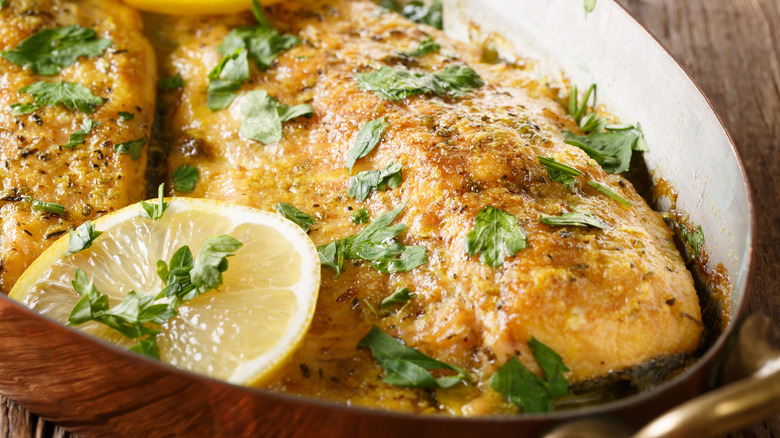
One of the most common garnishes for a fish dish is lemon, whether you're ordering sole meunière at an upscale French restaurant or the two-piece at your local fish and chips joint. Mostly, that's just because lemon brings a bright, fresh flavor that complements the fish. But it does play another role, as well.
Here's the thing: The reason fish begin to smell and taste "fishy" after a day or two is the buildup of a compound called trimethylamine, or TMA (there are others, but that's the big one). TMA is a basic substance, so acidic ingredients like lemon juice attack that offending molecule directly and break it down. That's why lemon juice removes the fish smell from your hands after handling seafood, and can even make canned sardines smell less fishy.
Let's face it, if lemon juice can damp down the fishiness of canned sardines, a quintessentially "fishy" fish, it'll do just fine with ordinary fish. So if your local restaurant has a habit of serving lemon-forward fish dishes, you might want to think about ordering something else on your next visit.
Soaking the fish in milk
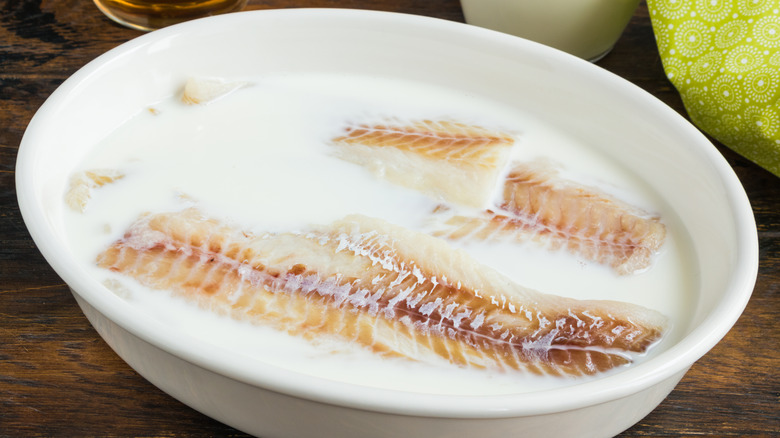
A quick milk bath is a widely spread tip for making a lot of foods taste better. My mother always soaked liver in milk for a while before she cooked it, for example, and you can also use it for getting that funky, gamey taste out of wild-caught venison.
If such a simple technique works on really funky foods like those, it's unsurprising that it's equally effective when you use it with (relatively) mild-tasting fish. There are a couple of reasons for this. One is that milk contains lactic acid, which helps break down TMA molecules in the same way lemon juice does. More importantly, the casein (protein) molecules in the milk bind to the TMA molecules, so they end up in the milk rather than in the fish.
That's why many recipes call for a quick milk marinade before cooking fish, or sometimes simply for cooking the fish in milk. Buttermilk works, too, and packs more of an acidic tang than fresh milk, so it's even more effective. That signature tang may or may not be an asset to the finished dish, which is something to bear in mind if you do this at home.
Using a boldly flavored marinade
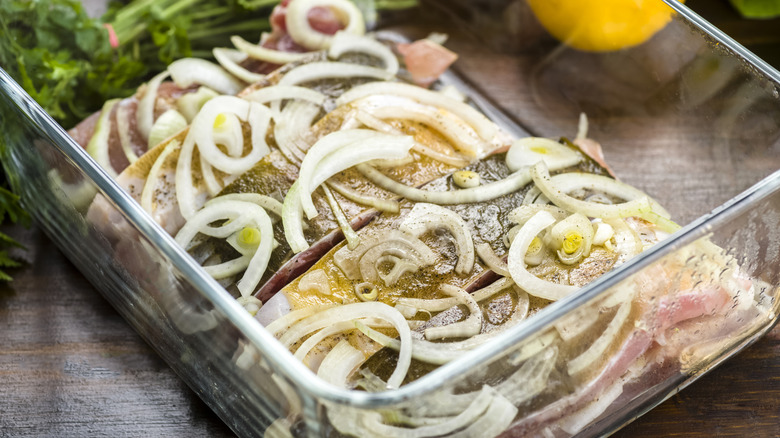
Marinades are a popular way to prepare food for cooking, and why not? It's a great technique. It adds a lot of flavor, though that flavor is mainly confined to the surface when you marinate meats (and sadly, marinades' ability to tenderize meat is minimal, despite that being a common piece of folk wisdom).
Fish is more responsive to marinades than meat is, partly because of its finer texture and partly because fish fillets are relatively thin. So marinades are actually a pretty effective way to address fish that's past its prime. This works on two levels. First, the marinade's acidic ingredient (usually some kind of vinegar or fruit juice) acts directly to break down the TMA in the fish. Second, its flavors actively mask any remaining off-tastes. That's a win, from a culinary perspective.
You can do this at home, too, if you find that you've forgotten your newly purchased (or caught) fish in the fridge for a day or two. Just remember not to leave the fish in the marinade for more than 30 minutes, because that's one of the biggest mistakes you can make when marinating seafood. If you overdo it, the marinade's acidity will give the fish an unpleasant, unnatural texture — I've done it myself, when I forget to set a timer.
Aggressively seasoning the fish
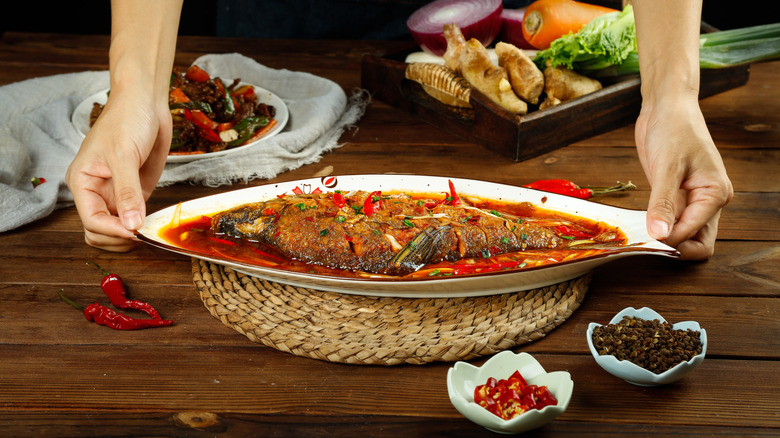
The classic French repertoire tends to focus on fish's delicacy and, on the whole, tries to avoid overwhelming it with bold flavors. There's a bit of wiggle room there, because oilier fish like mackerel or salmon can stand up to bigger flavors. But subtlety is the rule with white fish, especially.
That said, a chef with a walk-in full of highly perishable fish, with the clock ticking loudly, may be motivated to bend on that principle, leaning into — for example — Cajun or Thai flavor profiles, with heavy use of spices and chiles to mask any off-flavors in the fish itself. That's the kind of tactical flexibility that can keep a restaurant solvent. As long as customers enjoy the end result (and the chef doesn't push it until it's an outright food safety issue), there's nothing really wrong with that.
Some of these highly seasoned fish dishes are genuinely popular — blackened Cajun redfish was such a hit in the '80s that authorities had to impose a fishing ban to protect the species. That said, if the "catch of the day" uses a delicately flavored white fish in a highly spiced recipe, especially if that style of cooking isn't that restaurant's normal thing, you might want to order something else.
Leaning heavily into condiments and dips

There are an awful lot of dips, condiments, and sauces associated with seafood. They add flavor and moisture (which was especially important if you lived in a "cook everything to death" culture), and just generally add interest to the finished dish.
They're also kind of fun. Think of all those party platters you've enjoyed with a spread of dips and a variety of breads, crackers, pretzels, and similar items to dip into them. Creative chefs often apply the same logic to fish and seafood, leveraging everything from traditional tartar sauce and cocktail sauce to malt vinegar, remoulade (tartar sauce's dressed-up cousin), and a range of variations on things like aioli, pesto, or rouille.
Those dips and condiments also go a long way toward covering the taste of not-quite-fresh fish. Once again, it's partly because of acidity, but mostly it's just that the dips themselves are pretty boldly flavored. In a restaurant context, serving fish with lots of dips leans into that whole fun party platter/group dish ethos, and yields the pragmatic benefit of using up a lot of fish or seafood in one order.
Serving it with acidic sauces

If you've read this far, you've probably noticed that acidity is a recurring theme. Acidic ingredients like lemon juice, milk, and vinegar (or fruit juice) in marinades can all play a role in breaking down the TMA that gives fish its distinctive, "fishy" flavor and odor once it's past its freshest.
So you won't be surprised to learn that acidic sauces can have the same effect: When you think about it, it's basically like using a marinade except you apply it after (or during) cooking, rather than before. This may well be why we have so many variations on white wine sauce for fish, for example, with wine serving as the acidic ingredient. Usually, wine or wine vinegar is cooked down to concentrate its flavor and acidity, and then the sauce is finished with cream, or butter (beurre blanc), or even thickened fish stock (sauce Bercy).
Less-formal sauces might be tomato-based or draw on lemons and capers. Regardless, they'll all work as long as the acidic element is there.
Brining the fish
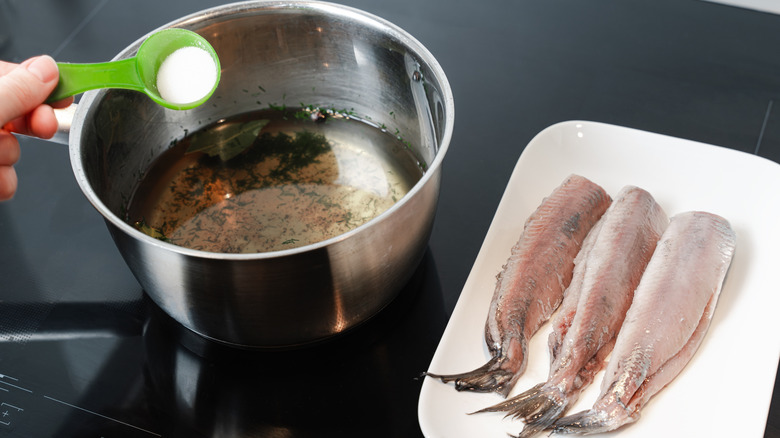
If you spend any time at all reading cookbooks, watching cooking shows, or reading about food and cooking, you'll see plenty of love for brining. It's a good technique for several reasons, whether you use a liquid or a dry brine.
In this instance, brining gives you a really well-seasoned piece of fish, because the salt will get right into the muscle tissues. That's a good thing if your fish is past its prime, because the salt will help distract your palate from any off-flavors. Brining also helps your fish stay moist and juicy even if it's a bit overcooked, which is especially useful with lean white fish.
My own personal experience tells me that a quick soak in brine helps keep down the smell and taste of fish that's getting a little bit sketchy, as well. Long before I became a chef, I cooked for my family of four on a tight budget, and frequently rolled the dice on marked-down fish as a money-saver. Salt was my friend in those cases. I haven't been able to find any studies or other direct evidence to show that salt or the brining process does anything to impact the levels of TMA in a fillet. All I can say is that it works for me.
Skinning the fish

Have you ever noticed that when you've left a piece of meat in the freezer for too long, it's usually the fatty parts that first start to taste nasty? That's because fats can go through chemical changes (mostly oxidation) over time, becoming rancid and unpleasant-tasting.
With fish, you won't find big seams of fat, as you'd see in a good steak. Instead, the fat is mostly concentrated in a thin layer on the underside of the skin. In lean fish, especially, that's where the vast majority of the fat can be found. Now, I'm personally a big fan of cooking fish with the skin on, partly because I want those healthy fish oils in my diet, and partly because I just plain love crisp, well-seared fish skin (I pan-sear fish like this for crispy skin). But if the fish is past its prime, that changes the math even for me.
Saturated fats like beef tallow take a long time to become rancid, but that's not the case for the unsaturated oils in fish (especially "oily" fish). Those omega-3 fatty acids are part of the reason that fish is so good for you, but sadly, they start to break down in a real hurry. So when restaurants find themselves with a surplus of skin-on fish, removing that skin is a quick way to slow its deterioration. This one's hard to spot as a customer, but if the menu changes overnight from whole fish or skin-on fillets to skinless, that's probably a giveaway.