

The Difference Between Diet And Zero Sugar Soda Isn't Just Taste — It's Marketing
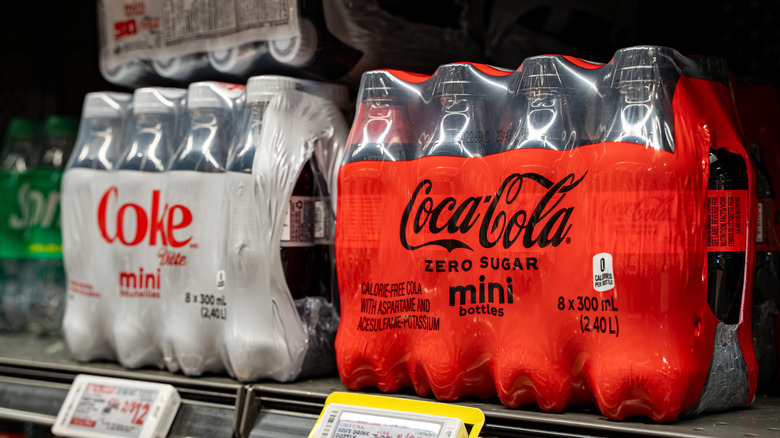
All it takes is one taste to notice the difference between Coca-Cola Zero Sugar and Diet Coke. Even though both are sugar-free versions of Coca-Cola, the formulations are distinct and offer different flavor profiles. Coca-Cola Zero Sugar uses the same flavorings as regular Coca-Cola, and is sweetened with aspartame and acesulfame potassium. Diet Coke only uses aspartame. As a result, the zero sugar version tastes more like the original sugar-sweetened kind. Pepsi has taken a similar approach with Pepsi Zero Sugar and Diet Pepsi. The other main difference between zero sugar and diet sodas is that zero sugar sodas were originally clearly marketed toward men more than women, while the ones with diet in the title were aimed at women.
In the packaging alone, there was a distinct difference between Diet Coke and Coke Zero, which was later branded as Coca-Cola Zero Sugar. Coke Zero was sold in a black can at its launch in 2005, with the Coca-Cola name in red. Diet Coke has long been sold in a silver can. Pepsi followed suit by introducing Pepsi Max in a black can while Diet Pepsi is sold in silver cans. According to the Cowan design agency which developed Coke Zero packaging, the silver and white of Diet Coke was seen as light and appealing to women. Black was chosen for Coke Zero to represent "strength, boldness, and modernity." When Coke Zero launched, it was immediately popular. Coke Zero was then marketed through sponsorships with NASCAR and James Bond movies. The male-centric marketing worked.
Multiple ads featured indications about who they were aimed at. In 2009, a Coke Zero ad with the tagline, "The impossible made possible" targeted 20-something men, turning them into heroes.
Making soda for men and women

Diet soda's roots can be traced back to the Jewish Sanitarium for Chronic Disease, a hospital in Brooklyn. That is where Hyman Kirsch first created artificially sweetened carbonated beverages for diabetics and people with heart conditions. When he succeeded in making something tasty, he expanded in 1953 and introduced No-Cal soda to consumers. It was marketed chiefly towards women with the promise that it would help keep them slim.
The diet boom was just kicking off in America, and diet soda was at the forefront. It began as something directed at women because, for many years, it was not considered a manly thing to diet. Women had to stay in shape but men did not. Call it sexism in a can. Coke's first attempt with a diet soda was TaB in 1963, marketed to "beautiful people" so they could keep tabs on their weight.
In 1982, Coca-Cola introduced Diet Coke and tried to give it broader appeal. It never took off in Europe because, to Europeans, diet meant something medicinal. The company ended up calling it Coca-Cola Light, and it worked. By the same token, since diet was so linked to women in America, Coke Zero was created to position the drink as something men could enjoy, too.
Other zero sugar soda brands have tried this. Dr Pepper is known for many varieties, and it tried a blunter approach in 2011 with Dr Pepper 10, a low-calorie version of their soda. Research the company conducted shows men avoid drinks they don't consider manly, per NBC. The slogan for Dr Pepper 10 was "It's not for women."
But as the years roll by, the Coca-Cola company has broadened its target for advertising, and in 2024, its marketing strategies became broader and less overtly split by the sexes, and both low-cal drinks are now seen as crossing demographics, including between men and women.