

Staub Vs Le Creuset: What Are The Most Important Differences Between These 2 Popular Cookware Brands?
We may receive a commission on purchases made from links.
From the mouths of foodie influencers and Michelin-starred chefs, from TikTok reels to print catalogues, the message is loud and clear: you need a Dutch oven. Yes, it's trendy, it's expensive, and it's not not about having a beautiful object in your kitchen that says "I know what I'm doing." But it would be a mistake to write them off. Dutch ovens are versatile workhorses that can be used to braise meats, simmer stew, make a soup, or even bake bread. Thanks to its hardy construction, it can go from stovetop to oven, and then, thanks to its often-lovely appearance, straight to the dining room table as a serving dish.
Two companies pop up, again and again, in professional and consumer kitchens alike: Staub and Le Creuset. Both companies are best known for their enameled cast-iron Dutch ovens, the product also known as the cocotte. Both also offer an array of other cookware, such as baking dishes and grill pans. And both have their own team of absolutely devoted fans. But what are the differences between the two companies and what they offer, and how do they matter in the kitchen?
What is Le Creuset?
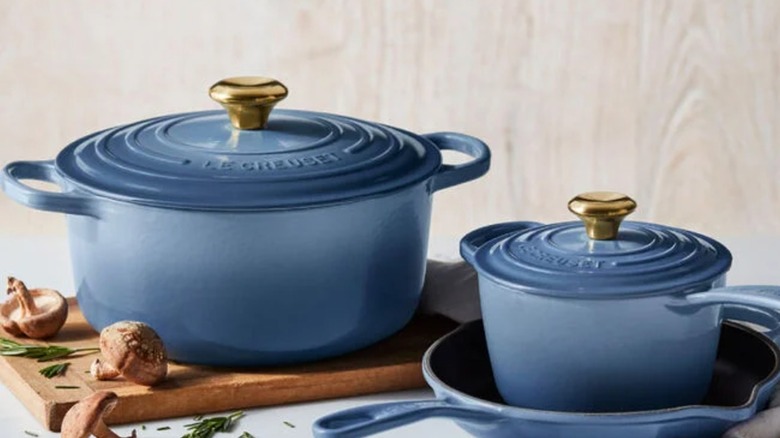
In 1924, two Belgians founded Le Creuset in a small town in Northern France. Octave Aubecq was an iron caster, and Armand Desaegher was an enameling expert. They joined forces to perfect the process of enameling cast iron in a town called Fresnoy-le-Grand, which just so happened to be at the intersection of key shipping routes for iron, coke, and sand — three key elements in making cast iron. The two entrepreneurs and the prototype they developed in 1925 changed cookware forever. Enameled cast iron has all the durability of traditional cast iron, but with a ceramic coating that is as useful as it is beautiful.
Le Creuset was widely popularized in American kitchens by Julia Child, who was a loyal fan and featured it on her show. A large, bright red Le Creuset pot was a particular fixture that she referred to as "her soup pot." Soon, everyone not only knew about Dutch ovens, but knew they needed one.
The first Le Creuset cocotte, or Dutch oven, was bright orange. Now, Le Creuset has introduced cookware in hundreds of colors and offers the widest variety in the industry. The company even has a Color Lab. While enameled cast iron was their original product, the company also makes everything from stainless steel to mixing bowls.
What is Staub?
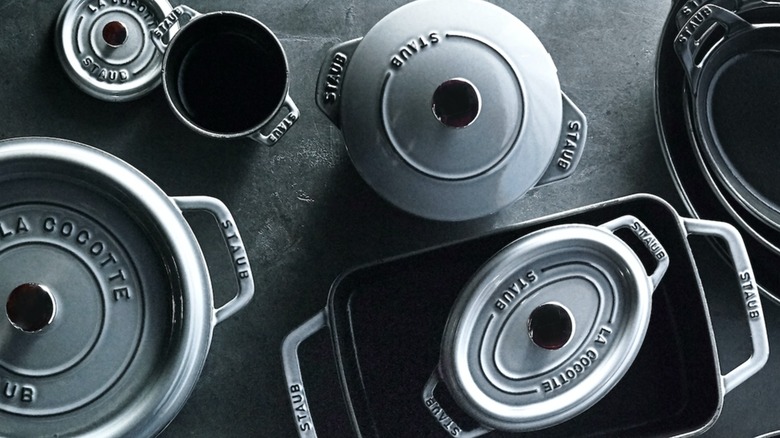
Francis Staub founded his namesake company in 1974, when he created his first enameled cast-iron pot design at an artillery factory in Alsace, France. The brand has a reputation as a professional chef's workhorse of choice; nearly half of French Michelin-starred chefs use Staub products, and three-quarters of Japanese Michelin-starred chefs do. The classic Staub cocotte is black, the natural color of cast iron, but, like Le Creuset, Staub produces cookware in a variety of colorways and aesthetic designs, making its products just as well suited to the dining room table as to the stovetop.
In 2008, Staub was acquired by Zwilling J.A. Henckels, a German knife-maker and one of the oldest operating companies in the world. While Zwilling now owns the Staub brand, the cookware company still seems to operate largely independently, and its products are still manufactured in Northern France. The Staub logo features a stork, a traditional symbol of Alsace. Staub still sticks with cast iron and ceramic for its cooking vessels, but it also produces accessories and utensils made from materials like silicone and glass.
Lid design
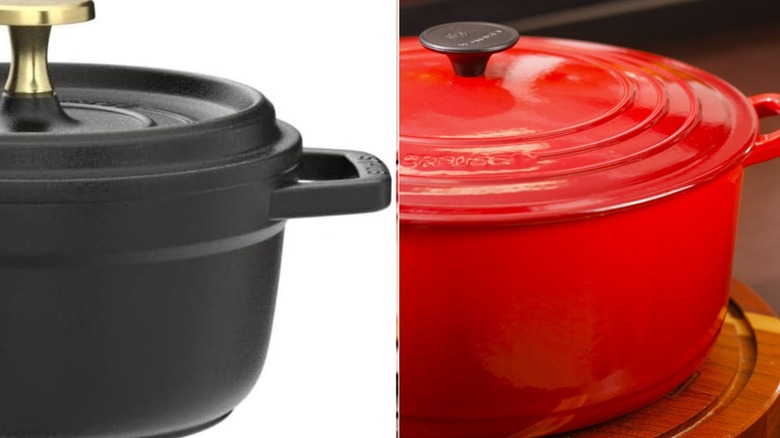
Some Staub and Le Creuset cast-iron cookware, such as Dutch ovens and saucepans, comes with lids. Both companies' lids have the same sturdy enameled cast-iron construction as the base and feature a round knob in the center for easy lid maneuvering. But when put side by side, a few subtle differences between the two companies' designs stand out. For one thing, Staub lids have a smaller topper knob than Le Creuset lids. The shapes of the lids themselves are also distinct. Typical Staub lids sit slightly below the rim of the pot itself, giving it a slightly recessed appearance. Le Creuset's lids, on the other hand, are typically slightly domed (both companies offer product collections with varying lid shapes).
There is one difference between the two companies' lids that some see as a game-changer. Staub lids feature small, swirling bumps on their undersides. Termed "self-basting" by Staub, the company claims the lid's bumps help efficiently collect condensation and uniformly baste the pot's contents with the liquid, making their products ideal for braising. Le Creuset's lids, on the other hand, feature the same smooth surface as the pot itself. Not everyone agrees on the efficacy of the self-basting technology, but plenty of home and professional cooks are big believers.
Interior
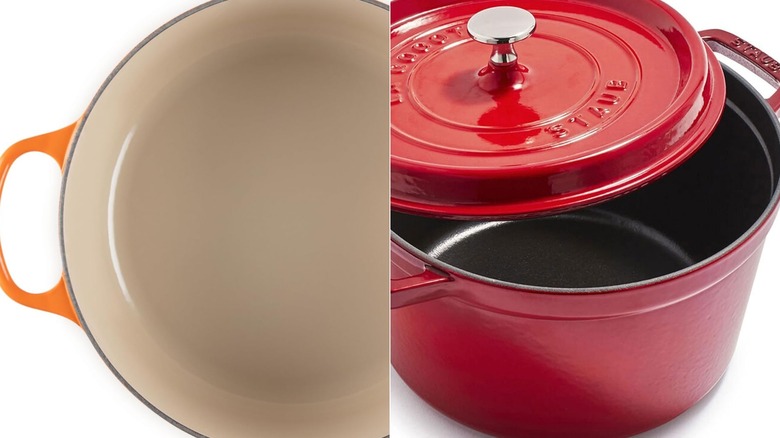
Le Creuset cookware typically features a ceramic-coated, light interior surface, while Staub interiors are black and feature a slightly rougher, 'honeycomb" finish. Firstly, this creates a difference in texture: Staub's cast-iron surface is rougher than Le Creuset's glass-like surface. Staub claims that its iteration encourages a nonstick effect due to its slight bumpiness. The company also claims that the slightly more porous bottom means the cookware becomes seasoned with cooking fat when used, bolstering flavor and that nonstick element (the idea that enameled cast iron is inherently nonstick is one of the biggest misconceptions surrounding the product).
The difference in interior colors is also a significant factor. Staub's dark surface makes it harder to see if you've developed a proper fond on the bottom of a pot, or whether things have started to burn. In a Le Creuset pot, it's easy to see how far along the cooking process is. The brand of cookware you use also affects cleaning. On one hand, the dark surface of a Staub makes it less prone to stubborn stains, and its extra nonstick-ness makes stains come off with ease. But on the other hand, it's more complicated to scrub such a dark surface totally clean.
Price point
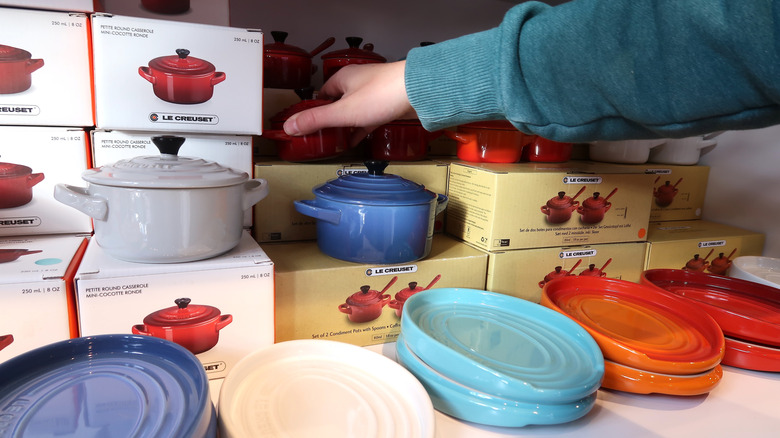
While it varies by product and across sales cycles, in general, Staub's products are slightly cheaper than their Le Creuset equivalents. For example, Le Creuset's 5½-quart Dutch oven is $435. A Dutch oven of the same size from Staub is $420. This slight discrepancy probably has something to do with brand recognition and status; after all, Le Creuset came on the scene a good half a century before Staub and boasts the affections of culinary Gods like Julia Child.
Both Staub and Le Creuset have price points that are still relatively high, and both brands strive to make products worth the price tag. It is worth noting that both companies offer lifetime warranties for their products and maintain stringent quality control, as they operate their own production facilities. Le Creuset and Staub both make products that undeniably get expensive, but are reasonable investments for a frequent home cook.
Weight and thickness
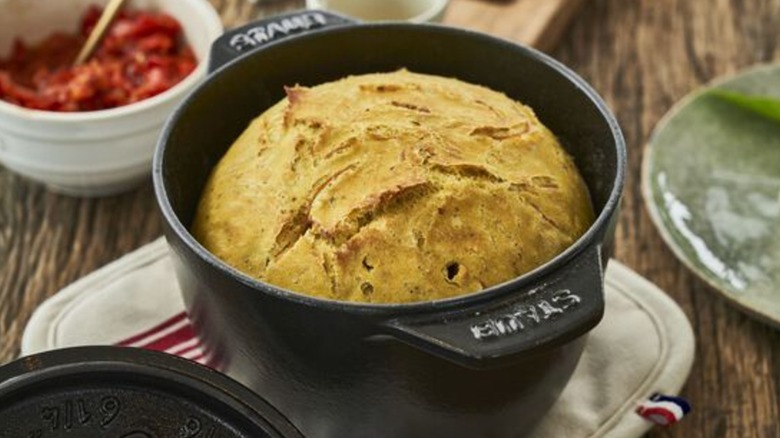
Staub cast-iron products have thicker walls than Le Creuset's products, as well as a thicker lid. A Staub Dutch oven is 4.2 millimeters thick, whereas a Le Creuset oven is 3.6 millimeters thick. Staub's thicker walls result in higher heat retention, once it gets up to temperature—it will hold a temperature for longer and more consistently, but it'll take longer to get there. That means, conversely, that a Le Creuset Dutch oven will reach any given temperature more quickly, but it will also cool down faster and won't be quite as consistent. Keep in mind that both products have sturdy, relatively thick walls and durable construction, so any preference for the slight thickness difference is a personal one.
Unsurprisingly, the thicker walls of Staub cast-iron cookware result in a slight increase in weight. While the weight discrepancy depends on the product's size and shape, Staub is typically heavier than Le Creuset. For example, the Le Creuset 5½-quart round Dutch oven weighs 11½ pounds, whereas the Staub Dutch oven of the same size weighs 12.8 pounds. Over a pound of additional weight is not insignificant when it comes to choosing a Dutch oven; it's a little more unwieldy to move around in the kitchen, but it's also more durable, and the heavier lid results in less escaping steam.
Temperature limits
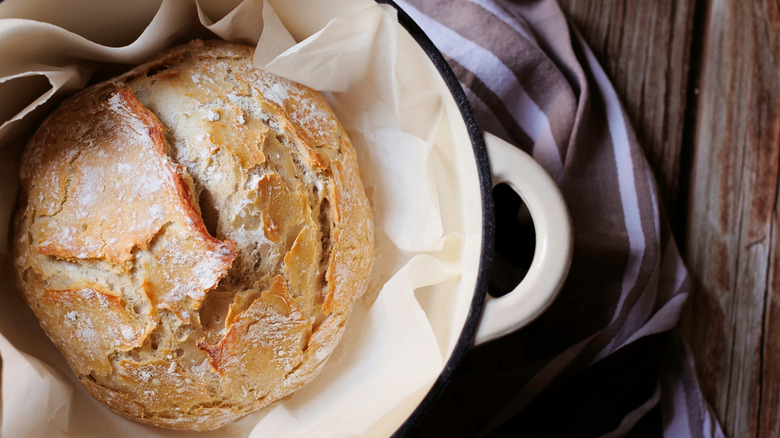
Both Le Creuset and Staub recommend a temperature maximum of 500 degrees Fahrenheit for their enameled cast iron, depending on the product. That consistency makes sense; after all, the cookware from the two companies is remarkably similar (you may need to read an article to learn the differences!). But there are still a few things to note about temperature; for one thing, you can use the knob at the top of each Le Creuset lid to find temperature guidelines for that product.
The stainless steel, gold, and copper knobs indicate that the cookware is oven-safe up to 500 degrees. A phenolic knob is safe up to 480 degrees, and the older, "classic" phenolic knob that has an additional logo on top is oven-safe up to 390 degrees. So, a quick tip for the bargain-hunters out there looking for their enameled cast iron second-hand: check for that older phenolic knob.