

The Telltale Sign Your Corn On The Cob Won't Be Very Tasty

No summertime backyard cookout or Mexican street food experience is complete without corn on the cob — and who better to give us corn on the cob tips than Jorge Guzmán, the executive chef and partner at modern Mexican restaurant Sueño and a James Beard Award finalist? Corn is, after all, a crop that originated in Mexico, and it's the foundation of Mexican cuisine and culinary identity. But how can you tell if the corn cob you picked up at your local farmers market or grocery store isn't up to snuff? According to Guzmán, the telltale sign your corn on the cob won't be very tasty is tactile.
"Pick it up and give it a squeeze," he instructs. "If there are any soft spots, then that is a sign it could be bad." Soft spots on corn on the cob indicate rotting kernels in a state of putrefaction, breaking down from a solid to a liquid. You might also feel a sliminess to the corn cob after you've shucked it, a further indication that it's going bad and might not be safe to eat. That's certainly one way to tell that your corn on the cob has gone bad.
While you can simply place a cob ridden with soft spots back into the pile at the grocery store, what if the corn cob incurs soft spots while sitting in the fridge or on your counter? While you might be able to cut soft spots out of apples or peaches, a bruise is different from spoilage. If corn cobs have soft spots, throw them away.
More tips for picking the best corn
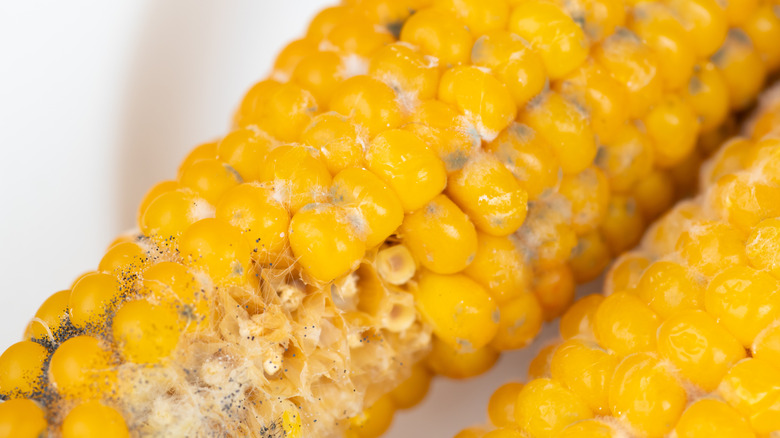
Additionally, Guzmán alerted us to another sign that corn has gone bad, this one being visual. "Look at the top of the cob, and if the husk is peeling away and you can see rotting, then that also is a sign," he says. A visual sign of freshness to look out for when buying corn is a vibrant green husk that's wrapped tightly and firmly around the cob. Corn silk will also reveal insight into cob quality. In fact, if you want to avoid the faux pas of pulling back the husk to inspect the corn kernels themselves, the silk will tell you all you need to know about what lies beneath the husk. Fluffy, tan, and gold corn silk indicates freshness, while black, slimy corn silk is a sign that the corn underneath is going bad.
While you should try to cook your corn on the cob the day you bring it home from the market, you can store it for a day or two without losing too much freshness. Be sure to keep the husk on your corn, as the husk locks in freshness and moisture. If you notice a series of brown spots, Guzmán believes it could still be salvaged. "You will most likely need to cut off the bad spots and use the good kernels off the cob," he adds. Fortunately, we have many great corn recipes for repurposed kernels. Turn grilled Mexican street corn into esquites (Mexican street corn salad) or this elote-style corn dip, for example.